
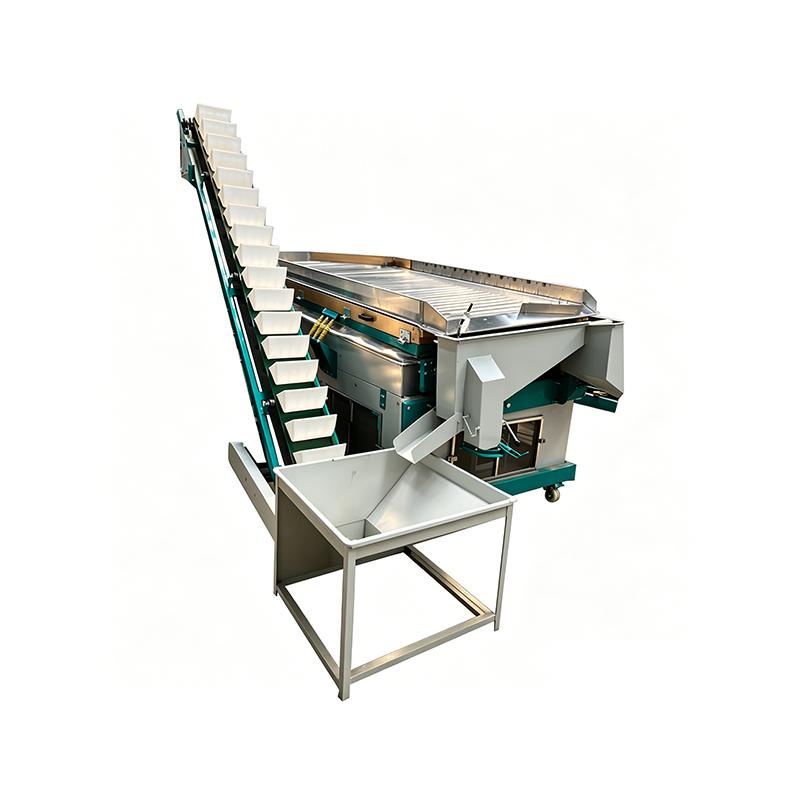
I. Working Principle of the Gravity Separator
The gravity separator (also known as a gravity destoner or gravity concentrator) utilizes the synergistic action of vibration and airflow to separate mung beans from impurities—as well as plump grains from shriveled or insect-damaged ones—based on differences in density (specific gravity).
Core Process:
Feeding and Spreading: Mung beans are spread evenly across a textured, inclined sieve surface, forming a thin layer of material.
Vibrational Fluidization: The sieve surface undergoes high-frequency, low-amplitude reciprocating vibrations, causing the material to loosen and reducing friction between individual grains.
Airflow Stratification: A fan located beneath the sieve blows air upward through the material layer; lighter particles (shriveled beans, insect-damaged beans, hulls, and dust) are suspended in the upper layer by the airflow, while heavier particles (plump mung beans, stones, and soil clods) sink to the lower layer, resting directly against the sieve surface.
Reverse Separation:
Upper-layer Light Materials: These slide downhill along the sieve surface toward the light impurity outlet.
Lower-layer Heavy Materials: Driven by the vibration, these move uphill and are discharged through the heavy impurity/stone outlet.
Intermediate-density Plump Mung Beans: These flow within the middle layer and are discharged through the clean product outlet.
In short: Light particles float while heavy ones sink; vibration pushes the heavy particles, while airflow suspends the light ones, thereby achieving precise separation.
II. Role in Mung Bean Cleaning
Removal of Heavy Impurities: Precisely separates stones, soil clods, and metal fragments that are similar in size to the mung beans, addressing the common challenge—unsolvable by standard sieves—of removing stones, and thereby ensuring food safety.
Elimination of Inferior Grains: Separates shriveled beans, immature grains, insect-damaged grains, and moldy grains, thereby enhancing the purity and commercial value of the finished product.
Grading and Quality Improvement: Classifies grains by density to yield mung beans with consistent plumpness, facilitating subsequent processing (such as milling or sprouting) and seed selection.
Auxiliary Removal of Light Impurities: Works in conjunction with other processes to remove light impurities—such as bean hulls, leaf fragments, and dust—thereby reducing the overall impurity rate.
III. Key Factors Affecting Cleaning Effectiveness
1. Material Characteristics (Fundamentals)
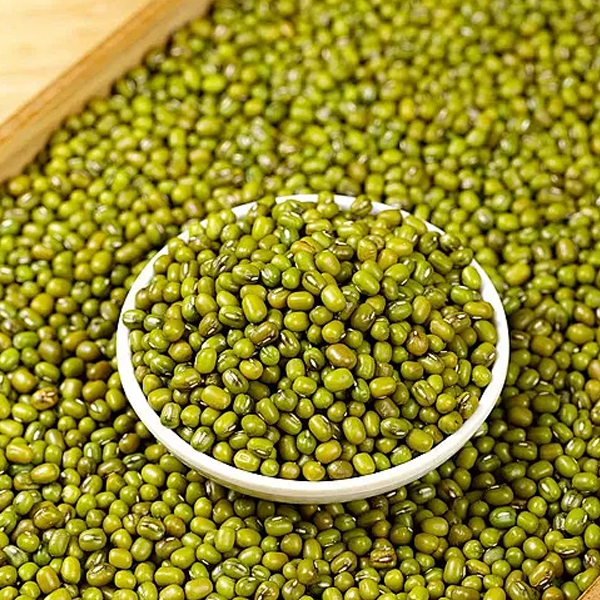
Moisture Content: For mung beans, the optimal range is 10%–12%. If too high (>14%), the beans tend to stick together, exhibit poor fluidization, and fail to stratify clearly. If too low (<9%), they become brittle, generate excessive dust, and result in high material loss.
Particle Size Uniformity: When there are significant variations in raw material size, smaller grains are prone to mixing with heavy impurities, while large, shriveled beans become difficult to separate. Utilizing a pre-cleaning air-screen separator or grading sieve to standardize particle size beforehand yields superior results.
Impurity Content and Type: Separation becomes more challenging when the material contains a high proportion of stones or soil clumps, or when the density of impurities closely matches that of the mung beans. Excessive light impurities can interfere with the airflow-induced stratification process.
2. Equipment Parameters (Core Factors)
Airflow Velocity (Air Gate Setting): If the wind speed is too low, there is insufficient lifting force; light impurities settle at the bottom, resulting in incomplete impurity removal. If too high, good beans are blown away, leading to significant material loss. For mung beans, a typical range is 1.8–2.5 m/s, calibrated to a point where the material bed exhibits a slight “boiling” (fluidized) motion without any material being blown airborne.
Vibration Frequency and Amplitude: Optimal settings are typically 10–15 Hz for frequency and 3–5 mm for amplitude. If too low, material accumulates and fluidization is poor. If too high, the material bed becomes turbulent, separation is unclear, and energy consumption increases.
Sieve Surface Inclination: The longitudinal inclination (downslope) is typically set between 2° and 5°. If the angle is too steep, the material slides too quickly, reducing the effective separation time. If too shallow, the material bed becomes too thick, hindering effective stratification. A lateral inclination of 1°–3° is used to control the lateral discharge of impurities.
Feeding Rate and Uniformity: The material bed thickness should be maintained at a stable and uniform 10–20 mm. If the bed is too thick, light impurities in the upper layer are difficult to separate, resulting in a high impurity content in the cleaned product. If too thin, the sieve surface runs idle, leading to low efficiency and an increased risk of good beans being discharged into the impurity outlet.
3. Equipment Condition and Installation
Sieve Surface Flatness and Wear: Deformation of the sieve surface or wear on its textured pattern leads to uneven material flow and a failure in stratification. The sieve surface should be inspected and replaced periodically.
Fan and Air Duct System: Insufficient airflow volume or pressure from the fan, as well as blockages or air leaks within the air ducts, result in uneven airflow and poor stratification. Regular cleaning to remove blockages and sealing of the air ducts are essential maintenance tasks. Leveling and Alignment: Improperly leveled equipment → skewed material bed, localized areas of excessive or insufficient thickness, and uneven separation; the equipment must be properly leveled.
4. Operation and Environment
Parameter Matching: Air velocity, vibration, and tilt angle require synchronized fine-tuning; for instance, if air velocity is increased, the tilt angle must be raised commensurately to prevent the loss of high-quality product.
Environmental Temperature and Humidity: Humid environments → material moisture absorption, clumping, and poor fluidization; the workshop must be kept dry and well-ventilated.
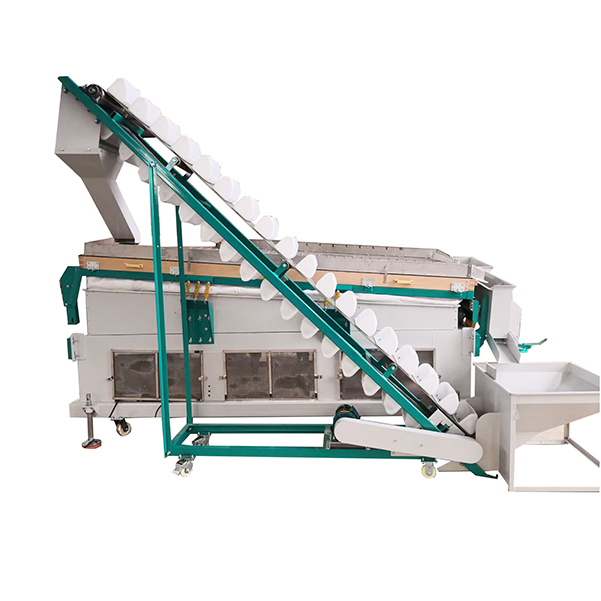
Scope of Application for Gravity Separators
I. Legumes and Miscellaneous Grains
Mung beans, soybeans, red beans, kidney beans, chickpeas, black beans, cowpeas, peanuts, sesame seeds, sunflower seeds, sorghum, corn, wheat, paddy rice, Job’s tears, etc.—for stone removal, elimination of shriveled, insect-damaged, or moldy grains, and density-based precision sorting.
II. Oilseed Crops
Rapeseed, flaxseed, pumpkin seeds, watermelon seeds, crushed walnuts, and nut kernels—for separating impurities and inferior produce to enhance the quality of raw materials for oil extraction.
III. Seeds and Seedlings
Grain seeds, vegetable seeds, flower seeds, and forestry seeds—for selecting plump, high-quality seeds while eliminating defective ones to improve germination rates.
IV. Dried Fruits and Agricultural By-products
Chestnuts, pine nuts, almonds, dried red dates, goji berries, etc.—for removing grit, stones, hard clumps, and shriveled, inferior items.
V. Specialty Cash Crops
Coffee beans, cocoa beans, Sichuan peppercorns, black pepper, etc.—for cleaning out impurities and sorting by quality grade.
VI. General Sorting Applications
Separating grit, soil clumps, and metal fragments that share the same particle size but differ in density.
Distinguishing between plump grains, insect-damaged grains, moldy grains, and broken grains.
Density-based material grading to meet the specific requirements of processing, seed breeding, and commercial sales.
Post time: May-22-2026