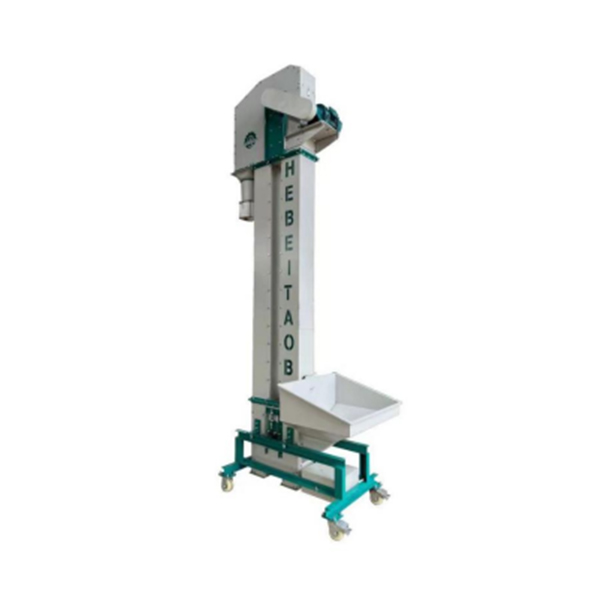
The core working principle of a bucket elevator is simple: it uses buckets to scoop up material from a lower level, conveys it to a higher level via a traction mechanism, and then discharges or tips out the material to achieve vertical transport.
Bucket Elevator Working Principle
The entire process consists of four continuous steps: Loading → Lifting → Discharging → Return.
1. Loading (Bottom Intake)
Material enters the elevator boot (base) through the bottom inlet.
As the moving buckets pass through the bottom section, they directly scoop up the material, filling themselves in the process.
The buckets are uniformly attached to a belt or chain and move continuously along with the traction mechanism.
2. Lifting (Vertical Conveying)
A motor drives the head pulley to rotate, propelling the traction belt or chain upward.
The material-filled buckets ascend vertically within an enclosed casing.
The casing prevents dust from escaping and also prevents material from spilling.
3. Discharging (Top Outlet)
Upon reaching the head section at the top, the buckets turn around the head pulley and begin to discharge their contents. There are primarily three methods of discharge:
Centrifugal Discharge (Most Common)
Operates at high speeds, relying on centrifugal force to fling the material out of the buckets.
Suitable for dry, free-flowing grains such as wheat, corn, soybeans, etc.
Gravity Discharge (Low Speed)
Operates at slower speeds; once the buckets reach the top, they tip over to discharge the material solely by the force of gravity.
Causes almost no breakage to the material; suitable for fragile specialty grains such as mung beans, sesame seeds, broad beans, etc.
Centrifugal-Gravity Mixed Discharge
A hybrid method falling between the two extremes, suitable for materials with slightly higher moisture content or those prone to sticking to the buckets.
4. Return (Empty Bucket Descent)
After discharging their contents, the empty buckets descend along the traction mechanism on the opposite side, returning to the bottom to be loaded again, thereby maintaining a continuous operational cycle.
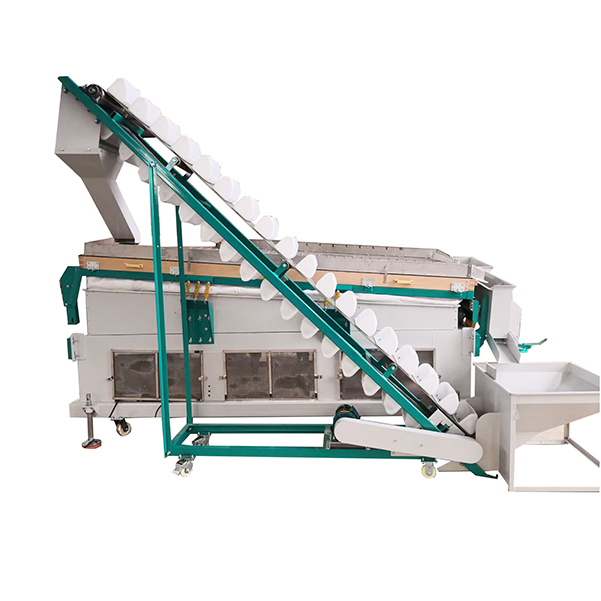
The inclined elevator (also known as a climbing conveyor or high-angle conveyor) is a core piece of equipment in grain and legume cleaning lines, responsible for achieving continuous, upward-sloping material transport. Unlike purely vertical bucket elevators, it is capable of performing both horizontal and inclined conveying simultaneously, making it ideally suited for scenarios involving limited floor space or requiring horizontal spans between pieces of equipment.
I. Core Working Principle
The inclined elevator utilizes a continuously moving traction element (such as a belt, chain, or screw auger) to carry material upward along an inclined frame, thereby overcoming gravity to achieve elevation. Throughout the entire process, there is no vertical free-fall of material, resulting in an extremely low rate of material breakage.
Feeding: Material falls uniformly from a bottom-mounted feed hopper onto the conveying surface (belt, buckets, or screw trough).
Conveying: A motor drives the traction element to move upward at a constant speed; the material climbs the incline in synchronization with the traction element, with no relative slippage.
Discharging: Upon reaching the top discharge port, the material is unloaded into the subsequent processing stage (e.g., a cleaning sieve or destoner), either by its own weight or via the inversion of buckets.
Return: The empty traction element returns to the bottom along the opposite side of the frame, completing the operational cycle.
II. Mainstream Structures and Types (for Grain and Legume Cleaning Applications)
1. Belt-Type Inclined Elevator (Most Commonly Used)
Structure: Inclined frame + patterned/sidewall conveyor belt + drive drum + idlers + tensioning device + anti-reverse mechanism.
Anti-Slip Design Features:
Patterned Belt: Features a surface pattern (such as herringbone or chevron) to increase friction; suitable for incline angles ≤ 30° and granular materials such as wheat, corn, and soybeans.
Sidewall and Cleated Belt: Features corrugated sidewalls on both edges combined with transverse cleats (cross-dividers) to form “bucket-like compartments.” This design allows for incline angles ranging from 45° to 60° and prevents fine materials (such as sesame seeds or mung beans) from spilling; it is ideal for high-angle applications and for conveying materials that are prone to rolling.
Characteristics: Smooth operation, low noise levels, simple maintenance, and low cost; features an extremely low material breakage rate, making it suitable for conveying high-value specialty grains. 2. Inclined Bucket Elevator (Single-bucket / Multi-bucket; Specialized for Low-Breakage Applications)
Structure: Inclined guide rail + Chain traction system + Large-capacity buckets + Automatic tilting discharge mechanism.
Principle: Buckets scoop material at the bottom, ascend along the incline, automatically tilt to discharge at the top, and return empty.
Features: Ultra-low operating speed (0.1–0.3 m/s) combined with a large-bucket design results in a breakage rate of nearly zero; the frame height and inclination angle are adjustable, making it suitable for scenarios such as returning material from specific gravity separators or feeding color sorters.
Applications: Fragile and high-value grains and legumes, such as mung beans, sesame seeds, peanuts, and broad beans.

III. Core Advantages of the Specialized Inclined Elevator
1. Low Breakage: Features no high-speed material ejection; materials move synchronously with the conveying surface, resulting in a breakage rate significantly lower than that of vertical bucket elevators, thereby preserving the quality of coarse grains.
2. Flexible Layout: Enables combined horizontal and inclined conveying, effectively bridging horizontal gaps between equipment and accommodating the spatial constraints often found in small-scale grain cleaning lines.
3. Adjustable Inclination: The machine frame features a largely adjustable design, allowing the inclination angle to be set anywhere between 15° and 60° as needed to suit the flow characteristics of different materials.
4. Easy to Clean: The conveyor belt and buckets are easily detachable for cleaning, meeting the strict hygiene standards required for grain processing and ensuring zero residual contamination when switching between different types of materials.
5. Simple Maintenance: Eliminates the need for complex vertical casings; wear parts—such as support rollers and belts—are easily replaceable, ensuring stable and reliable operation.
IV. Key Differences from Vertical Bucket Elevators
1. Conveying Path: Inclined Elevator = Inclined + Horizontal; Vertical Bucket Elevator = Purely Vertical.
2. Breakage Rate: Inclined Elevator = Extremely Low (synchronous conveying); Vertical Bucket Elevator = Moderate to High (centrifugal discharge).
3. Site Adaptability: Inclined Elevator is ideal for setups requiring horizontal spans between equipment; Vertical Bucket Elevator is ideal for purely vertical applications where saving horizontal floor space is a priority.
4. Inclination Range: Inclined Elevator = 15°–60°; Vertical Bucket Elevator = 90°.
Application Scenarios (Grain and Legume Cleaning)
1. Integrated Cleaning Lines: Facilitates inclined conveying between sequential stages—such as the Pre-cleaning Sieve, Destoner, Gravity Separator, and Color Sorter—serving as a direct replacement for multi-stage horizontal and vertical lifting systems.
2. Material Recirculation: Handles the return of rejected materials from Gravity Separators and Air Classifiers; the low-breakage design ensures effective re-cleaning results.
3. Pre-packaging Feeding: Enables precise material feeding from the Color Sorter to the Packaging Machine; Z-type or Inclined Bucket Elevators ensure smooth conveyance with minimal material breakage.
4. Small-scale Granaries / Processing Plants: Ideal for sites with limited space, utilizing inclined elevators to achieve “one-step” integrated inclined and horizontal conveying.
Post time: Mar-27-2026