
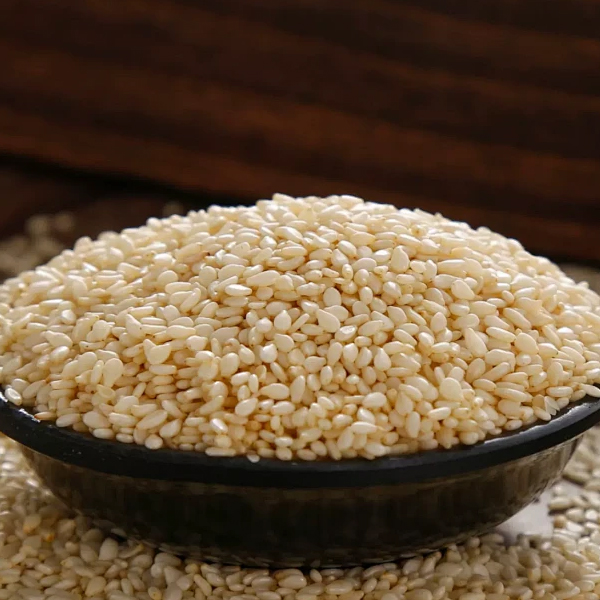
In a sesame cleaning production line, the air-screen cleaner, gravity separator, and destoner serve as the three core stages of physical impurity removal equipment. These three units feature complementary functions and operate in sequence to collectively achieve the highly efficient purification of sesame seeds.
I. Air-Screen Cleaner (Primary Cleaning)
Core Function: By utilizing the dual actions of airflow and screening, this machine removes impurities—specifically those differing significantly in size or weight from the sesame seeds—such as light debris, oversized objects, and undersized particles. It constitutes the first stage of coarse cleaning in the sesame purification process.
Working Principle
Air Separation: A fan generates a directional airflow; by exploiting the difference in suspension velocity between the sesame seeds and lighter impurities (such as dust, hulls, shriveled seeds, leaf fragments, and grass clippings), the light impurities are directly drawn away and separated.
Screening: The sesame seeds fall onto a series of multi-layer vibrating screens, where they are classified according to particle size. The upper screens remove oversized impurities (such as stalks, soil clods, and large pebbles), while the lower screens remove fine impurities (such as broken seeds and sand grains), simultaneously sorting the sesame seeds into different size grades.
Primary Targets for Removal
Light Impurities: Airborne dust, hulls, shriveled seeds, insect-damaged seeds, leaf fragments, and grass stems.
Oversized Impurities: Stalks, twine scraps, and large soil clods.
Undersized Impurities: Certain broken seeds and fine sand/soil.
Key Features: Characterized by high processing capacity and broad adaptability, this unit significantly reduces the workload for the subsequent stages of fine cleaning.
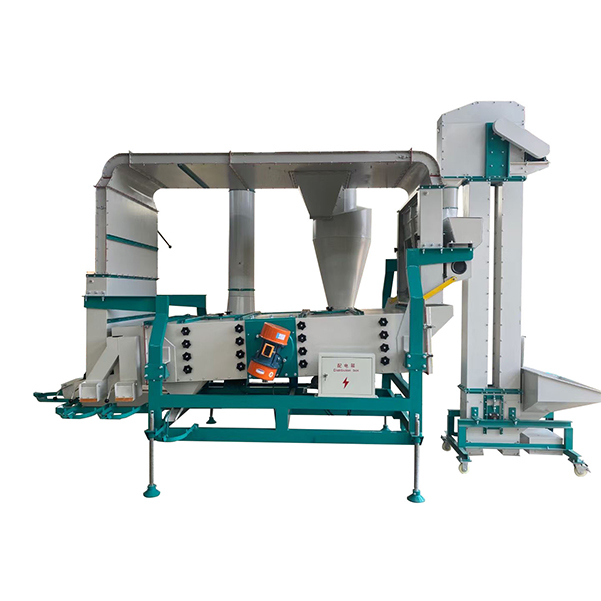
Overall Process Flow
Raw Sesame → Feeding → Air Separation Zone → Screening Zone → Graded Discharge → Separate Impurity Discharge
1. Feeding and Spreading
Sesame enters via a hopper and is evenly distributed across the screen surface by a spreading mechanism. This ensures a consistent layer thickness—preventing clumping—thereby allowing both the air separation and screening processes to function effectively.
2. Air Separation Process (Removal of Light Impurities)
A fan generates a steady airflow from either below or the rear of the unit.
The sesame, dust, shriveled grains, husks, leaf fragments, grass clippings, and other materials possess varying suspension velocities.
Light impurities are directly drawn away by the airflow and are subsequently collected and discharged via a settling chamber or dust collection bags.
The sesame and heavier impurities fall downward, proceeding to the screening stage.
3. Screening Process (Removal of Large and Small Impurities)
The material lands on a series of multi-layer vibrating screens, while the screen body undergoes a reciprocating or linear vibrating motion:
Upper Screen (Large Impurity Screen)
The screen apertures are larger than the sesame seeds. The sesame passes through, while large impurities—such as stalks, mud lumps, large soil clods, and twine scraps—are retained and discharged through the large impurity outlet.
Middle Screen (Grading / Finished Product Screen)
The screen apertures are sized to match the sesame seeds; qualified sesame passes through. Any half-seeds or oversized grains remaining on the screen surface can be discharged as graded material or secondary-grade product.
Lower Screen (Small Impurity Screen)
The screen apertures are smaller than the sesame seeds. Small impurities—such as broken sesame fragments, fine sand, and dust—pass through and are discharged via the small impurity outlet.
II. Gravity Separator (Precision Sorting & Grading)
Core Function: By leveraging differences in density (specific gravity), this machine precisely separates impurities—which are similar in size to sesame seeds but differ in weight—while simultaneously selecting plump, high-quality seeds. It serves as the critical precision-sorting stage in the sesame cleaning process.
Working Principle:
Under the combined action of vibration and an inclined airflow, the material undergoes automatic stratification. Denser, plump sesame seeds settle to the bottom layer and move upward along the screen surface; conversely, lighter impurities—such as shriveled seeds, insect-damaged seeds, broken seeds, weed seeds, and moldy seeds—float to the upper layer and are carried by the airflow toward the lower end for discharge.
Primary Targets for Removal (Sesame):
Homomorphic but Heterogeneous Impurities: Impurities that are similar in size to sesame seeds but lighter in weight (e.g., weed seeds, soil particles, shriveled seeds, insect-damaged seeds).
Moldy / Diseased Seeds: Damaged seeds with compromised internal structures and reduced specific gravity.
Key Features: Offers extremely high sorting precision, significantly enhancing both the purity and plumpness of the sesame seeds; it is a critical factor in ensuring optimal oil extraction rates and overall food quality.
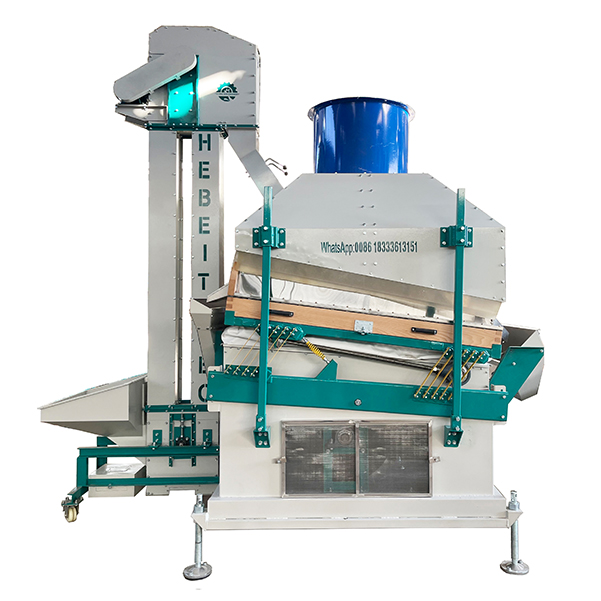
III. Destoner (Stone Removal)
Core Function: Specifically designed to remove heavy impurities—such as stones, clods of earth, and sand grains—that possess a specific gravity similar to that of sesame seeds and are therefore difficult to remove via air separation. It effectively resolves the issue of “grittiness” (sandy texture) in the final product, serving as a vital safety safeguard in the sesame cleaning process.
Working Principle:
The machine utilizes the specific gravity difference between sesame seeds (density: approx. 1.2–1.4 g/cm³) and stones (density: approx. 2.6–2.8 g/cm³), in conjunction with the vibration of a “fish-scale” patterned screen surface and a directional airflow. Stones, being heavier, remain in close contact with the screen surface and—driven by the vibration—move upward against the flow toward the stone discharge outlet; meanwhile, the sesame seeds remain in a semi-suspended state within the airflow and slide downward in the direction of the flow toward the finished product outlet.
Primary Targets for Removal (Sesame):
High-Density Impurities: Stones, clods of earth, sand grains, glass shards, etc.
“Companion Stones”: Stones that are similar in size and shape to sesame seeds, making them impossible to remove through standard air separation or sieving methods alone.
Key Features: Achieves an exceptionally high stone removal rate (up to 99%), thereby completely eliminating the risk of mechanical wear and tear on downstream equipment, as well as critical food safety hazards.
IV. The Synergistic Relationship Among the Three Machines in a Sesame Processing Line
Air-Screen Cleaner (Initial Stage): Performs coarse cleaning by removing the majority of light, oversized, and undersized impurities, thereby protecting downstream equipment.
Gravity Separator (Intermediate Stage): Conducts fine cleaning through density-based sorting, eliminating light shriveled grains, insect-damaged seeds, and weed seeds to enhance overall quality.
Destoner (Final Stage): Removes heavy impurities—specifically stones and sand particles—to ensure the safety and palatability of the final product.
Post time: Apr-16-2026