
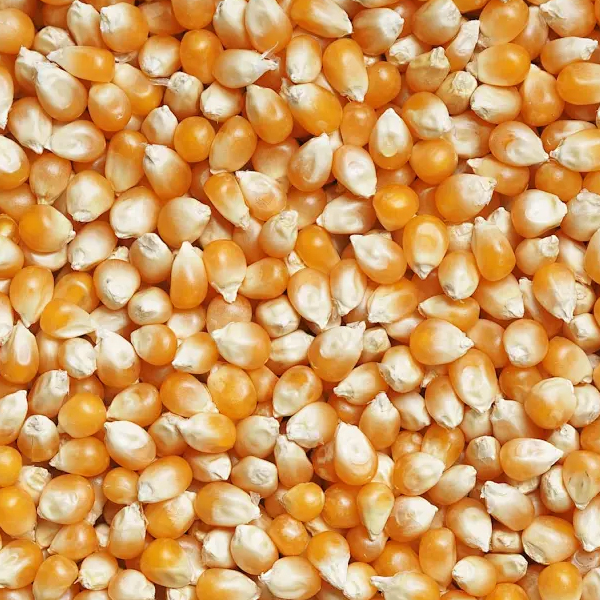
During the harvesting, drying, and transportation of corn and soybeans in Mexico, the crops often become contaminated with significant amounts of impurities—such as stalks, dust, shriveled or broken grains, stones, and clods of soil. Given the substantial differences in grain shape and specific gravity between these two crops, the cleaning process is highly challenging. To address this, air-screen cleaners and gravity separators serve as the two core, complementary machines in a complete cleaning line.
I. Air-Screen Cleaner
(A) Working Principle
The fundamental operation of an air-screen cleaner integrates two physical separation methods into a single unit: “screening” (separation based on geometric size) and “air classification” (separation based on aerodynamic properties). During operation, the material enters through an inlet, flows into a hopper, and is evenly distributed across the top screen layer via a flow-control mechanism. Driven by an eccentric mechanism, the screen assembly undergoes reciprocating vibration, causing the material to tumble and advance along the inclined screen surface. The screens are arranged in layers with varying aperture sizes: the top layer separates the primary product—corn or soybeans—from oversized impurities (such as stalks, large stones, or foreign objects), which are then discharged from the top of the screen. The lower layer retains the primary product while allowing smaller impurities (fine soil, debris, broken grain fragments, and shriveled kernels) to pass through. Simultaneously, an internal fan generates a controlled, directional airflow. Through an air suction duct and an air-classification chamber, this airflow removes light, high-surface-area impurities—such as dust, husks, lightweight weed seeds, and empty or shriveled grains—while the fuller, heavier kernels continue their downward movement. The airflow volume can be adjusted via dampers, allowing for flexible settings tailored to different crops. Consequently, an air-screen cleaner performs both “size-based” and “weight-based” separation in a single operation. (II) Core Function
The primary role of an air-screen cleaner is to perform an initial “coarse and intermediate” cleaning of materials at the start of the processing line. It rapidly removes the vast majority of easily separable impurities in large volumes, thereby reducing the workload for subsequent stages—such as gravity-based precision cleaning and optical sorting—and enhancing overall operational efficiency. It effectively addresses the challenge of handling large quantities of material containing a diverse range of impurities.
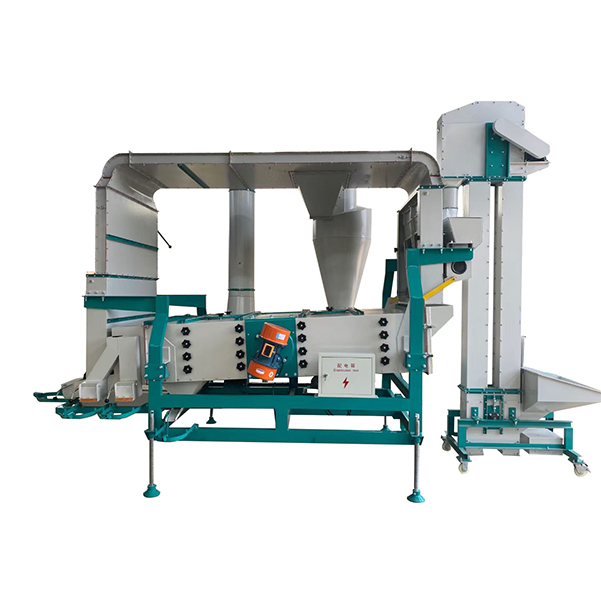
(III) Key Advantages
First, it significantly improves product purity. Through the synergy of screening and air-based separation, the purity of crops like corn and soybeans can be consistently raised to over 99.5%, laying a solid foundation for downstream processes and ensuring the final product meets required standards. Second, it offers excellent adaptability and adjustability. Screen apertures can be changed quickly, while airflow, vibration amplitude, and feed rates are all adjustable. This allows a single processing line to flexibly handle various crops—including corn, soybeans, sesame seeds, mung beans, and peanuts—demonstrating high versatility. Third, it ensures minimal damage to grain kernels while maintaining high throughput. By utilizing gentle vibration and precise pneumatic separation—rather than relying on mechanical impact to break down impurities—the system achieves a low breakage rate. It supports continuous, high-volume feeding with high production capacity and minimal dust leakage; the equipment’s fully enclosed design also makes it more environmentally friendly. These features—high airflow, low breakage, and superior adjustability—are the hallmarks of the air-screen cleaner offered by Hebei Taobo Machinery.
II. Specific Gravity Separator (Gravity Destoner / Gravity Precision Separator)
(I) Working Principle
The specific gravity separator addresses the challenge of removing impurities that have the same size as the target material but a different specific gravity—a task that air-screen cleaners cannot perform. Its core principle relies on the synergy of three physical processes: fluidization via airflow, vibration of the screen surface, and transport along an inclined plane. As material enters the separator, air is forced upward through a perforated screen (or a surface composed of overlapping, scale-like plates), creating a uniform upward airflow that “loosens” the bed of particles, bringing them into a fluidized, suspended state. In this state, particles with a higher specific gravity—due to their greater weight and closer contact with the screen surface—sink to the bottom layer, while particles with a lower specific gravity are buoyed up by the airflow and remain in the upper layer. Simultaneously, the screen deck, driven by an eccentric mechanism, undergoes reciprocating vibration while positioned at an incline. Through the combined action of “airflow-based flotation, vibration-induced stratification, and inclined transport,” denser materials—such as stones, sand, and metal fragments—settle at the bottom and are conveyed upward along the screen surface toward the discharge outlet for heavy impurities. Meanwhile, lighter, high-quality grains (such as corn or soybeans) remain suspended in the upper layer and, aided by vibration and airflow, move downward along the incline toward the grain discharge outlet. Consequently, materials of varying specific gravities are clearly stratified and discharged separately. When configured for precision separation, the same principle can be used to further sort grains based on density differences—for instance, distinguishing sound, full kernels from broken, insect-damaged, or moldy ones. Air volume, vibration amplitude, frequency, and the inclination angle of the screen surface are the four critical operating parameters; these must be precisely adjusted based on the specific gravity of the material and the nature of the impurities present. (II) Core Function
The core function of a gravity separator is to perform “precise specific-gravity grading” on materials that have already undergone preliminary cleaning via air-screen separation. It specifically targets high-density impurities—such as stones, sand, and clods—that may have slipped through the air-screen system. Furthermore, it facilitates quality-based sorting by distinguishing materials according to their degree of plumpness and maturity. As such, it serves as a critical step in maximizing the level of purity and ensuring the uniformity of the final product.
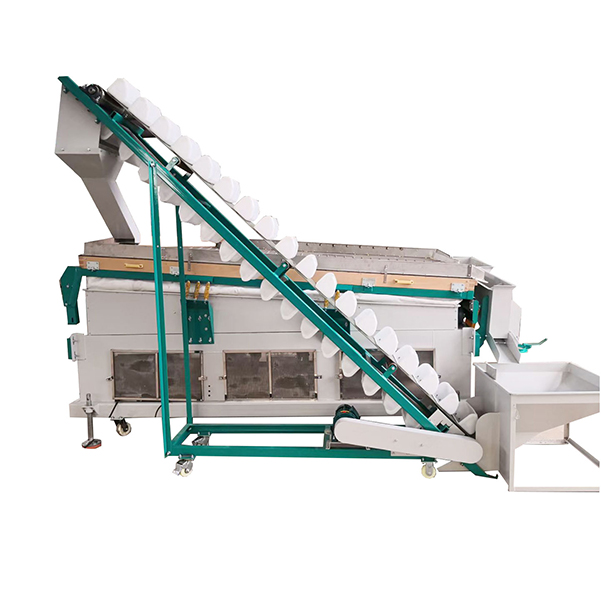
III) Specific Advantages
First, it offers high precision in the complete removal of heavy impurities. Heavy contaminants—such as stones, sand, and glass fragments—are often similar in size to grain kernels, making them difficult to remove with air-screen cleaners. A gravity separator, however, removes these efficiently, fundamentally preventing mechanical damage during milling or crushing and eliminating food safety risks. Second, it enables quality grading and enhances the uniformity of the final product. Beyond removing stones, it separates broken, shriveled, or immature grains from plump, high-quality ones. This ensures greater consistency in grain size, bulk density, and color for commodities like corn and soybeans, significantly improving their commercial grade and market appeal—a factor of particular importance for export trade. Third, it reduces the load on downstream processes, boosting overall efficiency. Material that has been refined by a gravity separator is already highly pure; consequently, a subsequent optical sorter only needs to handle a minimal number of discolored particles, leading to more accurate identification and higher throughput. This results in simultaneous improvements to both product purity and total line capacity. Gravity separators from Hebei Taobo Machinery are renowned for their stable airflow, precise vibration amplitude, and durable construction; when integrated into a full processing line, they can consistently achieve a purity level of over 99.5%.
III. The Significance of Combining These Two Machines
For raw materials such as corn and soybeans—which often feature significant variations in specific gravity and complex impurity profiles—the combination of an air-screen cleaner and a gravity separator creates a “coarse-to-fine” and “geometry-to-gravity” sequential process. The air-screen cleaner acts at the front end to remove large volumes of stalks, dust, husks, and fine debris, while the gravity separator follows to precisely eliminate stones and sand, while simultaneously performing quality grading. Together, they ensure high purity, minimal breakage, and high yields. Furthermore, this setup lightens the workload for subsequent stages—such as optical sorting, polishing, and packaging—resulting in a comprehensive, stable, and highly efficient cleaning line. It serves as a reliable solution for export-oriented processing enterprises looking to achieve both rigorous quality control and balanced production capacity.
Post time: Oct-19-2026