
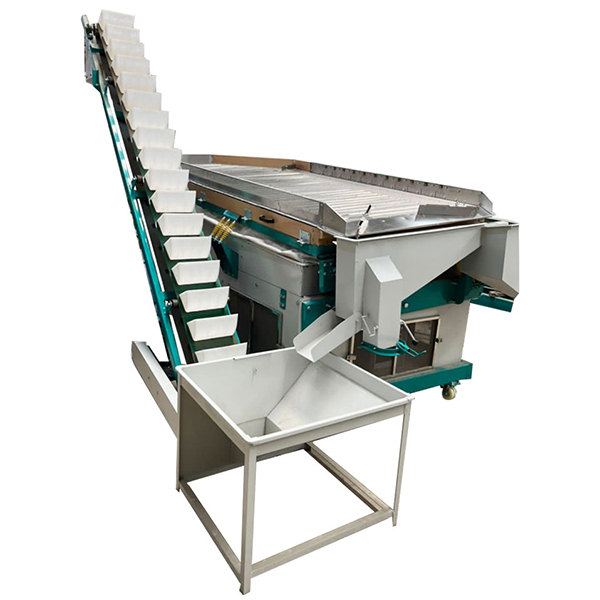
A gravity separator is a core piece of equipment that enables precise cleaning of seeds/commercial beans based on differences in material specific gravity (density). It is widely used in the pre-processing of beans such as soybeans, chickpeas, peas, and lentils. Its core value lies in solving the problem of separating beans of similar size but different specific gravities (such as plump beans and shriveled beans, soybeans and small stones), making it a key piece of equipment for ensuring bean quality and improving the efficiency of the industrial chain.
The gravity separator achieves stratified separation through the synergistic effect of “vibration excitation + airflow sorting.” The core mechanism is as follows:
Vibration System: The inclined screen surface is driven by an eccentric shaft to vibrate at high frequency. As the material flows along the screen surface, it naturally stratifies due to differences in specific gravity. Heavy impurities (pebbles, metal shavings) sink to the bottom, where they experience the greatest friction with the screen surface and move forward rapidly. Healthy beans are in the middle layer, moving at a uniform speed. Light impurities (shriveled beans, straw) float on the surface, experiencing minimal friction.
Airflow System: Fans at the bottom or side generate reverse airflow, blowing away the surface light impurities and discharging them through guide plates. Simultaneously, the airflow penetrates the material layer, further enhancing the stratification effect (preventing shriveled beans from adhering to the surface of plump beans and becoming impossible to separate).
Discharge Grading:The equipment has 3-4 discharge ports at the end to collect heavy impurities, primary clean beans, secondary clean beans (medium specific gravity), and light impurities, achieving graded separation of “impurities – high-quality beans – inferior beans.”
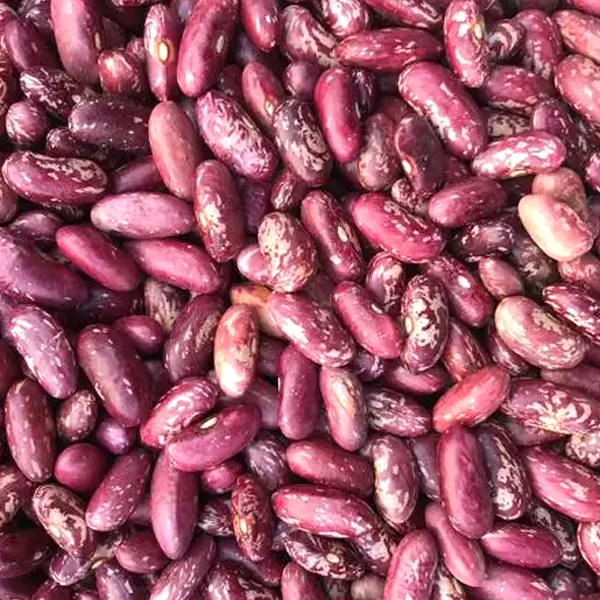
The separation principle of a gravity separator (why can it achieve precise cleaning?) The core difference between legume seeds and impurities (pebbles, mud, shriveled seeds, insect-damaged seeds, light impurities, etc.) lies in their specific gravity/density: Healthy legume seeds: plump kernels with a density of approximately 1.1~1.3 g/cm³ (soybeans approximately 1.18 g/cm³, chickpeas approximately 1.25 g/cm³); Impurity characteristics: Heavy impurities such as pebbles (2.6~2.8 g/cm³) and mud (1.5~1.8 g/cm³) have a much higher specific gravity than seeds; light impurities such as shriveled seeds, insect-damaged seeds, and straw fragments (0.3~0.8 g/cm³) have a lower specific gravity than seeds.
The gravity separator utilizes a synergistic effect of vibration and airflow: The vibrating table (with an adjustable tilt angle) stratifies the material: heavy impurities (pebbles, lumps) sink to the bottom, gaining significant propulsion through friction with the table and being discharged towards the front of the outlet; healthy seeds remain in the middle layer, conveyed forward at a uniform speed with the table vibration; light impurities (shriveled grains, debris) float on the surface and are blown to the side by the reverse airflow for discharge, ultimately achieving a three-stage separation of “heavy impurities – clean seeds – light impurities.”
This principle determines that the gravity separator’s cleaning precision is far superior to simple screening equipment (such as perforated screens or woven screens), effectively addressing the core problem of “similar sizes but different specific gravities” (such as small stones similar in size to soybeans, or shriveled grains of the same type with insufficient plumpness).
The Core Significance of Gravity Testing for Cleaning Legume Seeds
(I) Upstream Planting End: Ensuring Seed Quality and Laying the Foundation for High Yields
For legume seeds intended for sowing (not commercial edible beans), gravity testing is a “key step” in seed processing, directly impacting planting results:
Removing low-vitality seeds and improving germination rate:
Shriveled, insect-damaged, or half-kernel seeds, etc., have low specific gravity, insufficient internal nutrients, and incomplete embryo development, typically resulting in a germination rate below 30% (healthy seeds have a germination rate ≥85%).
After gravity testing, seed purity can reach over 98%, increasing the germination rate by 20-30%, reducing gaps in seedlings and rows, and ensuring yield per unit area.
Uniform seed size and specific gravity optimize sowing results: Seeds with consistent specific gravity result in more uniform sowing depth and emergence speed (avoiding uneven emergence caused by “large seeds sown deep, small seeds sown shallow”); Removal of harmful impurities protects sowing equipment: Heavy impurities such as stones and metal shavings mixed into the seeds can severely wear down the seeder’s seed metering and furrow opener, and may even cause equipment jamming and malfunction;
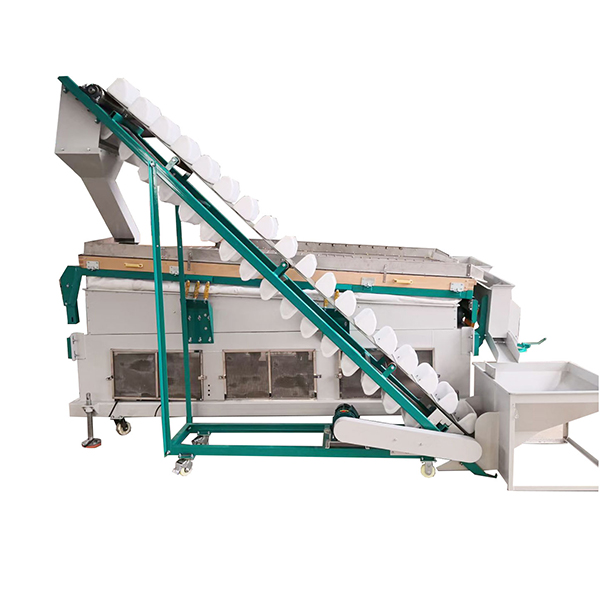
(II) Midstream processing: Improving product quality and reducing processing losses
For commercial edible/industrial legumes (such as soybeans for oil extraction and chickpeas for canning), gravity separator cleaning is essential before processing. “Core Pre-treatment”: Ensuring product purity and avoiding quality defects: For oilseed soybeans: The presence of stones and mud will wear down the oil press’s screw rod and pressing chamber, increasing the impurity content in the crude oil (requiring additional filtration) and raising the risk of excessive acid value in the oil; For edible legumes (such as chickpeas and peas): Removing light impurities (straw, dust) and heavy impurities (stones, sand) avoids a gritty texture and improves product marketability; Optimizing processing efficiency and reducing energy consumption: Legumes with uniform specific gravity allow for more even residence time and stress within the equipment during subsequent processing (such as peeling, grinding, and puffing), resulting in higher processing precision (e.g., a 10-15% increase in soybean peeling rate); The absence of heavy impurities reduces equipment load and energy consumption (e.g., reducing energy consumption per ton of soybean processed by the oil press by 5-8 kWh).
Grading and sorting enables differentiated pricing: Gravity analyzers can grade beans according to their specific gravity by adjusting vibration frequency and airflow intensity (e.g., high-specific-gravity “Grade 1 beans,” medium-specific-gravity “Grade 2 beans”); High-specific-gravity beans have fuller kernels and higher protein/oil content (e.g., Grade 1 soybeans have 1-2% higher oil content than Grade 2), and can be priced as high-end products (e.g., organic beans, special oilseed beans), with a premium of 15-20%.
For large-scale soybean planting and processing enterprises, gravity analyzers are an indispensable “core quality control equipment”. If you need the equipment, please contact us!
Post time: Dec-04-2025