
I. Characteristics of Impurities in Raw Chickpeas
Impurities found in imported and domestic raw chickpeas fall into three categories, each targeted by a specific stage of the machine’s process:
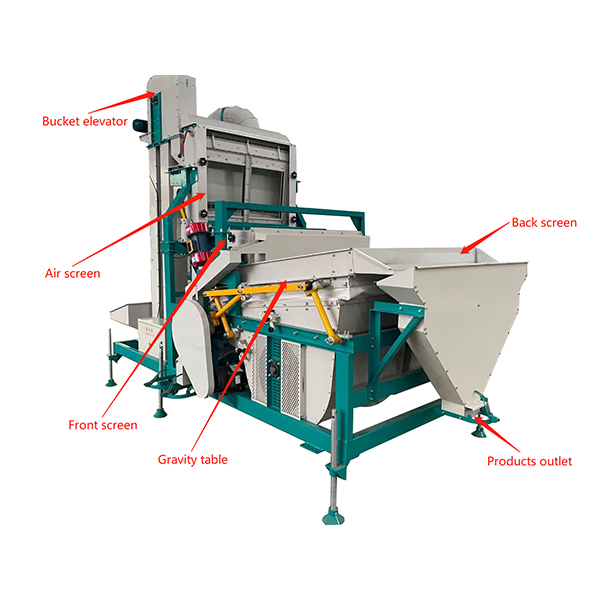
Light floating impurities: Broken skins, pod shells, stems and leaves, dust, empty shells, weed seeds, and fine dust (removed via air separation).
Impurities differing in particle size: Large soil clods, straw stalks, small stones, broken beans, tiny weed seeds, and insect-damaged fragments (removed via multi-layer vibrating screening).
Impurities of similar size but different specific gravity: Shriveled grains, insect-eaten beans, moldy or diseased beans, sprouted beans, mud clumps, lightweight stones, and immature green shriveled beans (separated via gravity table stratification).
Chickpeas are round with significant individual grain weight and wrinkled skins; therefore, screen specifications, airflow volume, and vibration amplitude require specific adjustments and cannot use standard settings for wheat or millet.
II. Three-Stage Cleaning Workflow (Air Separation → Vibrating Screening → Gravity Separation)
1. Pre-cleaning: Air separation and dust removal
Material enters the inlet, where a dual-duct variable-frequency fan generates a vertical suspension airflow:
Light impurities are lifted by the airflow and conveyed to a bag filter or cyclone dust collector for centralized collection;
Intact chickpeas descend under their own weight into the vibrating screening section;
Function: Removes dust and bean skins early on to prevent screen clogging and reduce the load on the subsequent gravity table.
2. Multi-layer vibrating screening: Grading and impurity removal (using perforated screen plates designed specifically for chickpeas)
Standard configuration includes three screen layers with apertures customized to chickpea grain sizes:
Top layer (large-hole screen): Retains straw stalks, large mud clods, and large stones;
Middle layer (main screen): Intact chickpeas flow off the screen surface and proceed to the gravity table;
Bottom layer (small-hole screen): Allows broken beans, fine sand, and small weed seeds to pass through;
The screen box is equipped with rubber cleaning balls to prevent the wrinkled skins of the chickpeas from clogging the screen apertures, ensuring continuous operation without material blockage. 3. Precision Gravity Separation (Core Process)
After initial screening for uniform particle size, the chickpeas enter a honeycomb-structured gravity separation bed, where they are stratified through the combined action of vibration and positive-pressure airflow from below:
Plump, high-density, premium-quality chickpeas stay close to the separation bed, move upward with the vibration, and are discharged through the finished product outlet;
Lightweight, shriveled, moldy, insect-damaged, or sprouted beans are lifted by the airflow to the upper layer and slide down the incline to be discharged as secondary-grade product;
Soil clumps and heavy stones, being denser than good beans, sink to the very bottom and are discharged separately as impurities;
Models equipped with dual gravity separation decks allow for a secondary pass to recover sound chickpeas from the rejected material, thereby minimizing waste—an ideal setup for high-standard processing destined for export markets.
III. Specialized Advantages for Chickpea Processing
1. Three-in-One Integrated Cleaning: Coarse cleaning and precision sorting in a single step
A single machine replaces the combination of an air-screen cleaner, destoner, and basic gravity separator; this simplifies the front-end of the chickpea processing line and reduces the equipment footprint.
2. Low-Damage Handling to Preserve Chickpea Skin Integrity
Utilizes gentle, low-frequency vibration and soft, uniform airflow to minimize skin scratches and breakage, meeting export-grade standards for whole-bean appearance.
3. Fully Adjustable Parameters for Both Large and Small Chickpea Varieties
Variable-frequency control allows for the adjustment of fan airflow, screen box amplitude, gravity table tilt angle, and feed rate, enabling seamless switching between the two mainstream varieties: large white Kabuli chickpeas and small black Desi chickpeas.
4. High Impurity Removal Precision Meeting Export Inspection Standards
Light impurity removal rate ≥ 98%;
Stone and soil clod removal rate ≥ 95%;
Shriveled, moldy, and insect-damaged bean rejection rate ≥ 90%;
Cleaned raw material can be fed directly into a color sorter for secondary precision sorting, significantly reducing waste and product loss during the color sorting stage.
5. Eco-friendly Enclosed Dust Removal
Fully enclosed air ducts prevent dust leakage during processing, meeting environmental standards for grain processing facilities.
IV. Standard Production Line Configuration
Bucket Elevator → Air-Screen Gravity Cleaner → Grading Screen → Bean Color Sorter → Packaging Machine
Seed-grade chickpea processing: Add a secondary precision gravity separator after the main unit to further purify high-germination-rate seeds;
Bean paste / Dehulled chickpea processing: Add a magnetic separator upstream of the main unit to remove mixed metal particles and protect the dehuller’s rollers.
Comprehensive Scope of Application for Air-Screen Gravity Cleaners
I. Various Grains (Cereals)
Staple grains: Wheat, corn, rice, brown rice, sorghum, millet, paddy, barley, oats, buckwheat, rye
Oil-bearing grains: White sesame, black sesame, oil sunflower seeds, rapeseed, flaxseed, safflower seeds, castor seeds
Minor grains: Quinoa, proso millet, foxtail millet, Job’s tears
II. All Edible Legumes (Core Specialty Materials)
Large-seeded legumes: Chickpeas, white kidney beans, red kidney beans, mottled kidney beans, pinto beans, fava beans, large white peas
Small-to-medium legumes: Soybeans, black soybeans, mung beans, adzuki beans, white hyacinth beans, lentils, green peas, pigeon peas, black small beans
Suitable for export-grade legumes, processing-grade legumes, and seed purification/cleaning lines
Application Scenarios Categorized by Cleaning Function
1. Pre-cleaning at collection stations and grain processing plants
Removes dust, straw, soil, broken husks, and impurities of various sizes; suitable for the pre-treatment of raw, unprocessed grain.
2. Precision processing of minor grains and legumes for export (Primary application)
Separates impurities (based on weight and size) from crops like chickpeas, kidney beans, lentils, and pinto beans; removes shriveled, insect-damaged, and moldy beans as well as stones. Cleaned product feeds directly into color sorters, reducing material loss during the color sorting process.
3. Pre-treatment for oil extraction
Removes shriveled seeds, soil, and weed seeds from sesame, oil sunflower seeds, and rapeseed to improve oil quality.
Post time: Jul-08-2026