
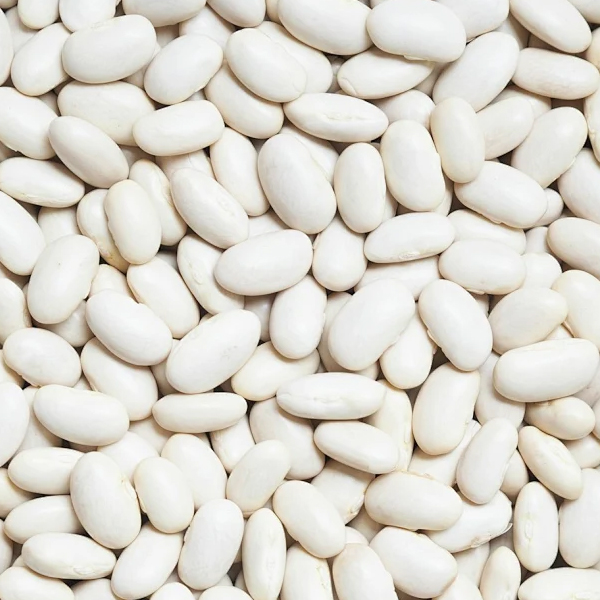
In Poland, white kidney beans (*Phaseolus vulgaris*) are a traditional dry bean variety rather than a staple field crop; they are considered a specialty regional commodity. Key production areas are concentrated in the Lublin region (Lubelszczyzna), followed by the Świętokrzyskie, Mazovia, and southern Lesser Poland regions. The Lublin region features well-drained loam and Luvisol soils, moderate summer temperatures, and relatively balanced precipitation, making it the primary cultivation zone and a central hub for domestic processing and export. Numerous processing plants are located here, equipped with comprehensive production lines for cleaning, grading, and optical sorting, supplying both EU canning companies and the global dry bean trade market.
Characteristics of Impurities and Challenges in Post-Harvest Cleaning
Polish white kidney beans are typically harvested from dry fields, resulting in distinct field-derived impurities. Harvested crops often contain straw, pod fragments, weed seeds, and soil clods. Clay-rich plots, in particular, generate significant amounts of clay clods; these clods often match the size and density of the beans, making them difficult to remove using only air-screen cleaners and gravity separators. Other impurities include small stones, weathered magnetic soil clods, and metal fragments. When clods break apart under pressure during lifting or vibratory sorting, the resulting dust adheres to the bean surface, giving the finished product a grayish hue and lowering its commercial grade. Consequently, high-end export production lines often incorporate a soil separator after the air-screen cleaner to remove magnetic soil clods before the beans reach the gravity destoner (which removes standard stones and grit). This setup protects downstream polishing and optical sorting equipment, preventing soil clods from scratching the optical sorter’s glass or clogging its ejection valves.
Soybean cultivation in Poland has expanded rapidly over the past decade or so, driven by EU policies aimed at reducing reliance on imported protein sources and boosting the domestic supply of non-GMO protein for livestock feed and, to a lesser extent, food-grade processing. Major production areas are concentrated in the southeastern regions of Lublin and Subcarpathia, as well as central Mazovia; the southeast offers the most favorable thermal conditions and serves as the core cultivation zone. Northern regions are limited to growing ultra-early maturing varieties due to latitude constraints—where higher latitudes require earlier-maturing varieties—while late-maturing varieties are restricted to small-scale trials in the south.
Cultivation Scale, Varieties, and Agronomic Characteristics
Soybean acreage in Poland has seen explosive growth: rising from just 5,450 hectares in 2018 to 48,194 hectares in 2022, with approximately 44,621 hectares recorded in 2023. Fluctuations in acreage are primarily influenced by annual weather conditions, market purchase prices, and EU subsidy policies. Sowing typically takes place from early to mid-May, once soil temperatures consistently exceed 10°C. Cultivation practices include rhizobium inoculation to optimize nitrogen-fixation efficiency, with fertilization focused on phosphorus and potassium. Crop rotation—commonly involving winter wheat and maize—is employed to mitigate soil-borne diseases such as root rot.
Characteristics of Impurities and Post-Harvest Cleaning Challenges
Given the high level of mechanization in soybean harvesting, the composition of impurities differs significantly from that of white kidney beans. Primary impurities include broken beans, shriveled grains, pod fragments, stalk pieces, and dust, alongside contaminants such as stones, soil clods, and weed seeds. As soybean grains are denser than white kidney beans, stones and soil clods are relatively easier to separate during gravity-based sorting; however, soybeans harvested from clay-rich soils may still carry adhering clay clumps. Soybean seed coats are tougher than those of white kidney beans; however, hard mud clumps or stones entering the polishing and dehulling equipment will still accelerate wear on the abrasive rollers. For soybeans intended as seed, requirements regarding broken grains, grains with lesions, mud clumps, and impurities are extremely strict; a graded cleaning process—comprising air-screen cleaning, soil separation, gravity destoning, and magnetic separation—is recommended. Requirements for the purity of feed-grade soybeans are relatively less stringent, allowing for a simplified process configuration consisting solely of air-screen cleaning and gravity separation.
White kidney beans feature large seeds and thin, brittle seed coats; they are typically harvested from dryland fields. Common impurities include stalk fragments, pod husks, weed seeds, small stones, and clay clods picked up from clay-rich soils. The processing challenges are twofold: first, dried clay clods closely resemble the beans in both size and density, making them difficult to capture with standard screens or fully separate using gravity separators; second, the seed coats are highly fragile, requiring gentle handling to avoid breakage, as rough impact would reduce both the whole-bean yield and the product’s visual quality.
Soybeans have smaller seeds and tougher seed coats, and are predominantly harvested mechanically. Impurities primarily consist of broken beans, shriveled beans, pod husks, and stalk dust, alongside sand, stones, soil clumps, and weed seeds. The challenges include the presence of significant quantities of “split beans,” “insect-damaged beans,” and “shriveled beans”—which are similar in size to sound beans and easily mis-sorted during screening—and the fact that hard contaminants like sand, stones, and metal fragments can cause significant equipment wear during subsequent dehulling and polishing stages.
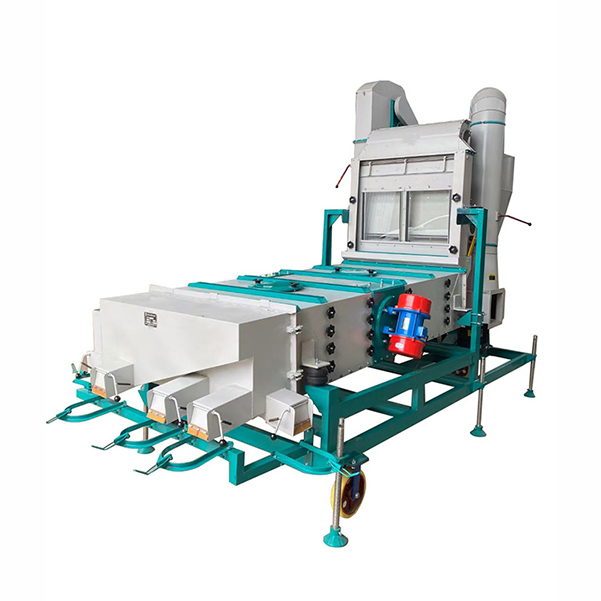
The air-screen cleaner employs a dual-action mechanism combining air separation and mechanical screening. Upon entering the machine, the raw material first encounters an upward airflow generated by a fan; light impurities with low specific gravity and large wind-facing surface areas—such as broken stalks, pod husks, shriveled grains, and dust—are blown away, completing the initial separation. Subsequently, the material falls onto a multi-layer vibrating screen assembly with varying aperture sizes. The reciprocating vibration of the screens causes the beans to move and stratify across the surface: coarse impurities larger than the beans (stalks, twine, large clods) are retained by the upper screen, while fine impurities smaller than the beans (fine sand, soil particles, chaff, small weed seeds) pass through the apertures and are discharged; meanwhile, uniform, plump beans flow along the screen surface toward the outlet.
For white kidney beans, the core objective of the air-screen cleaner is to preserve whole beans while removing pod husks. Since the seed coats of white kidney beans are brittle, the vibration frequency and amplitude of the screens are set lower to prevent skin breakage caused by tumbling or collisions. The process relies on the upper screen to capture pod husks and stalks, and the lower screen to remove soil particles and weed seeds, while the air separation stage blows away shriveled beans and broken skins, thereby ensuring the visual integrity of the large white kidney beans. For soybeans, the focus shifts to sorting by weight and removing split beans. As soybean sizes are relatively uniform, screen apertures are selected with greater precision; air separation is utilized to prioritize the removal of shriveled beans, split beans, and insect-damaged beans, while the screens separate out fine sand and broken pod fragments, laying a solid foundation for subsequent grading. Regardless of the bean variety, the air-screen cleaning process removes the vast majority of large, light, and small impurities, creating optimal feed conditions—characterized by low load and high efficiency—for the downstream destoner.
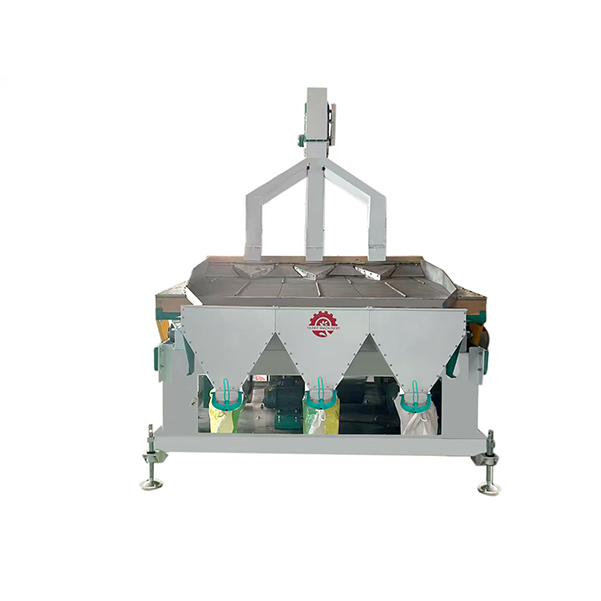
The gravity destoner operates on the principle of “airflow fluidization combined with gravity-based stratification,” specifically designed to remove hard, heavy impurities—such as stones, sand, and soil clumps—that are similar in size to the beans and difficult to eliminate via air-and-screen cleaning alone. The machine features an inclined vibrating deck with an upward airflow passing through it. As material enters the deck, the combined action of vibration and rising airflow causes fluidization and stratification: denser particles (stones, sand, and soil) sink to the bottom layer, move upward along the deck surface toward the high end, and are discharged through the stone outlet; meanwhile, lighter, plump beans float in the upper layer and flow toward the low-end discharge outlet, achieving precise separation based on specific gravity. Parameters such as deck inclination, vibration frequency, and airflow volume are all adjustable.
The destoner is particularly valuable for processing white kidney beans. Export orders for white kidney beans demand impeccable appearance; the presence of stones or soil clumps in the final product compromises both visual quality and hygiene standards. Given that white kidney beans are large and have brittle seed coats, the destoner’s use of airflow suspension ensures uniform force distribution on the beans, resulting in virtually no additional breakage and maintaining a high whole-bean rate. For soybeans, the destoner primarily removes small stones, heavy sand, and soil clumps that match the bean size. These impurities are the main culprits behind wear and tear on dehullers, polishing machine abrasive rollers, and color sorter glass windows; removing them significantly extends the service life of downstream equipment and reduces downtime. Additionally, the airflow and vibration amplitude must be fine-tuned to suit the characteristics of soybeans—which are smaller and denser—to prevent the beans from being blown off course or ensuring separation is not incomplete.
In the comprehensive cleaning process, the air-screen cleaner and the destoner form a sequential cleaning workflow—air-screening followed by destoning. The air-screen cleaner utilizes its high processing capacity to rapidly remove the bulk of light, large, and fine impurities; this allows the destoner to focus exclusively on density-based separation, thereby preventing performance degradation caused by large debris overloading the machine. Subsequently, the destoner performs precision separation of heavy impurities, effectively addressing the air-screen cleaner’s limitation in handling hard objects similar in size to the beans themselves. Through this tandem arrangement, common impurities found in white kidney beans and soybeans—such as stalks, pod fragments, shriveled beans, split beans, stones, soil clumps, and weed seeds—are removed in stages, consistently achieving an overall purity level exceeding 99%.
Post time: Oct-14-2026