
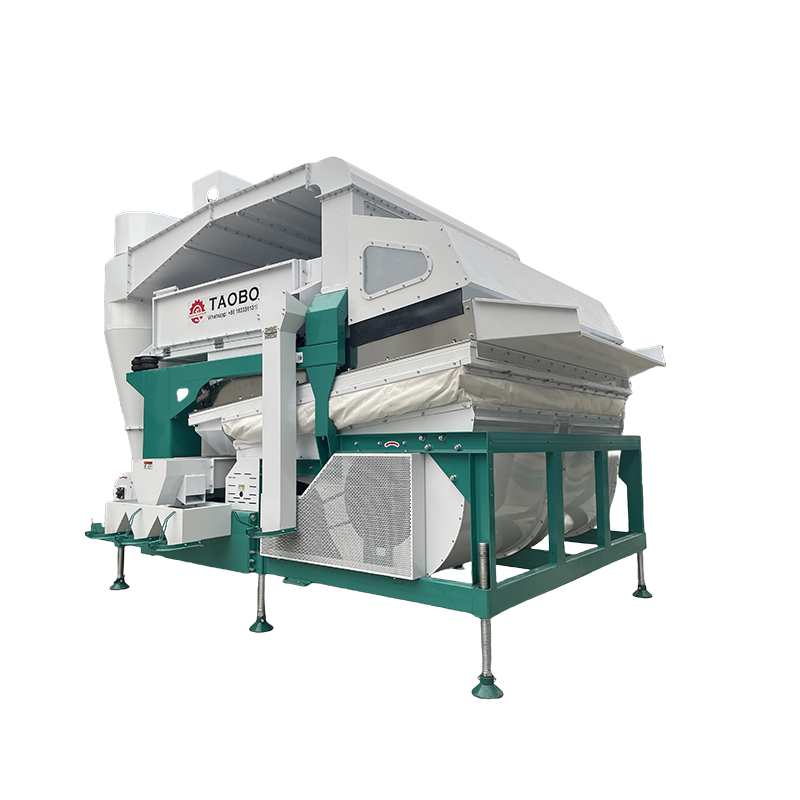
Sesame seeds are extremely small (with a particle size of approximately 1.5–2 mm), lightweight, high in oil content, and often contain significant amounts of sand, making them one of the most challenging commodities among grains and oilseeds to process with high-capacity cleaning equipment. A standard single-unit air-screen cleaner typically processes sesame at a rate of 3–5 tons per hour. Achieving a capacity of 15 tons per hour requires a design strategy based on “increased working width” and “dual-module parallel configuration.” This entails widening the screen surfaces or employing a dual-screen structure, utilizing an air-separation chamber with independently controlled multi-stage airflow, and incorporating either widened or dual-deck gravity separation tables. Furthermore, the entire process chain—including feeding, conveying, and dust extraction—must be scaled to accommodate a material flow of 15 tons per hour.
II. Complete Workflow
Stage 1: Feeding and Material Distribution. Raw sesame seeds are transported via an elevator into a buffer hopper. This hopper serves to “equalize the flow and stabilize pressure,” preventing fluctuations in the incoming material supply from compromising sorting precision. Equipped with a vibrating feeder or a variable-frequency drive (VFD) feeding mechanism, the hopper maintains a steady flow rate—set at 15 tons per hour—and spreads the material into a thin, uniform layer across the top screen surface. While this step may appear simple, it is the fundamental prerequisite for the stability of the entire line; uneven material thickness would directly lead to inconsistent air-based separation and incomplete screening—issues that are only amplified at high production capacities.
Stage 2: Air-Based Separation (Removal of Light Impurities). The material enters the air-separation chamber, where multiple independent air zones deliver controlled airflow—either from top to bottom or laterally. Impurities with low specific gravity and large surface areas—such as dust, husks, shriveled or empty seeds, lightweight weed seeds, and straw fragments—are lifted by the airflow and directed into a settling chamber and dust-collection system. Meanwhile, plump, high-density sesame seeds continue to move downward. At a capacity of 15 tons per hour, the critical requirement is that the airflow must be “adjustable by zone.” Given the wide material flow and thick layer, a single-chamber design would create “dead zones”—where airflow is too intense in the center but too weak at the edges. Zonal airflow control ensures uniform treatment across the entire width of the material bed.
Stage 3: Screening (Removal of Large and Fine Impurities). As the material lands on the screen surfaces, an eccentric drive mechanism induces reciprocating vibration, causing the sesame seeds to tumble and advance along an incline. The upper screen layer traps oversized impurities—such as straw, long stalks, large stones, or pieces of rope—which are then discharged through an outlet. The lower screen layer retains the sesame seeds while allowing fine sand, soil, and small debris to pass through. At a throughput of 15 tons per hour, the screen surface area must be sufficiently large; otherwise, the material layer becomes too thick, preventing effective screening and causing fine impurities to remain mixed in with the final product.
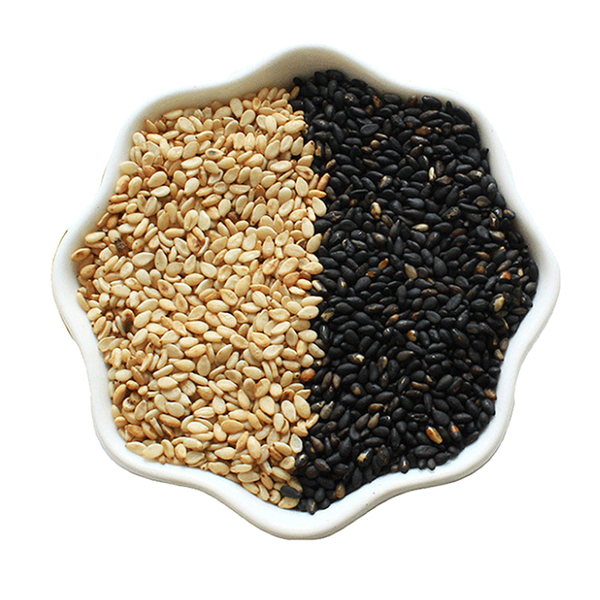
Stage 4: Gravity-based De-stoning (a core process). After air-classification and screening, the sesame seeds enter the gravity separator deck. A fan forces air upward through the perforated deck, creating a uniform rising airflow that fluidizes the material layer. Heavier particles—such as stones, sand, and metal fragments—sink to the surface of the deck, while the lighter, plump sesame seeds rise to the top. Simultaneously, the deck’s vibration and incline cause the sunken stones to move upward along the slope toward a stone-discharge outlet, while the floating sesame seeds move downward along the slope toward the product outlet. The primary challenge in de-stoning sesame seeds lies in the extremely narrow “optimal airflow window”: too much air causes the sesame seeds to be blown away, while too little air fails to fluidize the material layer, preventing stones from sinking. Given the high throughput of 15 tons per hour, the material layer must remain consistently thin and uniform; therefore, this stage is typically equipped with material-level monitoring linked to an automated feeding system to maintain the ideal layer thickness.
Stage 5: Final Screening and Discharge. Following gravity separation, the sesame seeds undergo a final check-screening to remove any small broken fragments or residual light impurities that may have emerged during the process. The finished product then exits through a discharge port, moving on to subsequent stages: magnetic separation, color sorting, and precise weighing and packaging. The entire production line is interconnected via bucket elevators and sealed conduits, ensuring a fully enclosed transport process that prevents secondary dust generation and contamination.
Stage 6: Dust Removal and Collection. The air-classification, screening, and gravity-separation stages all generate dust (particularly the extremely fine saponin powder released after sesame hulling). The entire line is equipped with a centralized dust-removal system, with suction points at each stage connected to a dust collector for centralized processing. This is essential not only for maintaining a compliant, hygienic workshop environment but also for ensuring the stability of the airflow used in separation; inadequate dust removal increases air resistance, leading to a drop in airflow volume and a subsequent decline in separation precision. III. Key Operating Parameters and Adjustment Sequence
There are six main sets of adjustable parameters for the entire processing line: feed rate, airflow volume for each section, screen amplitude and frequency, screen mesh aperture, inclination angle of the gravity separation deck, and airflow volume for the gravity separation stage. The standard procedure for on-site commissioning is as follows: first, set the feed rate to achieve the designed material layer thickness; next, adjust the amplitude and mesh aperture of the screening section to ensure the effective removal of large and fine impurities; then, regulate the airflow in the air-separation section to ensure that light impurities are removed without drawing away any sesame seeds; and finally, fine-tune the airflow and inclination angle of the gravity separation deck, using the criteria that “stones move steadily upward while sesame seeds move smoothly downward.” When switching between sesame seeds from different origins—for instance, raw materials from Pakistan and Ethiopia may have significantly different sand content—the parameters should be reset according to the specific recipe for that source.
IV. Overall Performance of the 2026 Sesame Seed Processing Line
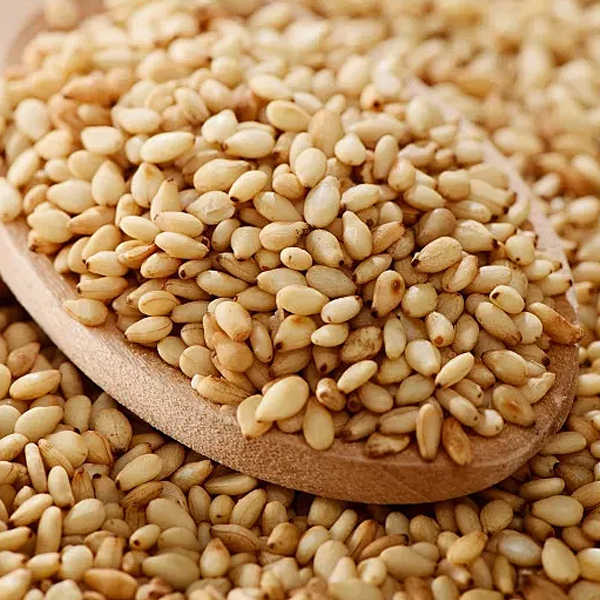
Purity: Through a three-stage process—air classification (to remove light impurities), screening (to sort by size), and gravity separation (to remove stones)—the purity of the sesame seeds can be consistently raised to over 99.5%. Stones, sand, and metal fragments are effectively eliminated, ensuring that the product meets export inspection standards for stone content and preventing issues such as shipment rejections or price reductions due to excessive foreign matter.
Damage and Yield: The process involves no mechanical impact or compression; sesame seeds simply roll across the screens and slide over the gravity separation deck, keeping breakage and unintended hulling to a minimum. Gravity separation sorts seeds by plumpness, with shriveled, insect-damaged, or moldy grains diverted into the “light material” outlet. This ensures a uniform, high-quality final product, with yield loss limited strictly to the removal of impurities rather than the accidental loss of good-quality seeds.
Capacity and Stability: Designed for a continuous feed rate of 15 tons per hour, the system utilizes surge hoppers and automated feeding to ensure stable, long-term operation. The dual-module, widened design ensures an even distribution of the product flow across the entire processing surface, preventing material drift or localized accumulation, and allowing for reliable, predictable daily throughput.
Environment and Labor: The entire line is enclosed and equipped with a centralized dust-extraction system, minimizing dust leakage and ensuring the facility meets food-processing hygiene standards. With a high degree of automation, the line requires only minimal personnel for routine inspection and parameter monitoring. Compared to manual sorting, this significantly reduces labor costs while ensuring consistent quality across every batch.
Post time: Nov-12-2026