
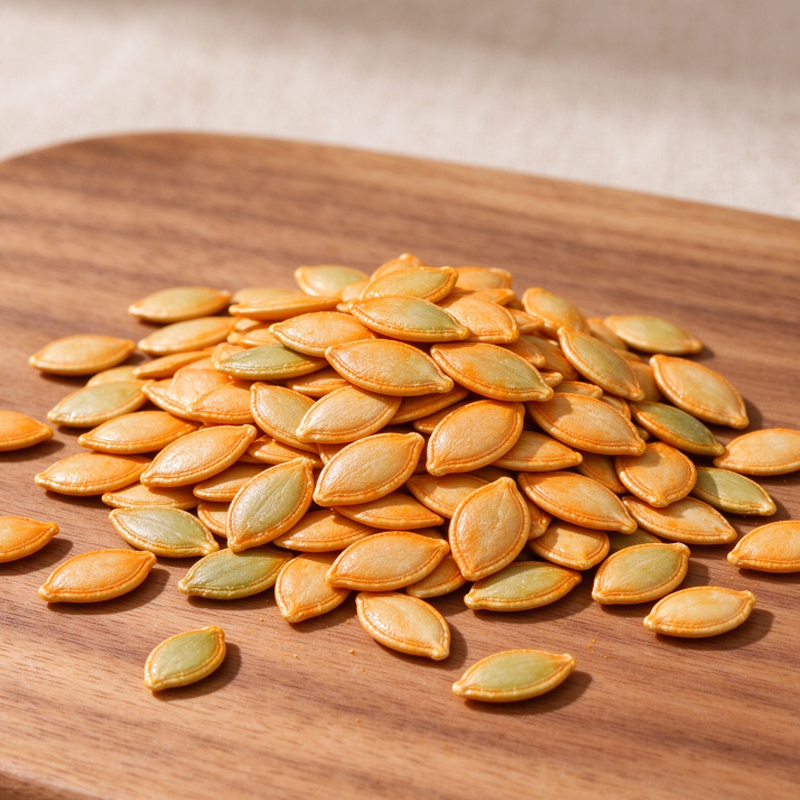
During the harvesting, drying, threshing, storage, and transportation of pumpkin seeds, they become contaminated with a complex array of impurities—far more diverse than those found in typical grains—which presents the primary challenge for the cleaning process. Based on their physical properties, these impurities can be categorized into four types: first, “light” impurities—such as pumpkin pulp fibers, shell fragments, shriveled seeds, leaves, dust, and chaff—which have a significantly lower specific gravity than the seeds and are best removed via air-based separation (aspiration); second, “large” impurities—such as vine segments, rind pieces, stalks, twine, and stones—which are substantially larger than the pumpkin seeds; third, “medium” and “small” impurities—including broken seeds, seed halves, weed seeds of similar dimensions, and small pebbles—which are close in size to the pumpkin seeds and difficult to separate through screening alone; and fourth, “heavy” impurities—primarily sand, clods of soil, stones of similar specific gravity, and even metallic foreign objects.
The complexity arises from the unique characteristics of pumpkin seeds themselves: first, they are flat and elongated, with a mucilaginous seed coat that easily attracts dust and causes the seeds to cling to one another; second, there is a significant density difference between empty/shriveled seeds and plump, healthy seeds, necessitating precise and controllable air-based separation; third, the wide range of seed sizes requires a multi-layered, graduated screening system; and fourth, high soil content and moisture levels can cause the seeds to clump together. Consequently, neither a standalone air separator nor a simple screen cleaner is sufficient. Instead, an integrated cleaning system—combining air-based separation, screening, and specific-gravity-based separation—is required to effectively remove all categories of impurities (light, large, medium, small, and heavy) in a single, comprehensive process.
II. Working Principle of the Air Screen Gravity Cleaner: A Three-in-One Composite Cleaning Process
The essence of an air-screen-gravity cleaner (also known as a composite air-screen-gravity cleaning machine) lies in integrating three distinct physical separation principles—separation by density via airflow, separation by particle size via screens, and separation by density variance via a gravity table—into a single piece of equipment. This allows the material to undergo multi-stage impurity removal in a continuous, sequential flow. The machine consists of five primary components: a uniform feed distribution system, an air-separation system, a multi-layer vibrating screen assembly, a gravity separation table, and multiple discharge outlets.
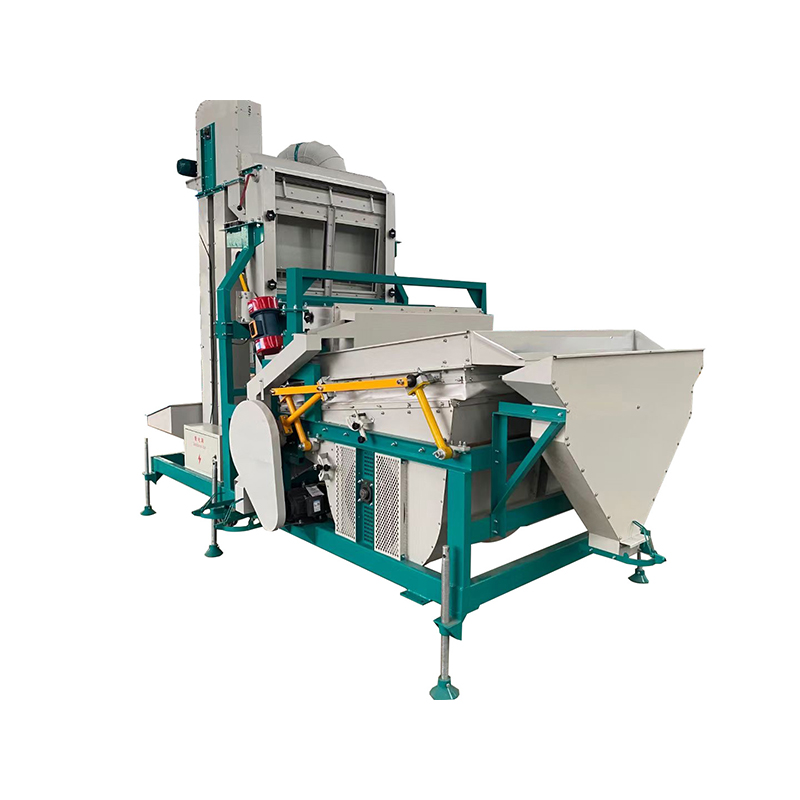
During operation, pumpkin seeds are fed into the machine in a metered, uniform manner. They first enter the primary cleaning section, where a large-aperture screen combined with vibration instantly intercepts large debris—such as vine fragments, rinds, and stalks—thereby reducing the load on subsequent stages and protecting the air ducts and screen surfaces. The material then moves into the air-separation zone, which is critical for removing “light impurities.” An integrated high-pressure centrifugal fan generates a stable, controllable airflow within the ducts. As the material descends in a thin, fluidized layer, lighter components—such as pumpkin pulp fibers, shriveled seeds, shell fragments, and dust—are lifted by the airflow and directed into a settling chamber or a cyclone dust-collection system. Meanwhile, heavier, plump seeds continue downward onto the lower screen layers for further processing. By adjusting the airflow volume and the cross-sectional area of the ducts, the upward buoyant force can be precisely regulated to ensure that light impurities are removed without the loss of high-quality seeds—a key distinction between this air-screen gravity separator and standard air-separation machines.
Following the removal of light impurities, the material enters a multi-layer vibrating screen assembly. The screen apertures are selected based on a gradient corresponding to the particle size of the pumpkin seeds (typically set at 1/3 to 1/2 of the minimum size of the target seeds). Driven by an eccentric or vibrating motor, the screens undergo reciprocating motion: broken seeds, seed fragments, and fine sand—all smaller than the target seeds—pass through the fine-mesh lower screens, while stones, clods, and coarse debris—larger than the target seeds—are separated by the coarse-mesh upper screens. Seeds that fall within the desired size range are then conveyed toward the final processing stage.
The final stage is gravity separation, which serves as the “finishing touch” of the air-screen gravity cleaner. Once the pumpkin seeds reach the gravity-separation deck, an upward airflow—supplied by a fan—is introduced from beneath, causing the seeds to enter a “fluidized, boiling” state on the screen surface. Simultaneously, the deck undergoes reciprocating vibration in a specific direction, with its tilt angle also subject to adjustment. Due to differences in specific gravity, particles such as sand, stones, and metal—which have a higher specific gravity—are discharged through the “heavy impurity outlet” at the lower end of the deck when the airflow’s buoyant force is insufficient to lift them. Meanwhile, plump pumpkin seeds, possessing an appropriate specific gravity, remain suspended and are conveyed along the deck toward the product discharge outlet, effectively separating the high-quality seeds from the heavy impurities. By precisely adjusting the deck’s inclination angle and vibration frequency, stones—even those similar in size to the pumpkin seeds—can be effectively “pulled” out, thereby achieving the removal of stones.
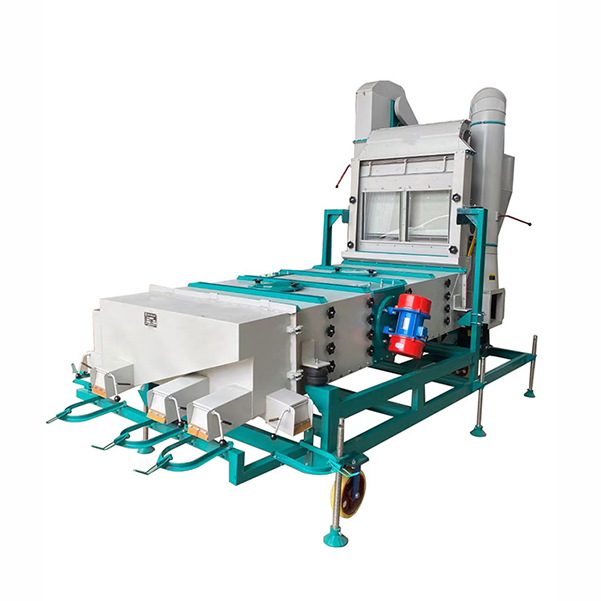
III. To achieve optimal results when using an air-screen gravity cleaner for pumpkin seeds, the adjustment of operating parameters is crucial—this is the most important aspect to master during equipment operation:
1. Air volume/pressure: Air volume acts as the “master control” for separating light impurities and fluidizing the material based on specific gravity. If the air volume is too low, fibrous pulp and shriveled seeds will not be effectively removed; if it is too high, sound (plump) seeds may be carried away, leading to increased product loss. In practice, adjustments should be made incrementally—based on the bulk density and moisture content of the pumpkin seeds—to find the “sweet spot” where light impurities are removed without damaging the good seeds.
2. Vibration frequency and amplitude: These factors determine the transport speed of the material across the screen surface and the effectiveness of stratification. If the vibration frequency is too low, material will accumulate, resulting in inadequate screening; if it is too high, the seeds may bounce excessively, leading to a higher breakage rate. These settings must be calibrated according to the hardness of the seeds.
3. Number of screen layers and aperture sizes: Screen apertures should be selected based on the particle size of the pumpkin seeds and the composition of the impurities. The aperture for the primary layer is typically set to a size slightly larger than the good seeds but smaller than the large impurities; combined with finer-mesh layers for smaller fragments, this allows for classification in a single pass.
4. Gravity table inclination and airflow: The inclination angle and the upward airflow work together to control the discharge of heavy impurities and the recovery rate of good seeds. These settings may require fine-tuning during operation, depending on the level of contaminants like sand or stones.
5. Feed flow rate: Maintaining a consistent feed rate is a fundamental requirement for the entire process. Fluctuations in the flow of material can disrupt the stability of both air-based and gravity-based separation; therefore, it is advisable to equip the system with an upstream feed hopper and a flow-equalizing device.
Post time: Oct-24-2026