
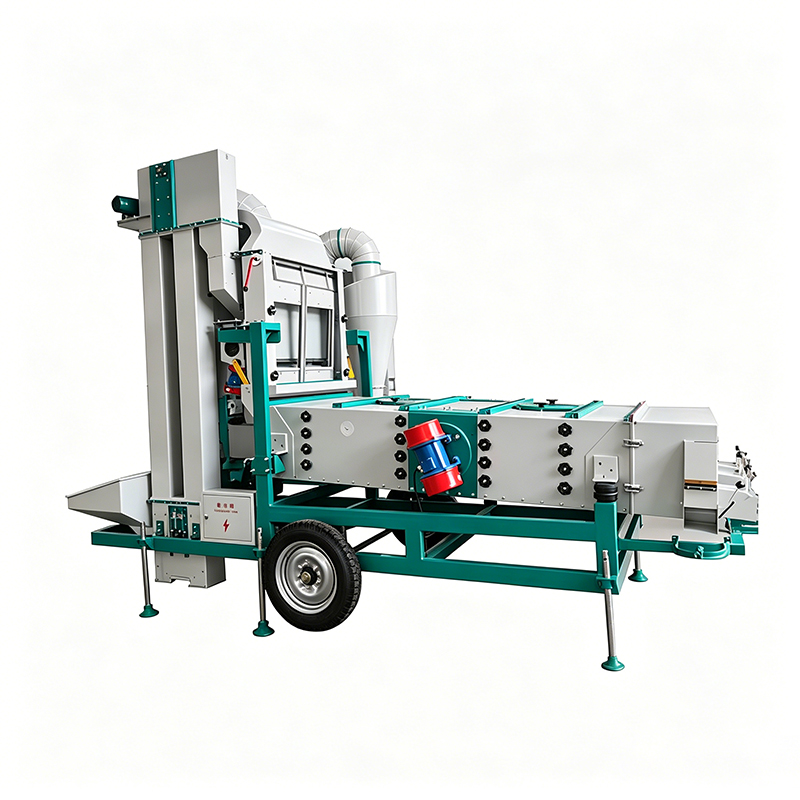
Overall Working Principle of the Taobo seeds Air Screen Cleaner
The core principle lies in combining two major mechanisms: air separation (aerodynamics) and screening (geometric sizing). By leveraging the differences in suspension velocity and particle size between the raw material and impurities, the machine sequentially separates various types of impurities to achieve comprehensive cleaning and grading.
I. Air Separation Principle (Removal of Light Impurities)
As the material falls, a fan generates a directional airflow (typically upward or lateral).
Light impurities—such as dust, husks, broken straw, shriveled grains, and insect-damaged kernels—have a suspension velocity lower than the airflow speed; they are carried away by the air stream and directed into a dust collection unit for capture and discharge.
Full-bodied grains: Possessing greater weight and a suspension velocity higher than the airflow speed, they remain unaffected by the air stream and fall normally into the screening unit.
The airflow speed is adjustable to accommodate different types of materials, thereby preventing viable grains from being blown away.
II. Screening Principle (Removal of Oversized/Undersized Impurities and Grading)
The screening unit undergoes high-frequency reciprocating vibration and is equipped with multiple layers of sieves featuring varying mesh sizes to sort particles based on their dimensions:
Upper-layer Coarse Sieve: The mesh openings are larger than the raw grains; this sieve intercepts oversized impurities—such as stones, clods of earth, coarse stems, and large weed seeds—which are then discharged through the coarse-waste outlet.
Middle-layer Main Sieve: The mesh openings are sized to match the viable grains; acceptable material passes through the sieve openings and falls downward, while similarly sized but irregularly shaped impurities remain on the sieve surface and are discharged.
Lower-layer Fine Sieve: The mesh openings are smaller than the raw grains; fine impurities—such as fine sand, broken kernels, and dust—pass through the sieve and are separated, while the viable grains remain on the sieve surface and are conveyed out.
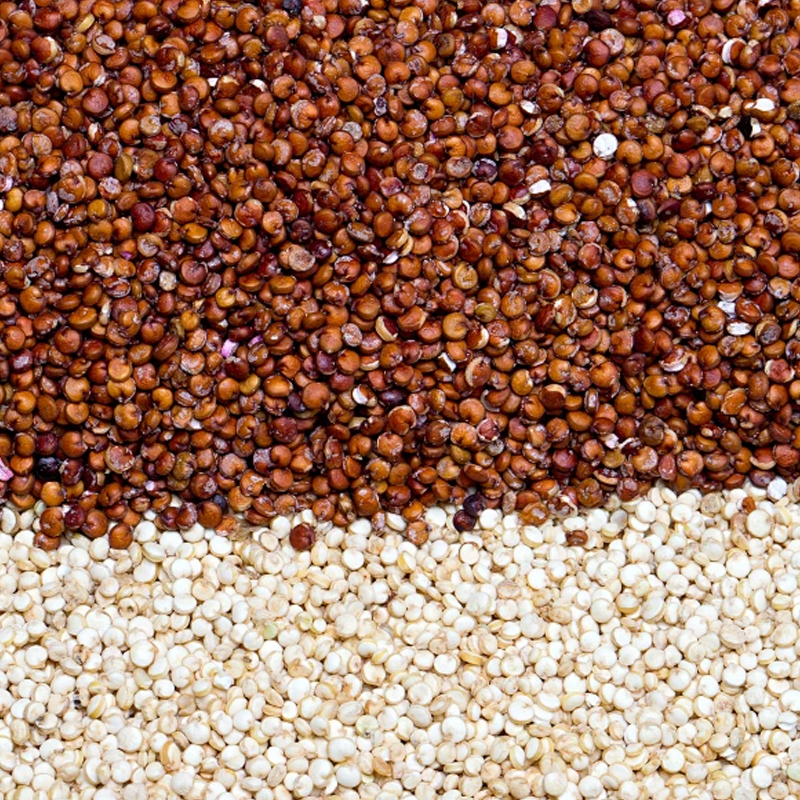
I. Characteristics of Quinoa Raw Materials and Impurities
Quinoa Seeds: Grain size approx. 1.5–2.5 mm; specific gravity 1.0–1.2; translucent; lightweight.
Common Impurities:
Light Impurities: Dust, broken straw, husks, shriveled grains, insect-damaged grains (low suspension velocity);
Large Impurities: Stones, soil clumps, grass seeds, coarse stems (dimensions > quinoa);
Small Impurities: Fine sand, fine dust, broken seed coats (dimensions < quinoa).
II. Cleaning Process (Step-by-Step Impurity Removal)
Feeding and Material Distribution
Quinoa is conveyed via an elevator into the feed hopper, where it is distributed evenly to prevent piling, which could compromise the effectiveness of the air separation.
Vertical Air Separation: Removal of Light Impurities
As the material falls, a fan generates a vertical upward airflow. Light impurities (dust, broken straw, shriveled grains) are lifted away because their suspension velocity is lower than the airflow velocity; they are drawn into a dust collector for collection and discharge. Plump, viable quinoa seeds, having a suspension velocity higher than the airflow velocity, fall vertically into the sieve box.
Key Parameter: Air velocity is adjusted to 2.5–3.5 m/s to ensure only light impurities are blown away without carrying off the good seeds.
Vibrating Screening: Removal of Large and Small Impurities
The sieve box undergoes reciprocating vibration (amplitude: 5–15 mm; frequency: 300–500 cycles/min), utilizing multi-layer screens to classify and remove impurities.
Upper Screen (φ3.0–3.5 mm): Retains large impurities (stones, grass seeds), which are discharged through a side outlet;
Middle Screen (φ1.8–2.2 mm): Allows qualified quinoa seeds to pass through while retaining slightly larger particles;
Lower Screen (φ1–1.2 mm): Allows small impurities—such as fine sand and dust—to pass through, while the qualified quinoa seeds remain on the screen surface and are discharged through the main outlet.
Screen Cleaning and Dust Collection
Bouncing rubber balls located at the bottom prevent screen apertures from clogging; a dedicated dust collector centrally processes the light impurities, preventing dust from escaping into the surrounding environment.
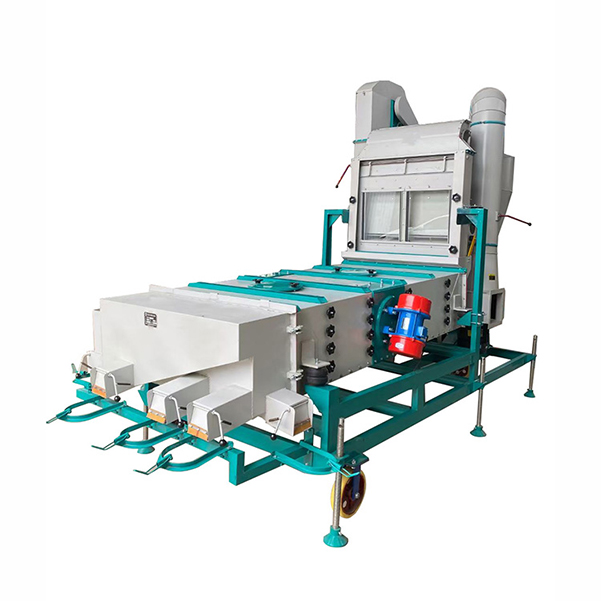
The air screen cleaner operates based on a combined principle of air separation and sieving, making it suitable for the vast majority of grain, coarse grain, oilseed, vegetable, and flower seeds. These categories are classified as follows:
I. Grain Seeds (Primary Application)
Wheat, rice, corn, barley, oats, sorghum, millet, rye, etc. It effectively removes straw, husks, shriveled grains, sand, soil, and broken kernels, performing both cleaning and grading functions.
II. Coarse Grains and Specialty Grain Seeds
Quinoa, buckwheat, Job’s tears, black rice, brown rice, broomcorn millet, proso millet, etc. It is particularly well-suited for materials such as quinoa—characterized by small particle sizes and a tendency to retain dust and seed coats.
III. Legume Seeds
Soybeans, mung beans, red beans, kidney beans, chickpeas, lentils, peas, broad beans, etc. It is capable of separating bean stalks, soil clods, shriveled beans, broken cotyledons, and fine sand.
IV. Oilseed Crop Seeds
Sesame, peanuts, rapeseed, sunflower seeds, flaxseed, perilla seeds, castor seeds, etc. It demonstrates exceptional separation performance regarding light husks, broken stems, and dust.
Post time: Jun-01-2026