
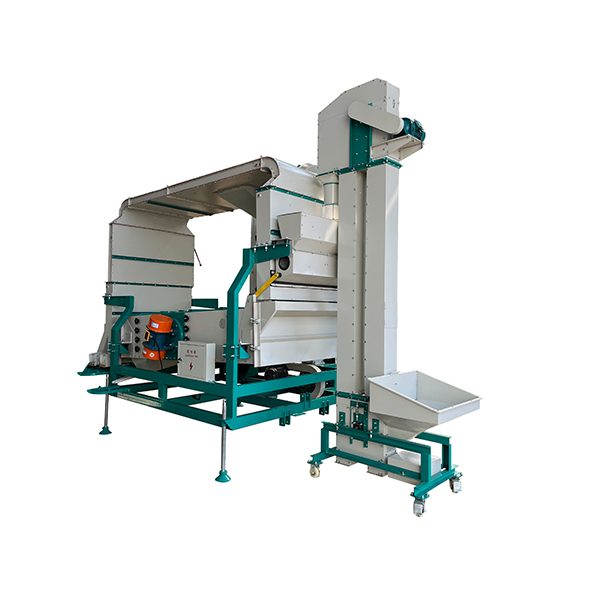
The air screen cleaner utilizes a combination of air separation and vibrating screening principles to process and clean materials. The motor drives the screen box to oscillate, while multi-layered screens with varying aperture sizes separate impurities based on physical dimensions. An adjustable fan generates a vertical airflow that exploits differences in specific gravity to blow away dust, chaff, shriveled grains, and lightweight, moldy seeds. Large impurities are trapped by the upper screen and discharged; fine debris falls through the lower screen mesh; the high-quality finished product exits through the middle outlet; and light impurities and dust are expelled via the dust extraction duct.
Core Structure
The machine primarily consists of a feed hopper, feed regulation gate, vibrating screen box, multi-layer interchangeable screens, fan, airflow control damper, outlets for large impurities, finished products, and fine debris, as well as a dust extraction port and a shock-absorbing frame assembly. The screens allow for quick disassembly and replacement, the damper regulates airflow volume, and the feed gate controls the material flow rate.
Key Functions
Grading and impurity removal: Separates impurities of various sizes and shapes—such as stalks, clumps of grass, large soil clods, broken beans, and fine sand/soil—while grading particles based on size via the screens.
Air separation for light impurities: Blows away dust, shriveled grains, insect-damaged kernels, bean hulls, and fragments of stems or leaves, effectively removing low-density, defective material.
Material pre-treatment: Performs preliminary cleaning for downstream equipment (such as gravity destoners and color sorters) by removing the bulk of impurities; this reduces the load on subsequent machinery and ensures a uniform, stable material feed.
Enclosed dust removal: Minimizes airborne dust at the processing site and reduces material loss.
Applicable Materials
Legumes: Soybeans, kidney beans, mung beans, chickpeas, pigeon peas;
Oilseeds: Sesame seeds, rapeseed, chili seeds;
Grains: Wheat, corn, paddy rice;
Cash crops: Green coffee beans, various vegetable and grain seeds;
Dried nuts/kernels: Peanuts, almonds, and other granular materials.
Key Parameters
Screens: Select round or rectangular holes based on the material; aperture size must match the grain dimensions. 304 stainless steel screens are preferred for food-grade applications; screens must be changed when switching materials.
Airflow: Adjustable damper; higher airflow for soybeans; lower airflow for lightweight, small seeds like sesame to prevent good seeds from being blown away.
Feeding Rate: Feed should be uniform and continuous; excessive feeding can clog the screen, while insufficient feeding reduces throughput.
Amplitude: Moderate vibration amplitude; amplitude control is crucial for legumes, as excessive vibration can cause bean breakage.
Application Scenarios
Can be used as a standalone unit for basic pre-cleaning in small workshops or grain depots; can also be integrated with bucket elevators, gravity destoners, and magnetic separators to form automated production lines. Suitable for grain and oil processing plants, sesame and legume processing facilities, coffee bean processors, and seed processing enterprises, meeting raw material pre-treatment needs for both domestic processing and export.
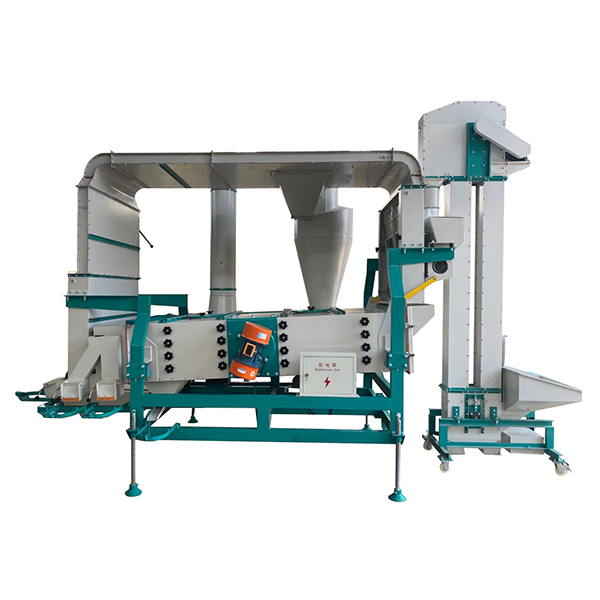
Selection and Replacement of Screens for Air-Screen Cleaners
I. Principles of Screen Selection (Using common materials such as soybeans, sesame, and kidney beans as examples)
Screen selection depends primarily on aperture shape, aperture size, number of layers, and material. Air-screen cleaners are typically configured with two or three screen layers: the top layer features large apertures to remove coarse impurities; the bottom layer features small apertures to remove fine debris and fragments; and the middle layer allows the qualified product to discharge.
1. Aperture Shape
Round-hole screens: Commonly used for legumes, soybeans, kidney beans, and coffee beans. They sort based on particle diameter, offer high sorting precision, and are resistant to clogging; round-hole screens are the preferred choice for legumes.
Rectangular-hole screens: Suitable for flat, slender seeds like sesame and rapeseed. They offer better throughput for stalks and grass fragments and are frequently used for small oilseed crops.
2. Reference for Aperture Size Selection
Soybeans: Top layer round holes φ8–10 mm (to catch soil clods, grass clumps, and bean stalks); bottom layer round holes φ5–5.5 mm (to sift out broken beans and fine soil); whole soybeans discharge from the middle.
Kidney beans: Top layer φ10–12 mm; bottom layer φ6–7 mm.
Sesame: Top layer rectangular holes 2.5×20 mm (to filter out large impurities like stalks); bottom layer rectangular holes 1.2–1.5 mm (to let sand, soil, and broken sesame pass through).
Raw coffee beans: Top layer φ11–13 mm; bottom layer φ7–8 mm.
Selection Tip: Qualified material should remain intact on the screen surface, while impurities should pass smoothly through the apertures. Compare using actual raw material samples: place the seeds on the screen—good seeds should not fall through, while impurities should. If the raw material has a high impurity content, do not choose apertures that are too large, as this causes the product to fall through along with the impurities; conversely, apertures that are too small tend to clog the screen.
3. Material Selection
Carbon steel screens: Low cost; suitable for grain storage and processing of oil-pressing raw materials. 304 Stainless Steel Mesh: Suitable for food products and agricultural exports; it is rust-proof, corrosion-resistant, and does not contaminate the material. Stainless steel is the preferred choice for export-oriented processing of commodities such as soybeans and sesame seeds.
4. Selection of Screen Layers
A double-layer screen is sufficient for standard processing; a three-layer screen should be selected when multi-stage grading is required to sort materials into various size specifications (e.g., large, medium, and small).

II. Screen Replacement Steps
1. Shut down and disconnect the power supply completely; wait for all vibration to cease to prevent accidental startup and safety hazards. Open the access doors on both sides of the equipment.
2. Loosen the screen clamping mechanism (typically consisting of clamping bars, handle bolts, or latches) and fully release the clamping bars.
3. Remove the old screen and inspect it for clogging, wear, or holes; clear any residual material or agglomerated debris from inside the screen box.
4. Install the new screen, paying attention to the orientation: the side with mesh burrs should face downward to prevent material from snagging or jamming. The screen must be laid flat and tensioned properly; it should not be loose or bulging, as slackness causes material to drift off-course and reduces screening efficiency.
5. Align the screen, secure the clamping bars, and tighten the bolts evenly. Ensure consistent pressure on both sides to prevent uneven tension that could cause localized bulging. Close the access doors.
6. After replacement, run the machine without load for 3–5 minutes to check for abnormal noises, excessive vibration, or shifting. Proceed with production only after confirming everything is functioning correctly.
III. Daily Use and Maintenance Points
1. Always shut down and disconnect the power before changing screens; disassembling or installing screens while the equipment is running is strictly prohibited.
2. Screen clogging: Do not strike the screen surface forcefully; use a brush for cleaning. For severe clogging, use compressed air to blow it clean. Damp material is prone to clogging the screen, so pretreat raw materials to reduce moisture content whenever possible.
3. Replace the screen immediately if holes appear, if there is significant deformation, or if mesh apertures have enlarged due to wear; otherwise, impurities may contaminate the finished product.
4. Change the screen when switching materials: For example, if processing sesame seeds after soybeans, the soybean screen’s aperture is too large and would allow sesame seeds to leak through; a screen with smaller apertures specifically designed for sesame seeds must be used. 5. Evaluate performance during commissioning: After feeding the material, observe the three discharge outlets. The “large debris” outlet should discharge only large impurities; the middle outlet should yield the qualified finished product; and the “fine debris” outlet should discharge small particles, sand, and soil. If the finished product leaks from the fine debris outlet, the screen mesh size is too large; if impurities remain in the finished product, the mesh size is too small or the screen is clogged.
Post time: Aug-15-2026