
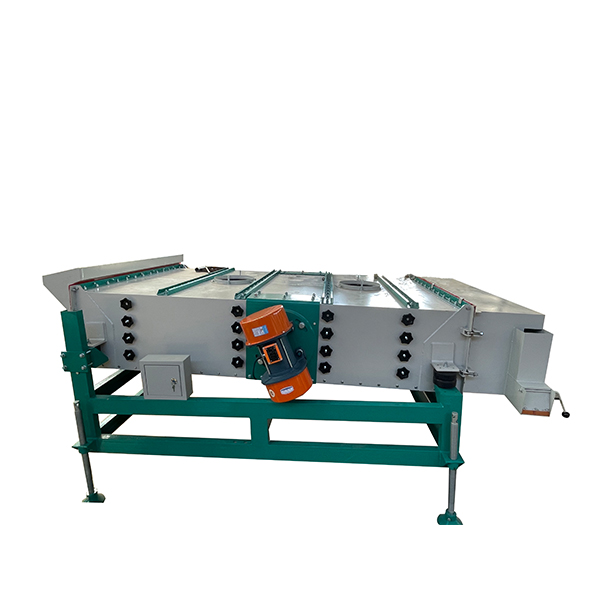
Grain and bean grading screens are devices used for particle size classification and impurity removal of granular materials such as grains and beans. They are widely used in grain processing, seed treatment, and other industries.
Working Principle: Primarily based on the screening principle, materials are separated by the different shapes and sizes of the screen openings. For example, circular screen openings separate grains by width, rectangular screen openings by thickness, and triangular screen openings by shape. Simultaneously, the movement of the screen surface causes relative motion of the materials on the screen surface, allowing particles smaller than the screen openings to fall through, thus achieving grading.
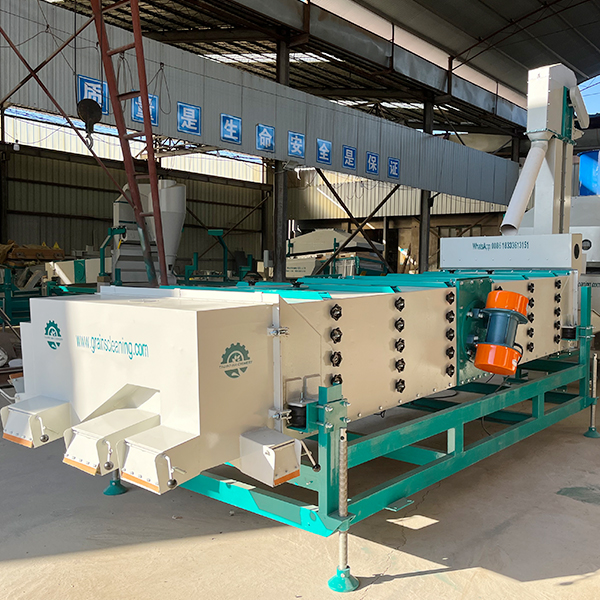
Vibrating Grading Screen: Our Taobo vibrating grading screen uses a combination of a vibrating motor and a counterweight to generate vibration. Its stroke and throwing angle are adjustable, and it can effectively grade rice, paddy, cereals, beans, etc. It can also be equipped with an automatic cleaning system to reduce screen clogging.
The selection of sieve plates for grading grains and legumes should consider three core factors: material characteristics, grading objectives, and equipment type, while also taking into account grading efficiency and sieve plate lifespan.

1. Selection Based on Material Characteristics
Material Particle Size and Shape
Round Particles (e.g., peas, soybeans): Prioritize round-hole screens with a hole diameter slightly larger than the maximum particle size to be screened. This allows for precise grading based on particle width, avoiding sieving errors caused by irregular shapes.
Flat and Long Particles (e.g., lentils, oats):Select rectangular-hole screens with hole lengths matching particle lengths and widths corresponding to the required thickness threshold for grading. This is suitable for thickness-based separation.
Irregular Particles (e.g., chickpeas, quinoa): If both particle size and impurity removal are required, trapezoidal-hole screens can be used. Their large-inlet, small-outlet structure reduces screen clogging and improves throughput.
Material Moisture Content
High Moisture Content Materials (e.g., freshly harvested beans, grains):Select screens with large apertures or sparsely spaced holes to reduce the probability of material adhesion and clogging. Prioritize smooth-surfaced materials (e.g., stainless steel) to minimize material adhesion.
Low Moisture Content Dry Materials:Use screens with small apertures and high-density holes to improve grading accuracy.
Impurity Types
For large impurities (such as straw and pebbles): First, use a large-aperture pre-screen for initial cleaning, then use a fine sieve for grading.
For light impurities (such as dust and shriveled particles): Combine with an air-screening function; select sieves that prioritize particle size classification, while light impurities are removed by the air separation system.
2. Selection Based on Grading Objectives
Grading by Application
Seed Grading: High precision is required. High-precision stainless steel sieves should be selected, with sieve aperture tolerance controlled within ±0.1mm to ensure uniform seed size and improve germination rate.
Food Processing Raw Material Grading: Sieves should be selected based on processing requirements. For example, beans used for canning require uniform particle size, so sieves with equal apertures should be used. For feed raw material grading, the precision can be relaxed appropriately, and lower-cost perforated sieves can be used.
Number of Grading Layers and Sift Sequence
Multi-layer grading sieves should follow the “coarse at the top, fine at the bottom” principle: Larger aperture sieves should be used in the upper layer to remove large impurities or separate large particles; smaller aperture sieves should be used in the lower layer to sieve out fine particles or impurities.
For example: When grading soybeans, a φ10mm sieve is used in the upper layer to separate extra-large particles, a φ8mm sieve is used in the middle layer to sieve out qualified particles, and a φ5mm sieve is used in the lower layer to remove broken and shriveled seeds.
3. Equipment Type Selection
Vibrating Grading Screen: Prioritize screen plates with good elasticity and wear resistance (such as polyurethane screen plates or stainless steel woven mesh) to match the high-frequency vibration characteristics of the equipment and reduce the risk of screen plate breakage. Woven mesh has a higher opening ratio, resulting in better screening efficiency than perforated screen plates.
Cylindrical Grading Screen: Use arc-shaped perforated screen plates. The material must have a certain rigidity to prevent deformation during rotation. A spiral arrangement of screen holes is recommended to extend the residence time of materials in the screen cylinder and improve the grading effect.
Gravity Grading Screen: The screen plates must be matched with the gravity separation function. Select screen plates with a moderate opening ratio to avoid excessively large screen holes causing materials to fall too quickly and affecting the gravity separation effect. Perforated screen plates are usually used because their stability is better than woven mesh.
Post time: Dec-11-2025