

The impurities present during the cleaning of coffee beans are diverse in nature. They primarily consist of light and heavy extraneous matter—such as twigs and weeds entrained from the field, withered leaves and fruit stems, soil clumps, stones, silt, and dust—as well as residues from processing, including fruit pulp, silver skin, broken fragments, shriveled beans, and immature green beans. Furthermore, the mixture often contains defective or discolored beans—such as insect-damaged, moldy, scorched, deformed, or broken beans—along with small quantities of metal shards and various other types of foreign debris.
I. Gravity Separator (Gravity Classifier)
1. Working Principle
Utilizing density differences—combined with an inclined vibrating deck and a controllable upward airflow—the machine stratifies and separates coffee beans according to their density.
Vibration: The deck undergoes high-frequency, low-amplitude vibration, propelling the material toward the higher end of the machine.
Airflow: A bottom-mounted fan generates an upward airflow that fluidizes the bean layer—causing lighter beans (hollow, unripe, or insect-damaged) to float, while heavier beans (plump and mature) sink and settle against the mesh deck.
Separation: Heavier beans travel uphill along the direction of vibration toward the heavy-bean outlet; lighter beans drift downhill along the inclined surface, carried by the airflow, toward the light-bean outlet; and extremely heavy impurities, such as stones, are discharged locally.
2. Process Flow (Within a Production Line)
Pre-processing: Air-screen cleaner (removes light impurities and stalks) → Grading sieve (classifies beans by size to ensure uniform input particle size).
Feeding: Beans are fed uniformly onto the vibrating deck of the gravity separator.
Stratification: Vibration combined with airflow causes the bean layer to stratify according to density.
Sorting:
High Density: Plump, high-quality beans (Outlet 1)
Medium Density: Standard commercial-grade beans (Outlet 2)
Low Density: Unripe, damaged, or insect-damaged beans (Outlet 3)
Extremely Heavy: Stones, metal fragments (Outlet 4)
Post-processing: The heavy beans proceed to a color sorter, while light impurities are collected and processed separately.
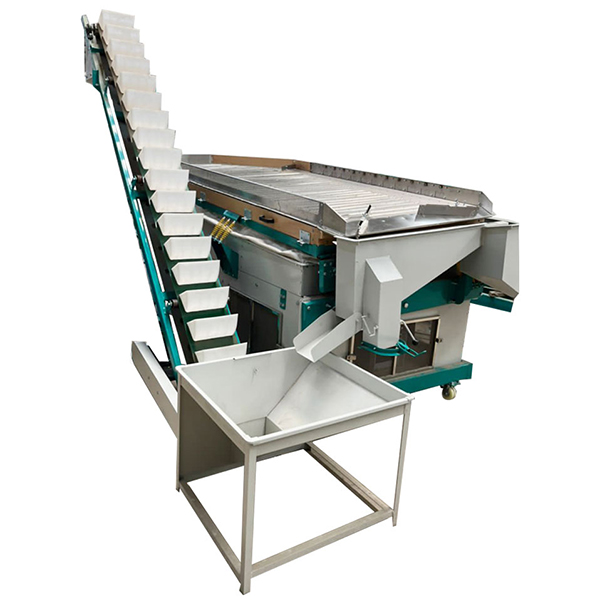
Core Functions: Density-based sorting, removal of heavy impurities, and coffee bean grading.
Removal of Hard, Heavy Impurities
Thoroughly screens out heavy contaminants—such as stones, soil clumps, metal particles, and hard fruit pits—that may be mixed in with the coffee beans; serves as the primary destoning equipment within the production line.
Density-Based Grading
Separates coffee beans by quality:
Isolates plump, solid, high-quality beans.
Eliminates hollow beans, shriveled beans, unripe beans, and insect-damaged shells.
Removes Light, Inferior Beans
Separates substandard beans that have become soft due to moisture or possess a loose texture, thereby enhancing the overall density and quality of the batch.
Pre-processing Purification
Performs preliminary physical quality screening to reduce the sorting workload on downstream color sorters, thereby boosting the overall yield of finished product.
II. Color Sorter
1. Working Principle
Based on optical recognition, AI algorithms, and high-speed pneumatic ejection, the machine performs precise sorting according to color and defects.
Feeding: Vibratory feeding → Sliding chute → Single-layer high-speed free fall.
Optical Inspection: CCD/RGB cameras combined with LED light sources capture the surface color and defects of each individual bean; an optional infrared module is available to detect mold or internal damage.
Signal Processing: AI algorithms perform real-time comparisons against standard templates to identify and flag defects such as discoloration, mold spots, black beans, scorched beans, unhulled beans, and insect damage.
Precise Ejection: High-speed electromagnetic valves (ejection nozzles) emit millisecond-duration air pulses to blow defective items into the reject bin, while quality beans fall directly into the finished product bin.. Process Flow (Within the Production Line)
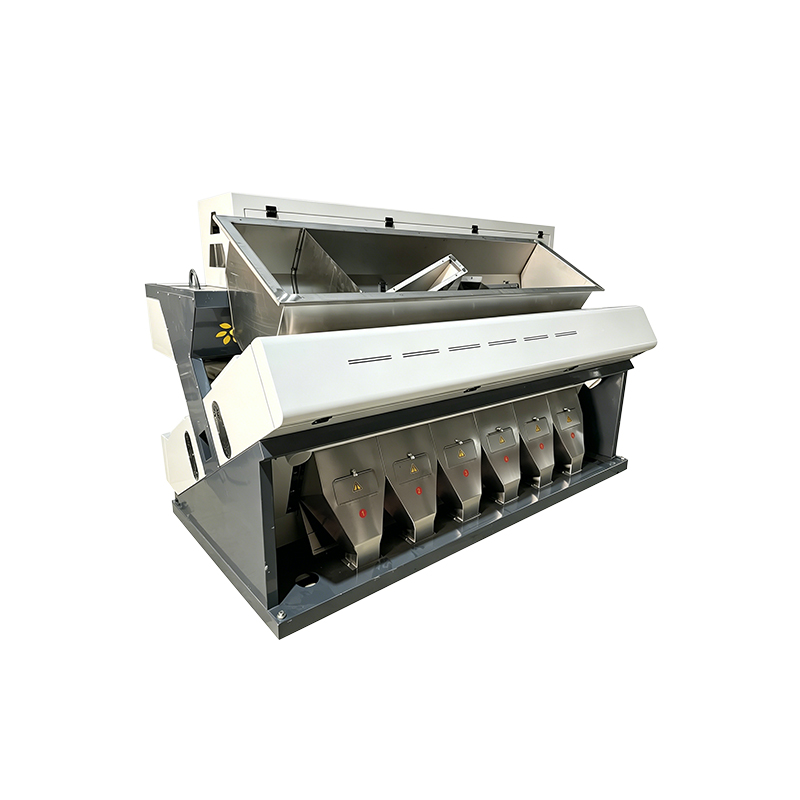
Pre-processing:Gravity Separator (isolating high-density, high-quality beans) → Bucket Elevator → Color Sorter Hopper.
Feeding: Vibratory Feeder (uniformly dispersing beans to form a single-layer, single-file stream, preventing overlap).
Detection:High-speed Cameras (scanning each individual bean; AI analyzes color and defects).
Sorting:
Good Product:Normal color, free of defects → Discharged to Finished Product Outlet.
Defective Product: Moldy beans, black beans, scorched/burnt beans, insect-damaged beans, discolored beans → Ejected via air jets to the Waste Outlet.
Impurities:Stones, metal fragments, plant stalks → Ejected simultaneously.
Post-processing: Premium beans (post-sorting) → Polishing / Packaging; Defective beans may be downgraded for alternative use.
3. Core Functions: Precisely remove discolored and defective beans based on color and visual imperfections.
Eliminate Discolored and Imperfect Beans
Precisely screen out black beans, scorched beans, reddish beans, greenish (unripe) beans, and spotted beans.
Remove Spoiled and Harmful Beans
Sort out moldy beans, insect-damaged beans, beans with disease spots, and fermented/spoiled beans to ensure food safety.
Clear Residual Impurities
Remove incompletely hulled beans (residual parchment), shell fragments, discolored broken beans, and miscellaneous foreign beans.
Refined Grading of Finished Product
Complete the final stage of premium selection, classifying beans into commercial premium grade, Grade 1, and defective grades, thereby directly meeting export or roasting standards.
Post time: May-21-2026