
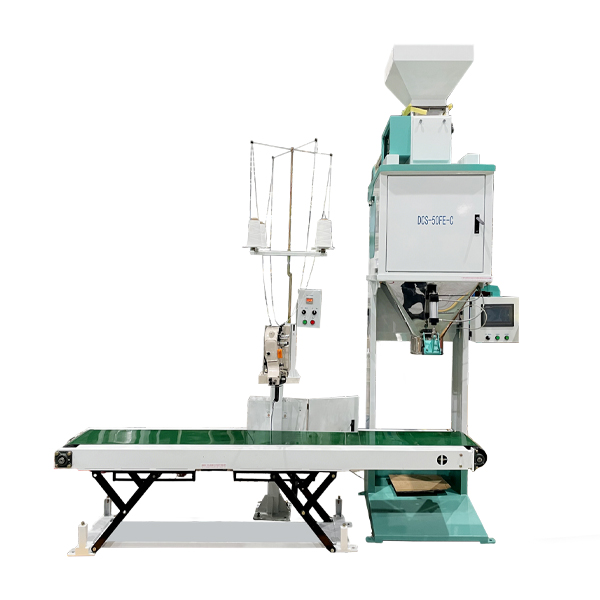
Automatic packaging scales (also commonly referred to as quantitative packaging scales or bagging scales) are typically positioned as the final stage in a grain and legume cleaning and processing line. Their primary function is to automatically weigh, bag, and seal grain that has been thoroughly cleaned and graded to meet quality standards, thereby automating the transition from bulk material to finished, bagged products. As such, they constitute a critical piece of equipment for grain processing, storage, and trade-related shipments.
I. Key Functions
Precise Quantitative Weighing
Automatically weighs grain according to a preset target weight (e.g., 25 kg or 50 kg per bag), ensuring weight consistency across every bag while minimizing error to meet the strict standards required for trade settlement and vehicle loading.
Automated Bagging and Sealing
Automatically grips, fills, and releases bags; working in conjunction with a bag-sewing machine to complete the sealing process, this significantly reduces manual labor requirements and boosts packaging efficiency.
Handling Post-Cleaning Finished Products
Receives clean grains and legumes that have undergone various processing stages—including cleaning, destoning, gravity separation, and polishing—thereby preventing secondary contamination of the finished product.
Measurement and Data Statistics
Capable of accumulating data on the total number of bags and the aggregate weight, facilitating production statistics, inventory management, and shipment reconciliation.
Enhancing Overall Line Efficiency
Operates in seamless coordination with upstream cleaning equipment to establish a continuous production workflow—encompassing “cleaning → conveying → packaging”—making it an ideal solution for large-scale processing facilities.

II. Typical Workflow
The entire process is divided into several steps: Feeding → Coarse Weighing → Fine Weighing → Discharge → Bag Clamping → Bag Release → Bag Sewing.
1. Material Preparation
Cleaned and qualified grains or beans are conveyed by an elevator into the storage hopper located above the packaging scale, ensuring a stable material level.
2. Automatic Bag Clamping
Bags are manually or automatically fitted onto the spout; upon sensing the presence of a bag, the clamping device automatically secures it to prevent material leakage during discharge.
3. Rapid Weighing (Coarse Weighing Stage)
The large discharge gate beneath the weighing hopper opens, allowing grain to flow rapidly into the hopper. Once the weight reaches 90%–95% of the target weight, the large gate closes.
4. Precise Supplementation (Fine Weighing Stage)
The small discharge gate opens slightly to provide a fine feed supplement. The control system monitors the weight in real-time and closes the gate immediately once the preset target value is reached, ensuring high accuracy.
5. Discharge into Bag
The bottom gate of the weighing hopper opens, allowing the grain to fall into the packaging bag, thereby completing one cycle of quantitative filling.
6. Bag Release and Conveyance
The bag clamping device releases the bag; the filled bag drops onto the conveyor belt and is transported toward the bag-sewing machine.
7. Automatic Bag Sewing and Output
The bag-sewing machine automatically stitches the bag opening. The finished bag is then conveyed out by the conveyor belt, completing the entire packaging process.
Cycle Restart
The system resets and awaits the next bag placement, repeating the aforementioned workflow to operate continuously.
III. Applicable Scenarios
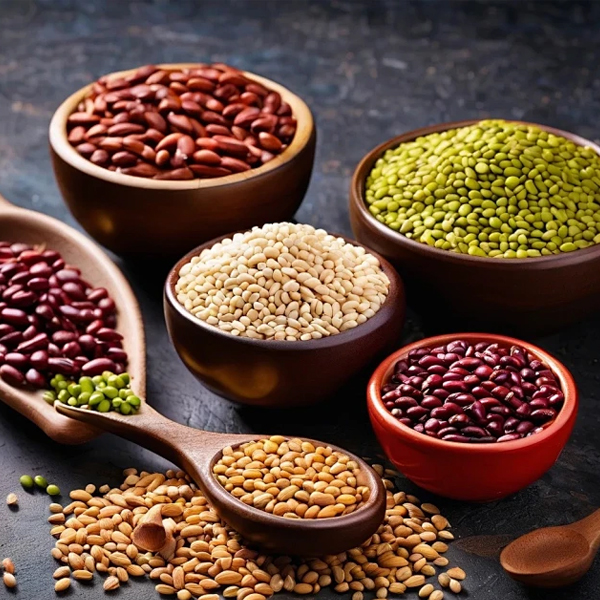
Packaging of cleaned legumes (such as mung beans, soybeans, black beans, chickpeas, pinto beans, etc.)
Packaging of finished grain products (such as wheat, corn, paddy rice, sesame seeds, etc.)
Standardized packaging for grain storage facilities, processing plants, and pre-export trade operations
For automatic packaging scales (quantitative scales) designed for granular commodities such as grains and legumes, accuracy is typically specified in terms of relative error percentage (%) or absolute error (g/kg); both industry-specific and national standards define clear ranges for these parameters.
Common Industry Accuracy Ranges (Specific to Grains / Granular Materials)
Standard Accuracy (Dynamic): ±0.2% ~ ±0.5%
This represents the most common configuration for grain processing plants and storage facilities, satisfying general requirements for production, warehousing, and domestic trade.
50 kg / bag: Error margin of approximately ±100 g ~ ±250 g
25 kg / bag: Error margin of approximately ±50 g ~ ±125 g
High-Precision Type (Dynamic): ±0.1% ~ ±0.2%
Utilizing a dual-hopper design, servo control systems, and digital sensors, this configuration is intended for export trade, seed packaging, and high-value legumes (e.g., mung beans, adzuki beans, chickpeas).
50 kg / bag: Error margin controllable within ±50 g ~ ±100 g
25 kg / bag: Error margin of approximately ±25 g ~ ±50 g
Static Calibration Accuracy: ≤ ±0.1%
This represents the theoretical accuracy of the equipment when calibrated in a stationary state; actual accuracy during dynamic packaging operations will be slightly lower.
Post time: Apr-21-2026