
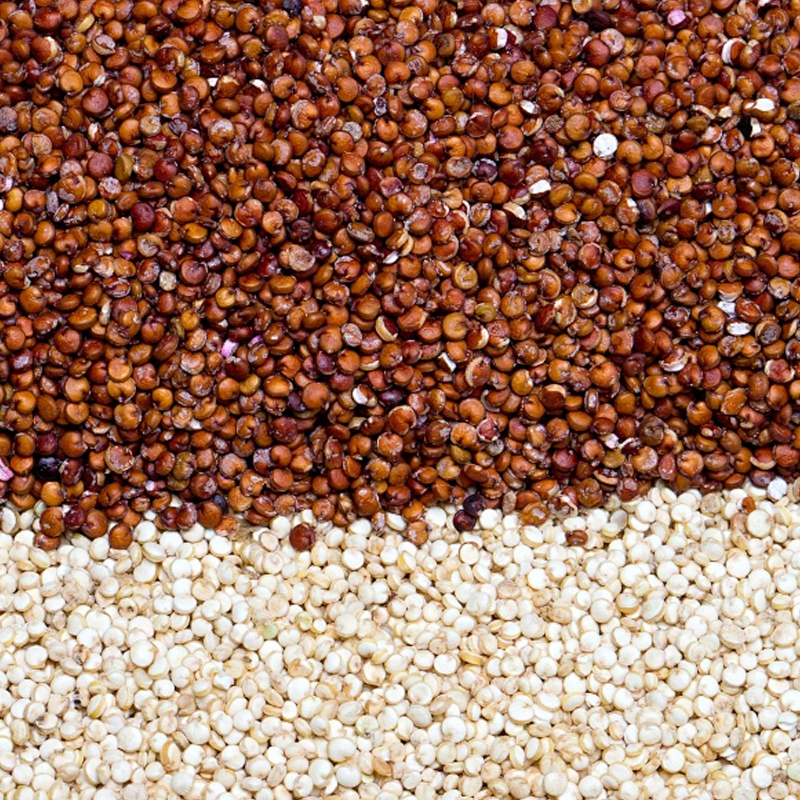
Peru is the world’s largest producer of quinoa, with an output of 92,000 tons in 2024, accounting for approximately 67% of the total production in Latin America and the Caribbean. Here are the specific details of its quinoa cultivation:
Planting Area: According to statistics released by the Food and Agriculture Organization of the United Nations (FAO) in 2024, Peru’s quinoa planting area reached 131,000 hectares in 2023, accounting for 55.3% of the global total, making it the country with the largest quinoa planting area globally.
Main Production Areas: Approximately 70% of Peru’s quinoa is produced by small family farms in the Andes Mountains. Major producing areas include Puno, Ayacucho, Junin, Aprimac, and Cusco, regions with high altitudes and cool climates suitable for quinoa growth.
Cultivation Patterns: Peruvian quinoa cultivation is primarily based on small-scale, scattered farming, with an average plot size of less than 2 hectares. While this model preserves traditional quinoa cultivation methods, it also limits the development of large-scale and mechanized farming to some extent.
Production and Yield: In 2023, Peru’s quinoa production was approximately 102,000 tons, accounting for 54.8% of global production, maintaining its leading position worldwide. However, the yield per unit area was approximately 0.78 tons/hectare, slightly lower than Bolivia. This is mainly attributed to the poor soil and insufficient irrigation facilities in some areas of the Peruvian highlands.
Industry Development: Peru’s quinoa industry not only plays a significant role in production but also maintains a strong domestic consumption base. In 2024, Peru’s quinoa consumption reached 47,000 tons, accounting for approximately 69% of total consumption in Latin America and the Caribbean. Simultaneously, Peru has strengthened its product premium through an organic certification system, enhancing the competitiveness of quinoa in the international market.
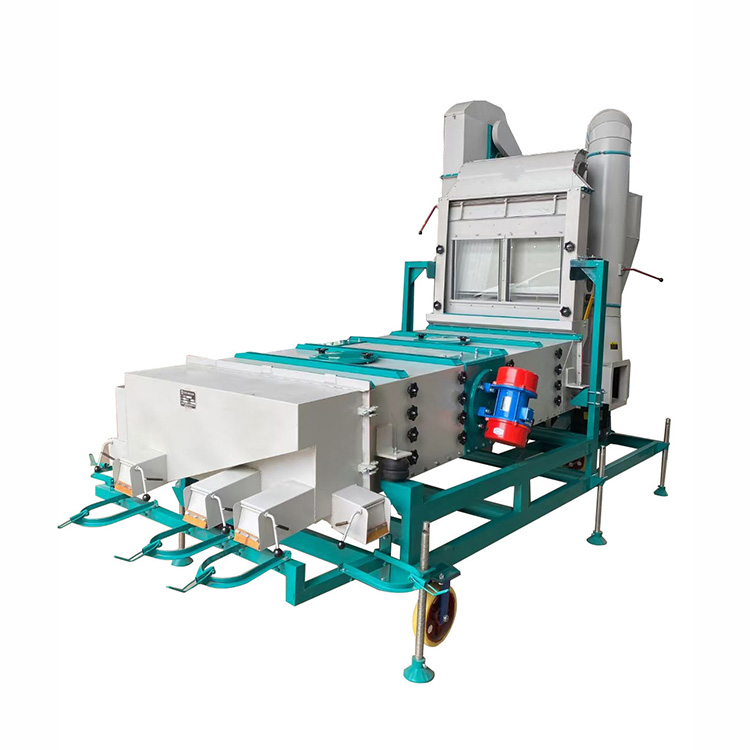
The core principle of the air-screen cleaning machine for removing impurities from quinoa is the combination of particle size separation by vibrating screening and specific gravity separation by air separation. This dual mechanism works synergistically to achieve precise separation of quinoa seeds from light, large, and small impurities, adapting to the characteristics of thin quinoa seeds and diverse impurity types.
The specific working process can be divided into two key steps:
Vibrating Screening: The equipment has multiple layers of screens (usually two layers) to separate impurities by particle size. The screen aperture is customized according to the particle size of the quinoa seeds:
Upper Screen:The aperture is slightly larger than plump quinoa seeds (approximately 2.5–3 mm). Its function is to remove large impurities, such as straw fragments, large grass seeds, and clods of soil. Quinoa seeds and smaller impurities pass through the upper screen and fall onto the lower screen.
Lower Screen:The aperture is slightly smaller than plump quinoa seeds (approximately 1.8–2 mm). Its function is to remove small impurities, such as shriveled quinoa seeds, fine soil particles, and small grass seeds. Plump quinoa seeds cannot pass through the lower screen and move along the screen surface to the outlet.
The screen body uses high-frequency, low-amplitude vibration (typically 300–400 times/minute) to prevent quinoa seeds and impurities from clogging the screen holes, while accelerating the stratification and passage of materials of different particle sizes.
Air-driven sorting: Lighter impurities are separated based on their specific gravity. A fan is equipped below or to the side of the screen body to generate a controllable airflow (typically 3–5 m/s for quinoa). The airflow direction is perpendicular to or at a certain angle to the direction of material movement on the screen surface. Quinoa seeds have a higher specific gravity (approximately 1.2–1.3 g/cm³), so the airflow cannot move them and they continue to move along the screen surface, eventually entering the qualified material bin.
Lighter impurities such as husks, shriveled quinoa grains, and straw fragments have a much lower specific gravity than quinoa seeds and are blown up by the airflow into a dedicated light impurity collection channel.
The wind speed can be adjusted according to the moisture content and impurities of the quinoa to avoid blowing away plump grains with too high a wind speed or failing to effectively separate light impurities with too low a wind speed.
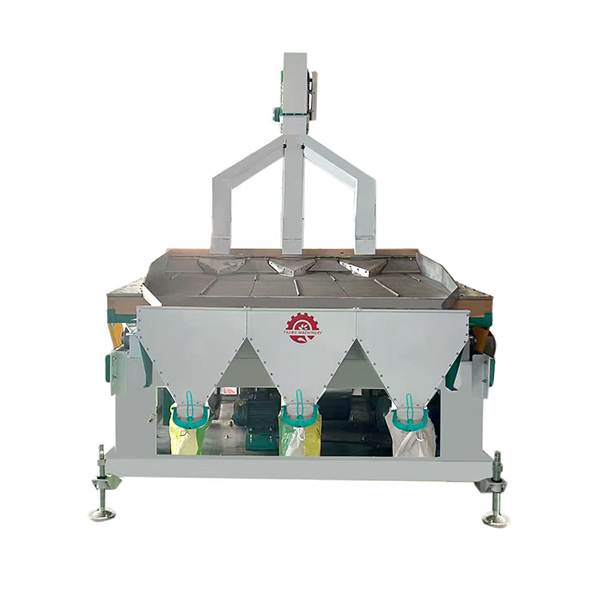
The core principle of destoning machines (mainly gravity destoning machines) for removing heavy impurities such as sand and clods from quinoa is to utilize the density difference between quinoa seeds and sand/gravel, combined with the synergistic effect of vibration and airflow, to achieve precise separation, especially for “side-by-side stones” impurities with similar particle size to quinoa (which are difficult for air-screen cleaners to remove).
Material stratification lays the foundation for separation. The mixture of quinoa seeds and sand/gravel is fed into the inclined screen of the destoning machine (the screen surface is covered with a special non-slip rough material), and the screen body vibrates at high frequency. Due to the density difference, the denser sand/gravel settles downwards under the vibration, adhering tightly to the screen surface; the less dense quinoa seeds float on top of the sand/gravel, forming a stratified structure of “quinoa on top, sand/gravel below.” This stratification is the core prerequisite for separation, preventing sand/gravel from being carried away by the quinoa seeds.
Airflow lifts and enhances the stratification effect. A fan at the bottom of the equipment blows a controlled airflow upwards, which passes through the screen openings and acts on the lower layer of material. The airflow speed is precisely adjusted (suitable for quinoa density: 1.2–1.3 g/cm³), which gently lifts the quinoa seeds, keeping them in a semi-suspended state to further increase the separation between them and the sand/gravel; however, it does not blow the quinoa seeds off the screen surface. The sand/gravel, due to its higher density, cannot be lifted by the airflow and remains firmly attached to the screen surface.
Directional conveying completes impurity separation. The screen surface is at a certain angle, and the vibration direction is coordinated with the tilt direction of the screen surface:
Quinoa seeds: In an upper semi-suspended state, under the action of vibration and material thrust, they move upwards along the screen surface and are finally discharged from the discharge port at the high end of the screen surface into the qualified material bin.
Sand/gravel: Adhering tightly to the screen surface, they slide downwards along the screen surface under the action of vibration and are discharged from the stone discharge port at the low end of the screen surface, completing impurity removal.
Post time: Dec-19-2025