
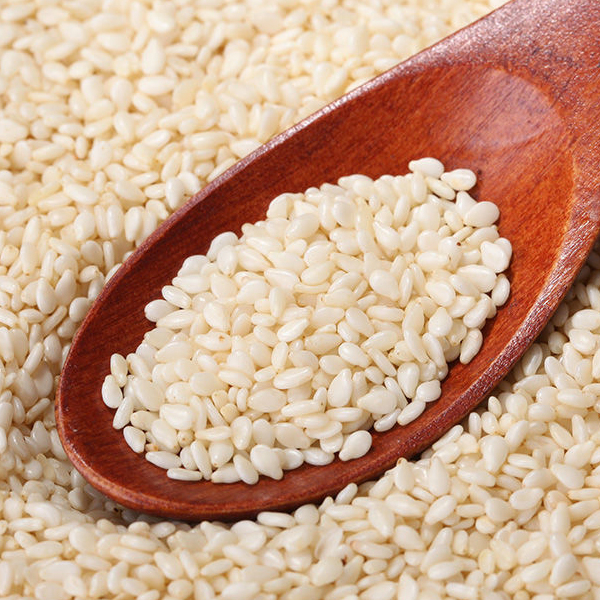
In the sesame cleaning process, the air-screen cleaner, gravity separator, and destoner serve as the core dry-cleaning impurity removal equipment. Each targets specific impurities—light/oversized/undersized debris, shriveled/moldy grains, and stones of similar size to the sesame seeds—to collectively form a comprehensive impurity removal system that spans the entire spectrum from coarse cleaning to fine cleaning.
I. Air-Screen Cleaner (Core Component for Initial Cleaning + Grading)
1. Core Functions
Air Separation: Removes light impurities from the sesame (dust, hulls, shriveled grains, grass clippings, leaf fragments, insect carcasses, etc.).
Screening: Removes oversized impurities (straw, large soil clumps, large pebbles) and undersized impurities (broken seeds, fine sand, weed seeds), while simultaneously grading the sesame seeds by size.
Positioning: As the primary workhorse in the initial stage of sesame cleaning, it removes over 60% of light, oversized, and undersized impurities, thereby reducing the processing load on subsequent equipment.
2. Working Principles
Dual separation mechanism based on aerodynamic properties and differences in geometric dimensions:
Air Separation Principle: Utilizes the difference in critical velocity between sesame seeds and light impurities. Sesame seeds are plump and dense, resulting in a high critical velocity; conversely, light impurities have a lower density and a lower critical velocity. By adjusting the airflow velocity within the vertical air chamber (typically set to 8–10 m/s for sesame), light impurities are entrained by the airflow and drawn into a dust collector, while the qualified sesame seeds pass through the air zone and fall onto the vibrating screens.
Screening Principle: Separates particles by size using a series of multi-layer vibrating screens (typically 3–4 layers). The top screen, featuring larger perforations, removes oversized impurities; the middle screen features perforations sized to match the sesame seeds, allowing the qualified seeds to pass through; and the bottom screen, with smaller perforations, removes broken seeds and fine impurities. The screen body is driven by a vibrating motor, causing the material to perform a reciprocating, bouncing motion across the screen surface, thereby enhancing screening efficiency.
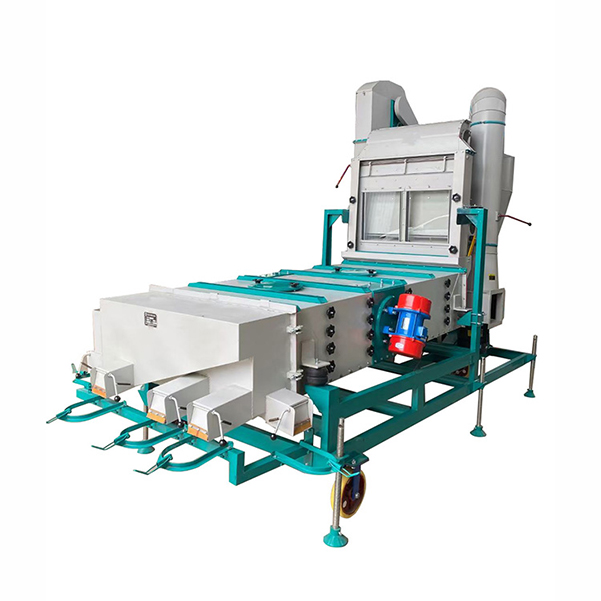
II. Gravity Separator (Core Selection: Separating Shriveled / Moldy Grains)
1. Core Function
By leveraging differences in specific gravity, this machine separates impurities that are similar in size to sesame seeds but differ in density—such as shriveled grains, empty hulls, insect-damaged grains, moldy grains, sprouted grains, and weed seeds.
Removing inferior seeds that are lighter than sesame seeds enhances the plumpness, thousand-grain weight, and purity of the sesame, serving as a critical step in ensuring the quality of the finished product.
2. Working Principle
Based on specific gravity sorting, the process relies on the combined action of vibration and airflow:
Raw materials are fed onto an inclined gravity separation deck (the screen surface features either “fish-scale” perforations or woven mesh).
The screen surface undergoes a reciprocating vibration, while an upward counter-airflow is simultaneously introduced from beneath the screen plate, creating a fluidized bed state.
Heavier, plump sesame seeds settle at the bottom of the material layer, resting directly against the screen surface; supported by the combined forces of vibration and airflow, they migrate upward along the inclined screen and are discharged through the outlet at the higher end.
Lighter impurities and shriveled grains float on the surface of the material layer; under the influence of airflow and gravity, they flow toward the lower end of the screen surface, pass over a baffle, and are discharged through the impurity outlet.
3. Standard Workflow
Feeding: Cleaned sesame seeds—having passed through the air-screen separator—are fed uniformly into the inlet end of the gravity separator.
Fluidized Separation: Under the combined action of vibration and airflow, the sesame seeds become fluidized and stratify; differences in specific gravity are thereby amplified.
Directional Movement: Plump, high-density seeds migrate upward, while light, low-density impurities migrate downward, achieving a complete separation.
Discharge:
Upper Outlet: Premium-grade sesame seeds (primary product).
Lower Outlet: Mixture of light seeds and impurities (by-products/tailings).
Parameter Fine-tuning: By adjusting the airflow volume, vibration amplitude, and tilt angle, the machine can be adapted to handle sesame seeds of various varieties and moisture levels, thereby ensuring precise separation accuracy.
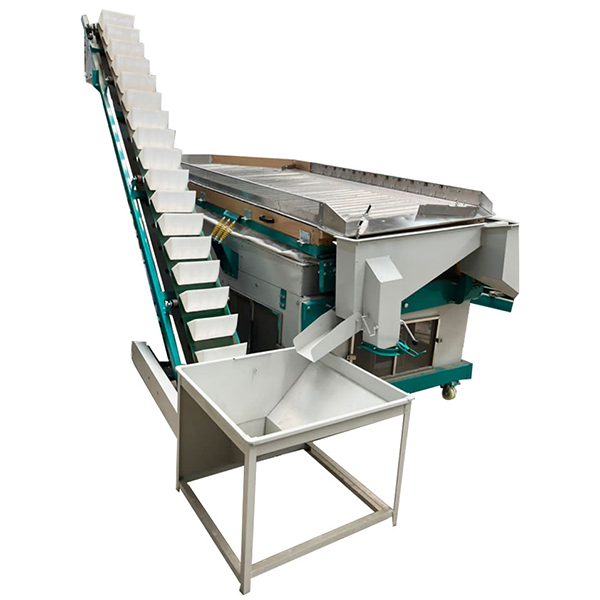
III. Destoner (Core Destoning Unit: Removal of “Companion” Stones)
1. Core Function
Specifically designed to remove heavy impurities—such as stones, clods of soil, and glass shards—that are similar in size to sesame seeds but possess a significantly higher specific gravity.
It resolves the issue of “grittiness” (the unpleasant sensation of grit when consumed) and is an essential piece of equipment for food-grade sesame processing; its destoning efficiency exceeds 98%.
2. Working Principle
Similar in principle to a specific gravity separator, but with a greater focus on separating heavy impurities, it employs a suction-type specific gravity destoning method (the industry standard):
It leverages the difference in specific gravity between sesame seeds and stones (sesame: approx. 0.8–0.9; stones: approx. 2.6).
Material is fed onto the destoning screen surface (typically a woven stainless steel mesh), which vibrates while an upward airflow is introduced.
Due to their higher specific gravity, stones sink to the bottom and remain in contact with the screen surface, moving upward along the screen to be discharged through the stone outlet.
Due to their lower specific gravity, sesame seeds remain suspended in the upper layer, flowing downward along the screen surface to be discharged through the clean material outlet.
The suction-type design prevents dust spillage and ensures that stones do not carry away any sesame seeds, thereby guaranteeing thorough destoning without any loss of usable product.
3. Standard Workflow
Feeding: Sesame seeds that have undergone preliminary specific gravity sorting are fed into the destoner.
Specific Gravity Destoning: Under the combined action of vibration and airflow, the stones and sesame seeds rapidly stratify and move in specific directions.
Separation and Discharge:
Upper Outlet: Stones and soil clods (heavy impurities).
Lower Outlet: Stone-free, clean sesame seeds (final product).
Screen Cleaning and Dust Removal: The screen surface features a self-cleaning mechanism, while a suction system collects airborne dust, ensuring the continuous and stable operation of the equipment.
Post time: Mar-23-2026