
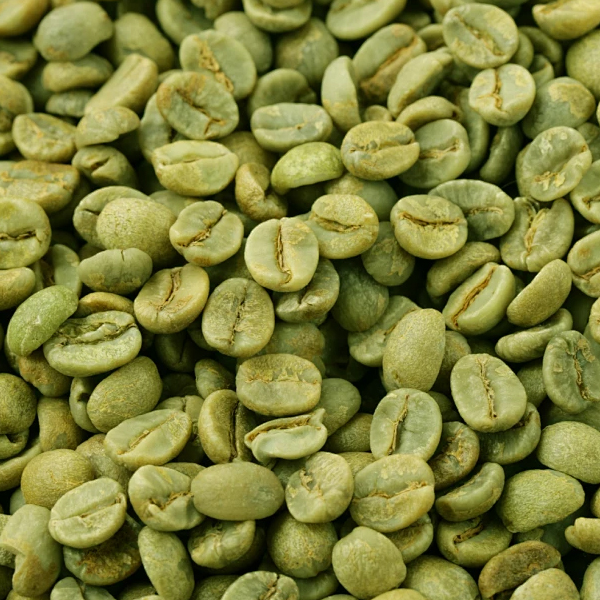
Complete Process Flow for Impurity Removal in Dry and Wet Coffee Bean Processing
I. Dry Processing (Natural sun-drying method; widely used in producing regions; involves various types of impurities such as stones, soil clumps, twigs, unripe cherries, shriveled beans, and foreign seeds)
Overall Process: Fresh cherry harvesting → Sun-drying → Hulling → Multi-stage cleaning and sorting
After harvesting, fresh cherries are spread out on drying grounds to dry naturally until the moisture content drops to 11%–12% and the pulp and skin have completely dried and hardened;
Once dried, the cherries are fed into a huller to remove the dried pulp and parchment, yielding green coffee beans still covered in silverskin;
Primary air-screen cleaning: Fans separate light impurities (dried skins, shell fragments, dust, twig debris), while multi-layer vibrating screens grade the beans by size and remove fine sand, large stones, and tiny weed seeds;
Specific gravity sorting: A gravity table separates heavy impurities—such as stones and soil clumps that are similar in size to the coffee beans—based on density differences, while also rejecting hollow or shriveled beans;
Precision sorting and grading: A drum grader removes beans of irregular lengths or shapes; an optical sorter then removes moldy, black, and unripe beans, as well as off-colored impurities;
Final manual inspection and dedusting to obtain the finished green beans.
II. Wet Processing (Washed method; yields a clean flavor profile; removes significant organic impurities early on)
Overall process: Harvesting fresh cherries → Flotation → Pulping → Fermentation & Washing → Drying wet beans → Hulling → Green bean refining & impurity removal
Fresh cherries are poured into a flotation tank; buoyancy is used for sorting: floating cherries (unripe, shriveled, or hollow fruit) rise to the surface and are separated, while mature, high-quality cherries sink; leaves, twigs, and lightweight debris are simultaneously washed away;
Sinking cherries enter the pulper, where the flesh is mechanically stripped away and the majority of pulp residue is separated;
Mucilage-coated beans are transferred to fermentation tanks to break down the pectin, followed by high-pressure water washing to remove pectin and pulp fragments;
Washed wet beans undergo mechanical drying or sun-drying; once the target moisture content is reached, they enter hulling equipment to remove the parchment layer;
Secondary green bean cleaning: air separation removes silverskin and broken hull fragments; vibrating screens grade the beans and remove fine grit/stones; gravity separators remove stones mixed in during drying; color sorters reject defective beans and off-colored particles;
Dust removal and polishing complete the processing.
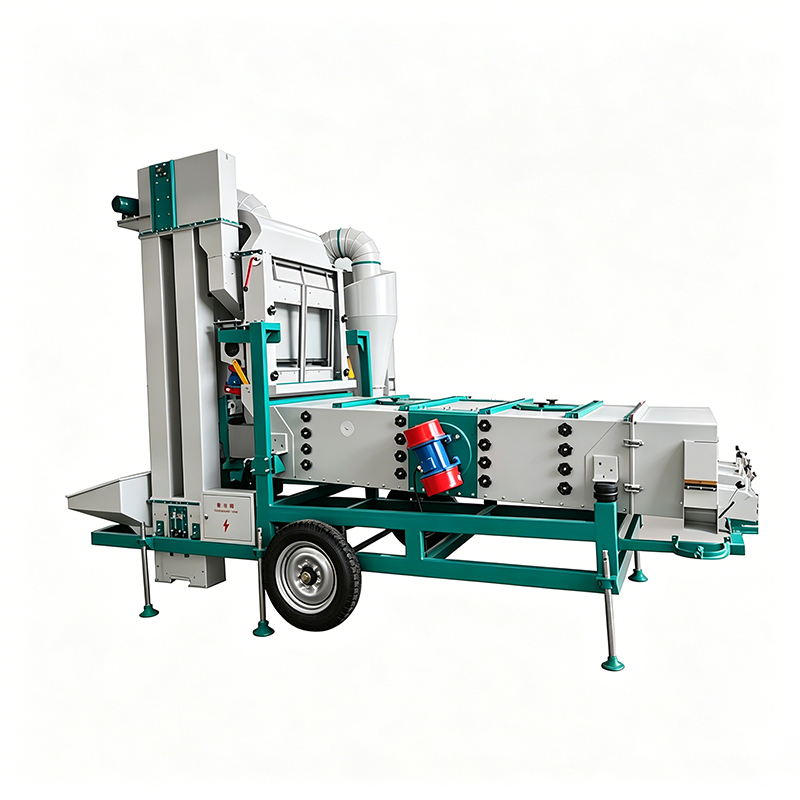
Mainstream Coffee Bean Cleaning Equipment and Operating Principles
Designed for green coffee bean cleaning lines following dry or wet hulling, the integrated system features the following equipment arranged in sequence: bucket elevator → air-screen cleaner → gravity destoner → grading screen → coffee bean polisher → color sorter, all supported by a dust collection system.
1. Bucket Elevator (Conveying Equipment)
Operating Principle: Uses a chain-driven system to circulate food-grade buckets at low speeds for bean transport; features an enclosed structure. Unlike gravity-drop lifting, this method minimizes impact from material drops, thereby reducing bean breakage. It is responsible for sequentially transferring coffee beans to each primary cleaning machine, ensuring continuous feeding.
Function: Gentle conveying and intermediate feeding; prevents bean breakage caused by free-fall impacts.
2. Air-Screen Cleaner (First Stage of Primary Cleaning)
Operating Principle: Combines vibrating screening with vertical air separation. Multi-layer stainless steel vibrating screens (with varying aperture sizes) use reciprocating motion to grade beans by size and separate large debris (twigs, large soil clumps) from fine impurities (sand, shell fragments, weed seeds). A fan generates directional airflow to suction away lightweight impurities such as silverskin, dried fruit husks, light/shriveled beans, and dust.
Function: Preliminary grading and removal of impurities with significant differences in weight and size compared to the beans; reduces the workload on downstream equipment.
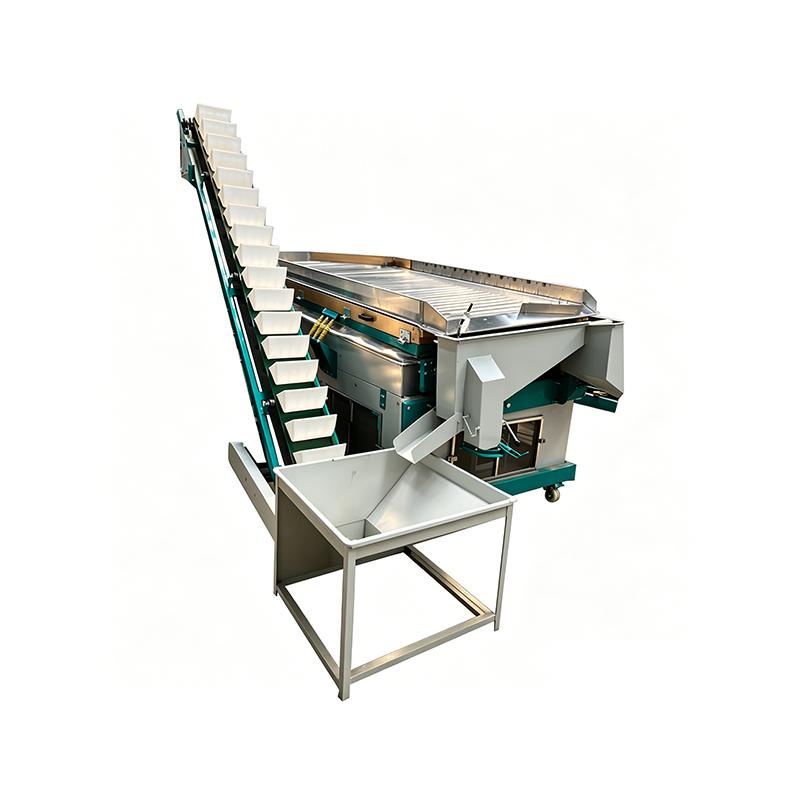
3. Gravity Destoner (Core Equipment for Removing Stones and Soil Clumps)
Operating Principle: Leverages the differences in specific gravity and suspension velocity between coffee beans and stones/grit. An inclined, perforated gravity deck vibrates reciprocally while uniform airflow is introduced from below, causing the material to fluidize and stratify. Heavier stones sink and move toward the high end for separation, while coffee beans remain suspended and flow toward the low end; this allows for the precise removal of stones and hard soil clumps that are similar in size to the coffee beans.
5. Coffee Bean Polishing Machine
Working Principle: A polishing roller rotates at low speed inside a drum, causing the coffee beans to rub gently against one another while a negative-pressure dust removal system operates. This process softly strips away residual silverskin from the bean surface; the machine’s clearance is adjustable to control friction intensity, preventing damage to the bean’s outer skin.
Function: Enhances the sheen of the bean surface and removes silverskin without damaging the integrity of the coffee beans.
6. Specialized Coffee Color Sorter (Precision Sorting for Defective Beans)
Working Principle: Coffee beans descend at a constant speed along a chute, while high-speed optical cameras capture the color and surface characteristics—such as spots or mold—of each individual bean. Upon identifying green beans, black beans, moldy beans, insect-damaged beans, or off-colored beans, the system instantly ejects the defective particles using a high-pressure air blast.
Function: The final step in precision processing, used to eliminate various types of defective beans that are difficult to distinguish quickly with the naked eye.
After undergoing dry (natural) or wet (washed) processing and hulling, raw coffee beans often contain various impurities such as stones, soil, twigs, fruit skins, silverskin, weed seeds, and irregularly shaped beans, as well as defects like unripe (green) beans, moldy beans, and insect-damaged beans. Using a comprehensive set of professional cleaning equipment to sort and remove these impurities stage-by-stage is essential for safeguarding the commercial value, roasting quality, and food safety of the green beans.
From a safety perspective, if stones or hard clumps of soil enter roasting or grinding machinery, they can easily impact or abrade drums and grinding discs, causing equipment damage and increasing maintenance costs; furthermore, hard impurities pose a risk of fire or deflagration during high-temperature roasting. Removing moldy and insect-damaged beans mitigates risks associated with harmful substances like aflatoxins, ensures compliance with international food import standards, facilitates smooth customs clearance, and reduces losses from cargo returns.
Regarding commercial value, impurities and defective beans lower the coffee’s grade. During roasting, moldy and unripe beans release pungent, off-putting odors, while scorching stones produce acrid, burnt smells; these elements ruin the coffee’s inherent fruity and nutty notes, causing flavor imbalances across the entire batch. Precision impurity removal—combined with uniform bean sizing and the elimination of defective grains—results in a consistent, high-quality appearance, significantly boosts the selling price of green beans, and makes the product more attractive to coffee roasters and brand buyers.
In terms of processing efficiency, using air-screening, gravity separation, and color-sorting equipment for initial impurity removal drastically reduces the burden on subsequent manual sorting. This minimizes inconsistencies associated with manual labor and enables standardized, continuous production. Beans that have been graded and cleaned are uniform in size, ensuring consistent heat absorption and controllable roasting color variations, which allows roasting facilities to establish standardized roasting profiles.
In the context of international trade, markets in Europe, the Americas, and Southeast Asia enforce strict limits on impurity levels in green coffee beans. A robust cleaning process keeps impurity levels within contractual limits, thereby enhancing product competitiveness. This is particularly important for natural-process beans from West Africa and Southeast Asia, which often have higher sand and stone content; an efficient impurity-removal line highlights the quality of the raw material, helping enterprises expand into overseas markets. In short, the removal of impurities from coffee beans is not merely a matter of eliminating foreign objects; it is a core process essential for ensuring production safety and food safety, stabilizing flavor profiles, enhancing product value, and meeting market access requirements for international trade.
Post time: Jul-23-2026