

Working Process and Core Functions of the Sesame Air-Screen Cleaner
I. Core Functions of the Machine (Tailored to Sesame Characteristics)
Raw sesame contains a wide variety of impurities: light impurities (dust, broken sesame bits, weed seeds, stalk fragments, empty hulls), large impurities (stones, hemp rope, bean stalks, large mud clods), small impurities (fine sand/soil, broken seeds), and immature, shriveled sesame seeds.
The air-screen cleaner utilizes a dual-separation principle—combining air classification and multi-layer screen grading—to remove various impurities in a single pass while simultaneously separating plump finished sesame, shriveled seeds, and light waste. It serves as the primary cleaning equipment for initial sesame processing, reducing the workload for subsequent gravity-based destoning and polishing stages, and enhancing sesame purity and commercial grade.
II. Complete Workflow (Feeding → Air Separation/Layering → Multi-layer Screening → Multi-channel Discharge)
1. Feeding and Material Distribution Stage
Bagged or silo-stored sesame is conveyed via a hoist into the machine’s feed hopper, which is equipped with flow-regulating baffles and buffer dispersion plates.
Function: Spreads the material into a uniform, thin layer to prevent piling or uneven thickness, ensuring stable air and screen separation; feed flow can be adjusted based on output requirements, making it suitable for processing lines of various scales.
2. Primary Pre-screening Air Separation (Pre-separation of Light Impurities)
As the material falls, a fan generates a horizontal airflow that passes through the material layer:
Very light impurities—such as dust, broken stalks, sesame hulls, and empty/shriveled seed fragments—are carried away by the airflow and collected in dust-collection bags.
Plump, heavy sesame seeds, stones, and coarse weed debris descend under gravity onto the lower screen deck.
Advantages: Removes large quantities of light, floating impurities early on, preventing screen clogging and reducing dust pollution.
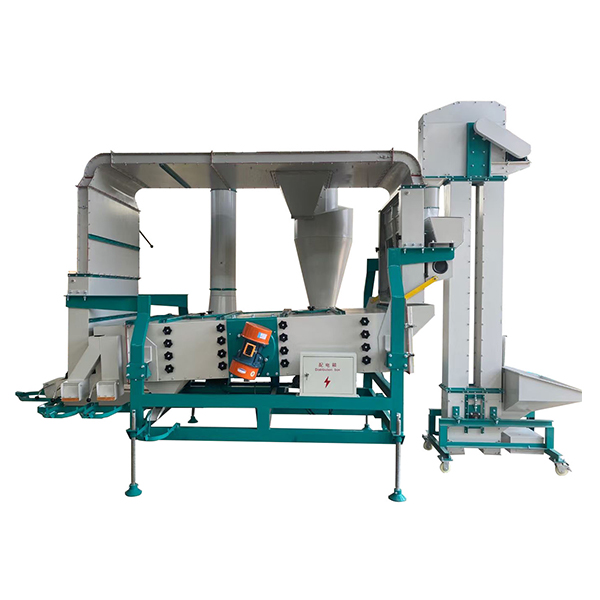
3. Multi-layer Vibrating Screen Classification (Separation by size and removal of impurities)
The equipment features three independent vibrating screen decks that utilize reciprocating eccentric motion. The mesh sizes are customized for sesame seeds, arranged from top to bottom as follows:
Top Layer: Coarse Screen (Large Aperture)
Process: Material lands on the top screen surface and slides while vibrating.
Separation: Large impurities (larger than sesame seeds)—such as soil clumps, twigs, hemp rope, corn stalks, and large stones—are discharged through the side waste outlet;
Qualified sesame seeds pass through the mesh onto the middle screen.
Middle Layer: Standard Precision Screen (Core Product Layer)
Mesh size matches the diameter of intact, plump sesame seeds; whole, high-quality seeds remain on the screen surface and are conveyed forward;
Fine broken sesame, fine sand/soil, and tiny weed seeds pass through the mesh onto the bottom screen.
Bottom Layer: Fine Screen (Small Aperture)
Retains broken sesame seeds; fine sand, dust, and debris smaller than the mesh size fall through to the bottom for collection as waste.
4. Secondary Air Separation (Combined screen-surface air separation for product purification)
Vertical air ducts are positioned beneath each screen layer, blowing air upward through the flowing layer of sesame seeds:
Dual action of vibration + upward airflow:
Shriveled seeds and lightweight, immature seeds float upward and are suctioned out via side ducts for separate collection as secondary-grade sesame;
Plump, heavy seeds stay close to the screen surface while moving forward, undergoing secondary purification to remove any remaining lightweight impurities.
5. Multi-channel Discharge
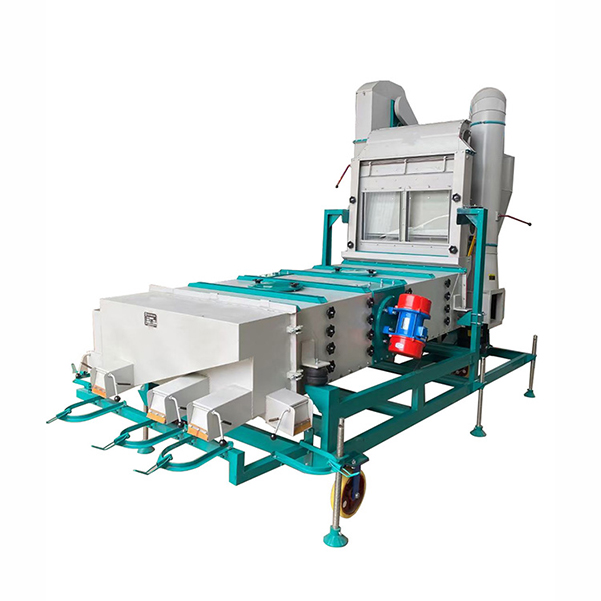
The equipment is configured with four independent discharge outlets to simultaneously separate four types of material:
Finished Product Outlet: Clean, plump, high-quality sesame seeds (conveyed to the next stage: gravity destoner);
Light/Shriveled Material Outlet: Shriveled and immature sesame seeds (can be recovered separately for oil extraction);
Large Impurity Outlet: Twigs, soil clumps, coarse stalks;
Fine Sand/Waste Outlet: Fine soil, fragments, and tiny impurities. 6. Closed-loop dust removal process
The intake air ducts at both the upstream and downstream stages are connected to pulse-jet dust filter bags, ensuring no dust escapes during the entire sorting process; collected fine sesame dust is consolidated for centralized disposal, keeping the workshop free of airborne dust.
III. Summary of Module-Specific Functions
Airflow System
Utilizes differences in material specific gravity to stratify and separate light husks, shriveled seeds, and dust; overcomes the limitations of screens that sort solely by size.
Multi-layer Vibrating Screens
Grades material based on particle size, removing large impurities, fine sand, and broken seeds to isolate high-quality, uniform sesame seeds.
Vibration Drive Mechanism
Drives the screen surface to vibrate reciprocally, preventing sesame seeds from clumping and clogging the mesh; ensures steady forward material flow and enhances screening efficiency.
Material Leveling & Buffer Structure
Stabilizes the material layer thickness to ensure uniform airflow and screening, preventing poor separation caused by excessive feeding.
Multi-channel Discharge
Separately collects impurities, finished product, and secondary material; eliminates the need for manual re-sorting and enables automated, continuous production.
IV. Unique Advantages for Sesame Cleaning
Sesame seeds are small and lightweight; the dual-direction (up-and-down) airflow design prevents the loss of finished seeds into the exhaust stream.
Interchangeable multi-layer screens accommodate varying particle sizes of white, black, and oil-grade sesame seeds.
Pre-removal of stalks and soil significantly reduces clogging and wear on the screen plates of downstream gravity separators.
Combines four cleaning steps—dust removal, large impurity removal, fine sand removal, and shriveled seed separation—into a single process, replacing multiple manual screening stages with one machine.
Post time: Jul-02-2026