
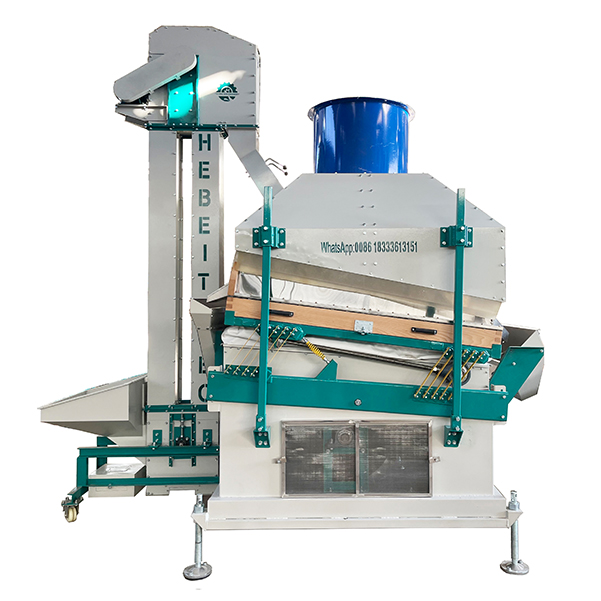
Pigeon Pea and Sesame Destoner: Function + Principle
I. Core Function
Specifically designed to address the presence of stones, grit, and heavy soil clumps within these two types of materials—contaminants that are difficult to remove via standard sieving or air classification due to their similar particle size—this machine utilizes differences in specific gravity to achieve precise separation. This ensures the purity of the finished product while simultaneously reducing wear and tear on downstream color sorting and polishing equipment.
General Function
To eliminate heavy impurities of a similar size, thereby reducing the stone content and safeguarding both subsequent processing operations and food safety.
Specific Functions
For Pigeon Peas: Removes stones and coarse sand mixed in with the beans, preventing the kernels from being cracked by hard objects and protecting the equipment’s sieve plates from damage.
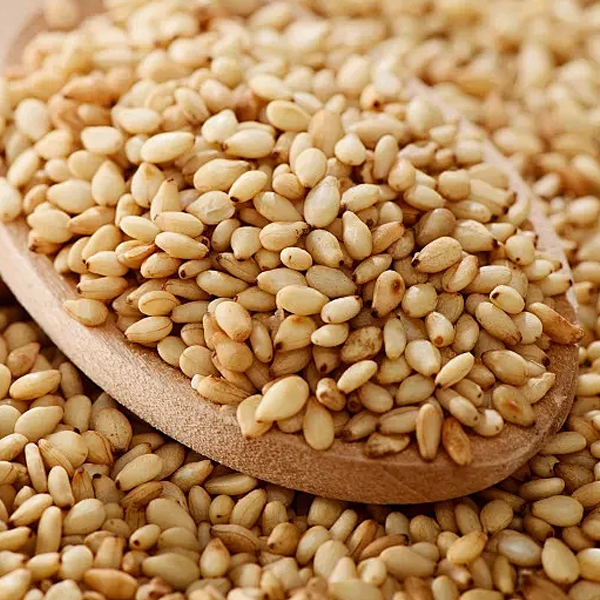
For Sesame: Separates fine stones and grit, preventing hard particles from scratching the sesame seeds’ outer skins—which can lead to oil leakage and breakage—while also minimizing the generation of airborne dust.
II. General Operating Principles
Both material types utilize a suction-type specific gravity destoner. Its core operation relies on the synergistic interaction of three forces: the reciprocating vibration of the sieve body, an upward-penetrating airflow from beneath, and the difference in specific gravity (or suspension velocity) between the material and the stones. This combination creates a “counter-current separation” effect, wherein the material flows downward along the sieve surface while the stones “climb” upward against it.
The material is spread evenly across the inclined, scale-patterned sieve surface;
A fan generates an upward airflow that penetrates the sieve perforations, loosening the material layer and inducing a fluidized state;
Normal material—possessing a lower specific gravity—is lifted by the airflow and flows downward, driven by the combined effects of the sieve’s incline and vibration;
Heavier impurities—such as stones and grit—cannot be lifted; they remain in close contact with the sieve plate and, under the influence of vibration, move in the opposite direction (upward), eventually being discharged through the stone outlet;
The upper “fine-selection zone” is supplemented by a gentle counter-flow of air, which blows any finished product inadvertently entrained within the stones back onto the main sieve surface, thereby minimizing product loss.

III. Material-Specific Variations: Detailed Principles (Key Differences)
(I) Pigeon Peas: Destoning Principles
Material Characteristics: Large grain size, high individual weight, high density, low suspension capability, and hard texture.
Dominant Forces: Vibration is the primary driver; airflow serves as an auxiliary aid.
The airflow serves solely to loosen the material layer; it does not generate sufficient lift to suspend the peas. Separation and movement are driven primarily by high-frequency vibration.
Material Layer Stratification:
The material layer is relatively thick and dense overall. The peas concentrate in the upper layer and slide downward along the sieve surface, while the stones sink to the bottom, remaining in close contact with the sieve plate, and utilize large-amplitude vibrations to generate the momentum required to “climb” upward.
Airflow Logic (Moderate Wind Speed):
Wind speed ranges from 1.8 to 2.5 m/s, providing ample air pressure. Its function is to create a buffer between the material and the sieve surface—preventing the peas and stones from becoming intermingled—without blowing the peas away, as the weight of the peas significantly exceeds the force of the airflow.
Sieve Surface Incline (8°–10°):
The incline angle is set relatively steep; this utilizes the gravitational component to accelerate the downward flow of the material, thereby accommodating high-capacity processing requirements. **Refining Zone Supplementary Airflow**
The reverse airflow volume is moderate; it can easily blow beans adhering to stones back into the material bed, resulting in effective material recovery.
(II) Sesame: Destoning Principle
Material Characteristics: Fine particles, lightweight, low density, highly prone to suspension, and possessing fragile skins that are easily damaged, leading to oil release.
Primary vs. Secondary Forces: Airflow is the primary force; vibration is the secondary force.
It relies on a gentle airflow to lift the entire layer of sesame seeds into a semi-suspended, fluidized state, thereby achieving stratification. Vibration serves merely as an auxiliary guide and must not be excessive.
Material Bed Stratification
The material bed is thin and loose, with the sesame seeds suspended in the airflow and flowing slowly. The stones, being heavier, cannot be lifted; instead, they remain firmly pressed against the screen surface and move upward.
Airflow Logic (Low Air Velocity)
Air velocity ranges from 1.2 to 1.8 m/s—an extremely narrow operational window. If the velocity is too low, the sesame seeds will sink to the bottom and mix with the stones; if the velocity is too high, the sesame seeds will be carried away by the airflow, resulting in significant material loss.
Screen Surface Inclination (6°–8°)
The inclination angle is kept relatively shallow to slow down the downward movement of the sesame seeds and extend their residence time. This ensures that the stones have sufficient time to settle and separate, thereby enhancing the precision of the separation process.
Vibration Logic
Micro-amplitude vibration (featuring a smaller displacement) is employed for two reasons: First, to prevent the sesame seeds from colliding with one another, which could damage their skins and cause oil release; second, to avoid disrupting the suspended material bed, thereby preventing stones from becoming entrained in the flow of sesame seeds.
Refining Zone Supplementary Airflow
Only an extremely gentle reverse airflow is applied; a strong airflow would directly blow the sesame seeds out through the stone discharge outlet. Consequently, material recovery in this zone relies primarily on the assistance of low-amplitude vibration.
Post time: May-26-2026