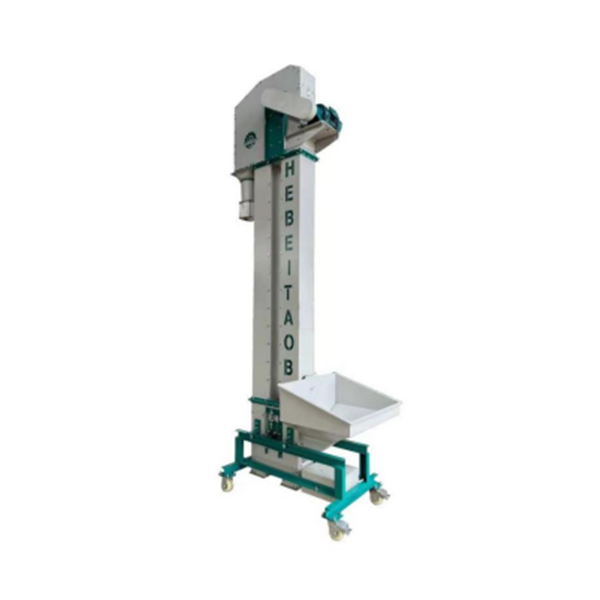
Grain and bean elevators are material handling equipment specifically designed for vertical or inclined conveying of grains and beans. They are core connecting devices in grain and bean cleaning, processing, and storage production lines. Their design must be fully adapted to the characteristics of grain and bean particles, such as morphology, density, and fragility, to avoid material damage and loss.
Although the elevator does not directly participate in the “cleaning” operations of grains and beans (such as destoning, air screening, magnetic separation, etc.), it is the “logistics core” and “connecting hub” of the grain and bean cleaning production line. Without the elevator, various cleaning equipment cannot form a continuous operation process, and the cleaning efficiency, automation level and operation stability will drop significantly. Its importance runs through the entire cleaning process and it is an irreplaceable auxiliary core equipment.
I. Serial Cleaning Process: The Foundation for Continuous Operation The cleaning of grains and legumes involves multiple processes (e.g., primary cleaning → destoning → air screening → magnetic separation → grading). Each process corresponds to different equipment (primary screen → destoner → air screening → magnetic separator → grading screen). These devices are typically designed in a top-down or segmented layout (e.g., the destoner’s inlet is higher than the air screening machine’s outlet). The core function of the elevator is to vertically/horizontally transfer materials, accurately conveying the output of the previous cleaning device to the inlet of the next device, forming a closed-loop process.
For example (using a Turkish chickpea cleaning line): Harvested chickpeas (containing soil, stones, and other impurities) first enter a primary cleaning screen (to remove large impurities); After primary cleaning, the chickpeas are conveyed by an elevator (mainly a bucket elevator) to a destoner (to remove stones and other heavy impurities); After destonerization, the chickpeas are then conveyed by an elevator to an air screen cleaner (to separate light impurities and immature particles); Finally, the cleaned chickpeas are conveyed by an elevator to a storage silo or packaging equipment.
Without an elevator, materials must be manually moved to connect the various machines, which not only prevents continuous operation (the hourly processing capacity drops drastically from tens of tons to just a few tons), but also increases labor costs and material losses (such as chickpeas falling and breaking).
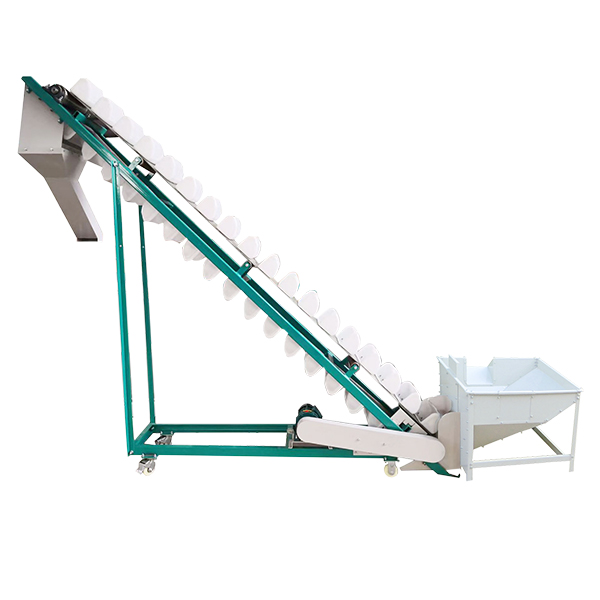
Hopper Design:
For large, fragile beans (chickpeas, broad beans): Shallow hoppers with small capacity, large spacing, and low operating speed (≤1.5m/s) are used to reduce material breakage during lifting and unloading.
For medium-sized, high-density beans (soybeans, black beans): Deep hoppers with large capacity, small spacing, and moderate speed (1.5-2.0m/s) are used for higher lifting efficiency and to prevent material backflow.
For small beans (mung beans, red beans): Pointed-angle hoppers with leak-proof baffles are used to prevent small particles from falling through the hopper gaps.
II. An “Invisible Support” for Ensuring Cleaning Quality: Adapting to Different Crop Characteristics Grains and legumes (chickpeas, soybeans, mung beans, etc.) have significantly different physical characteristics (e.g., chickpeas are large and have a brittle skin, while soybeans are uniform in size and have a high density). During cleaning, it’s crucial to avoid material breakage and clumping. High-quality elevators, through their adaptive design, reduce material damage, indirectly ensuring the effectiveness of subsequent cleaning equipment.
III. Adapting to Different Regional Planting Scales and Flexibly Matching Production Capacity Needs The scale of grain and legume planting varies greatly across different countries/regions (e.g., large-scale chickpea planting in India and Turkey, large-scale soybean planting in northern China, and small-scale mung bean planting in Southeast Asia). The production capacity requirements for cleaning equipment range from “small (1-5 tons/hour)” to “large (50-100 tons/hour)”. Elevators, through model and power adjustments, can adapt to cleaning lines with different capacities, which is key to achieving “large-scale cleaning”.
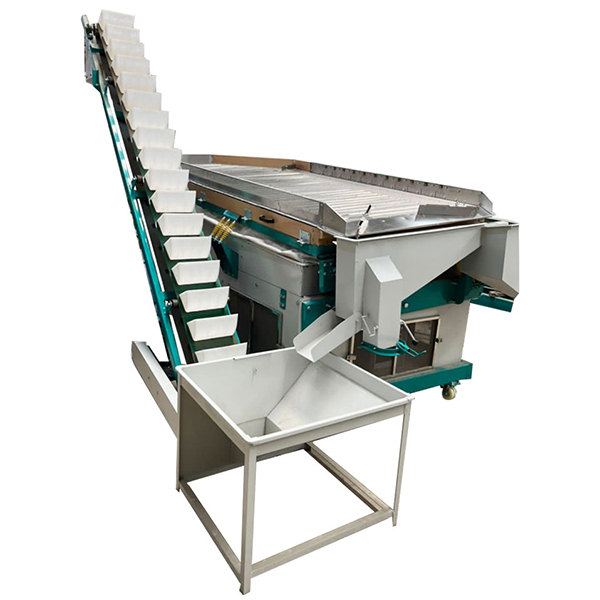
IV. Reducing Energy Consumption and Losses to Enhance the “Economic Efficiency” of the Cleaning Process One of the core goals of grain and bean cleaning is “cost reduction and efficiency improvement” (reducing material loss and energy consumption). Although bucket elevators are auxiliary equipment, their impact on economic efficiency is significant:
Reduced Energy Consumption: Compared to manual handling or other transfer methods (such as screw conveyors), bucket elevators consume less energy (only 60% of the energy consumed by a screw conveyor per ton of material transported), making them particularly suitable for large-scale cleaning lines (operating for more than 10 hours per day), resulting in substantial long-term electricity savings;
Reduced Material Losses: The “sealed design” of high-quality bucket elevators prevents material dust (such as the flying of small particles of soybeans and mung beans), and the “flexible buckets” reduce material breakage, typically keeping the material loss rate in the cleaning process below 0.5% (compared to 3-5% without a bucket elevator);
Reduced Labor Costs: One medium-sized bucket elevator can replace 3-5 manual handlers. For large-scale cleaning lines (such as a Turkish chickpea processing plant), this can save hundreds of thousands of yuan in labor costs annually.
V. The “Core Hub” for Ensuring Automation and Intelligence in the Cleaning Line Modern grain and legume cleaning lines (especially export-grade processing plants) are increasingly emphasizing automation and intelligence (such as monitoring the operation of each piece of equipment through a PLC control system). The elevator is the key link to achieve “full-process automation” – by linking with the control system, the elevator can automatically adjust its speed and feed rate according to the feeding needs of subsequent cleaning equipment, avoiding equipment “overload” or “material shortage”.
Post time: Dec-08-2025