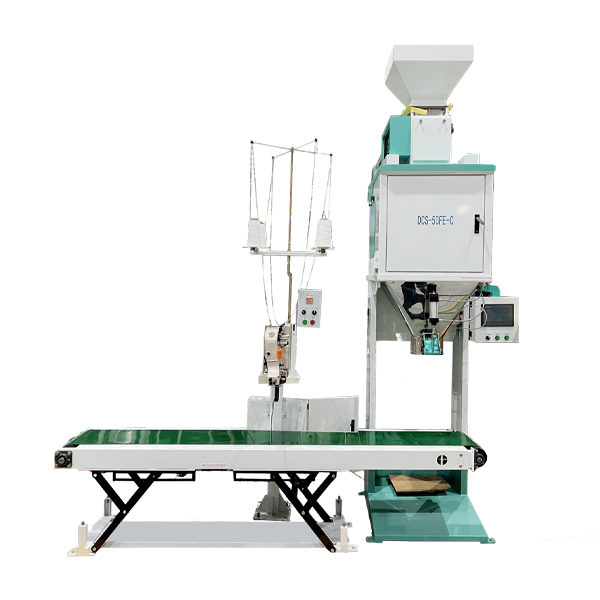
In the entire grain and bean cleaning and processing line, the automatic packaging scale is the core automated equipment that completes finished product measurement, quantitative filling, and finalizes the subsequent warehousing/logistics. It connects the finished product discharge and warehousing/transportation stages of the cleaning section. While not the cleaning equipment itself, it is a crucial supporting device for achieving standardized and large-scale production of grain and bean products, and is an essential finishing unit of the cleaning and processing line. It is suitable for packaging various grain and bean products such as wheat, corn, soybeans, chickpeas, and sesame.
The core working principle of the automatic packaging scale is to accurately collect material weight signals through sensors, combined with an electronic control system to achieve graded feeding control of “coarse feeding + fine feeding,” completing quantitative weighing and automatic discharging and filling. The entire operation revolves around four core cycles: feeding, weighing, unloading, and resetting. Simultaneously, it incorporates a structure design adapted to the particle characteristics of grains and beans, including dust prevention, anti-sticking, and anti-impact features, ensuring measurement accuracy and operational continuity.
Its workflow is a closed-loop automated control, starting from manual bagging (or fully automatic bagging) to the completion of quantitative filling. A single machine can achieve integrated operation of “weight detection – precise feeding – automatic unloading”. The core principle is the same for different models (such as granule-specific and powder-specific), with only the feeding and unloading structures being adapted. The following is a detailed working principle and step-by-step process of the automatic packaging scale for grain and bean granules, which is also the general principle of industrial-grade equipment:

I. Core Components (Hardware Foundation for Principle Implementation)
All actions are controlled by a unified instruction system (PLC/microcontroller). The core components are indispensable and are specifically adapted for the characteristics of grain and bean granules:
Feeding Unit: Buffer hopper (temporarily stores the cleaned finished product, stabilizing the material flow) + Graded feeding mechanism (large-diameter belt/vibration feeder for coarse feeding, small-diameter screw/fine-adjustment vibration feeder for fine feeding, adapted to the flow characteristics of beans/sesame);
Weighing Unit: Weighing hopper (receives material) + High-precision weighing sensor (strain gauge/pressure type, core component, converts weight into electrical signal with an accuracy of 0.01%, suitable for quantitative requirements of grains and beans) + weighing bracket (suspended design to avoid signal interference from external vibrations);
Unloading unit: unloading gate/scraper (granule-specific, prevents material jamming) + bag clamping mechanism (clamps packaging bags to prevent leakage and dust during filling, suitable for woven bags/paper bags);
Electrical control unit: PLC main control + touch screen (parameter setting) + relays/solenoid valves (action execution) + photoelectric switches (detects whether the bag is properly positioned);
Auxiliary units: dust cover, material flow stabilizer (prevents weight errors caused by grain and bean slugging), and shock-absorbing pads (isolate production line vibrations).
Its core functions revolve around quantitative, efficient, standardized, and automated processes, specifically reflected in multiple dimensions throughout the entire processing flow. It adapts to the needs of bagged (woven bags, paper bags) and some smaller packaged grain and bean products, serving as a core piece of equipment in industrial-grade processing lines to replace manual weighing and packaging:
1. Precise Quantification, Controlling Finished Product Specifications: As bulk commodities, grains and beans require standardized packaging with fixed weights (e.g., 25kg/bag, 50kg/bag, 1kg/small bag) during factory production, storage, and trade. Automatic packaging scales achieve high-precision measurement (error typically ≤ ±0.1%~0.5%) through sensors and a feeding control system (coarse feeding + fine feeding), far superior to the error of manual weighing. This meets industry trade weight compliance requirements and avoids raw material losses or customer disputes caused by weight deviations. It is suitable for precise measurement of small particles such as sesame seeds and beans, as well as large grains such as corn and wheat.
2. Improved Packaging Efficiency, Adapted to Large-Scale Processing: Grain and bean cleaning lines are mostly continuous operations. Automatic packaging scales can be linked with upstream cleaning equipment (air screen cleaners, gravity separators, etc.) to achieve continuous quantitative filling. A single unit can achieve a packaging efficiency of tens to hundreds of bags per hour, perfectly matching the finished product output speed of industrial-grade cleaning lines. This solves the problems of low efficiency and inability to connect with continuous production caused by manual weighing and packaging, and avoids downtime of upstream equipment due to packaging bottlenecks.

3. Automated Operation, Reduced Labor Costs and Human Error: The equipment can automatically feed, weigh, and fill materials. Some models can be equipped with automatic bag sewing/conveyor, requiring only a small amount of manual assistance for bagging and inspection, significantly reducing the manual input for weighing and packaging. It also avoids human errors such as laziness, misjudgment, and omissions during manual weighing, ensuring the consistency of the weight of each bag of finished product, making it especially suitable for large-scale grain and bean processing enterprises.
4. Seamless Integration for a Closed-Loop Processing Flow
In the grain and legume cleaning and processing line, after the air-screen cleaner and gravity separator complete the core cleaning tasks of impurity removal and grading, the finished product enters the automatic packaging scale via conveyor equipment. After quantitative filling, the finished product can be directly connected to the subsequent automatic bag sewing machine, palletizer, and conveyor line, achieving a fully automated closed loop of **”cleaning – metering – packaging – palletizing – warehousing”**, improving the production continuity and intelligence level of the entire line, and reducing manual transfers at each stage.
5. Adaptable to Different Working Conditions, Meeting Diverse Packaging Needs of Grains and Legumes
Considering the particle characteristics of grains and legumes (e.g., small sesame seeds are prone to dust, large soybeans are easily flowable, and chickpeas are irregularly shaped), automatic packaging scales can be configured with different feeding methods (e.g., belt feeding, screw feeding, vibrating feeding) and dust-proof and anti-sticking structures. They also allow for flexible adjustment of packaging weight parameters, adapting to various specifications such as bulk bags (ton bags), standard commercial bags (25/50kg), and small packages (1-5kg), meeting the packaging needs of enterprises in different scenarios such as domestic sales, foreign trade, and warehousing.
Post time: Feb-09-2026