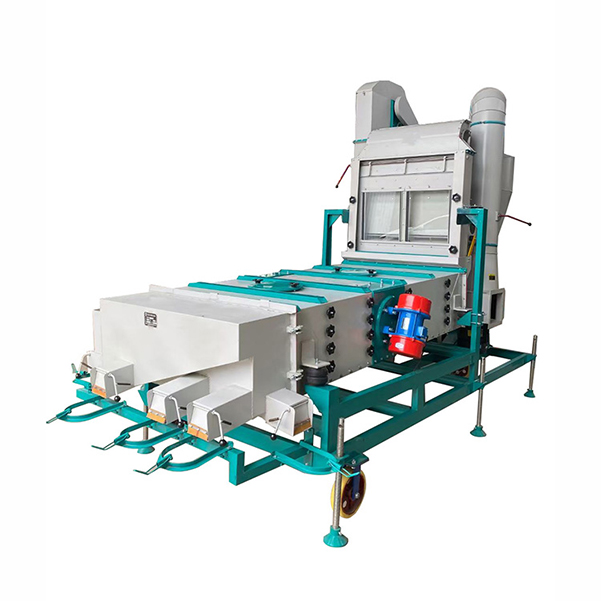
Air Screen Cleaner
Function
Air separation removes light impurities: A fan generates airflow to blow away light contaminants—such as dust, shriveled grains, broken shells, weed seeds, stem/leaf fragments, and lightweight moldy particles—from sesame seeds and soybeans. For sesame (which has small, lightweight seeds), the airflow separates shriveled seeds from sound ones; for soybeans, it removes leaf fragments, broken skins, and lightweight, insect-damaged beans.
Multi-layer screen grading: Vibration-based screening separates impurities based on particle size. Large-aperture screens remove coarse impurities like soil clods, clumps of grass, and large stalks, while small-aperture screens remove fine impurities such as fine soil, sand, and broken seed fragments. For soybeans, this primarily removes large soil clods and broken beans; for sesame, it removes fine sand, soil, and broken seeds.
Preliminary grading: Materials are sorted into different specifications, providing pre-processing for the downstream gravity destoner and reducing its workload. After air-screen cleaning, most stems, leaves, dust, and large/small impurities are removed, leaving only “companion stones” (stones similar in size to the product particles) for the gravity destoner to handle.
Advantages
Combines air separation and multi-layer screening in one machine, removing impurities of varying weights and sizes in a single pass; offers high pre-processing efficiency and reduces the load on downstream equipment.
Interchangeable screens: Compatible with both materials; switching production between sesame and soybeans requires only a screen change, offering high versatility.
Enclosed operation: Effectively suppresses dust, improves the workshop environment, and minimizes material loss due to spillage.
Adjustable feed rate: Matches the capacity of the entire production line; pre-processing ensures uniform material flow, leading to more stable separation performance in the downstream gravity destoner.
Removes broken and moldy grains early on: Enhances the overall quality of the finished product; ideal for the preliminary cleaning of export-grade raw materials.
Note: The air-screen cleaner cannot effectively remove “companion stones.” Since these stones are similar in size to sesame seeds or soybeans, they cannot be removed by screening and require a gravity destoner for separation.
Destoner
Function
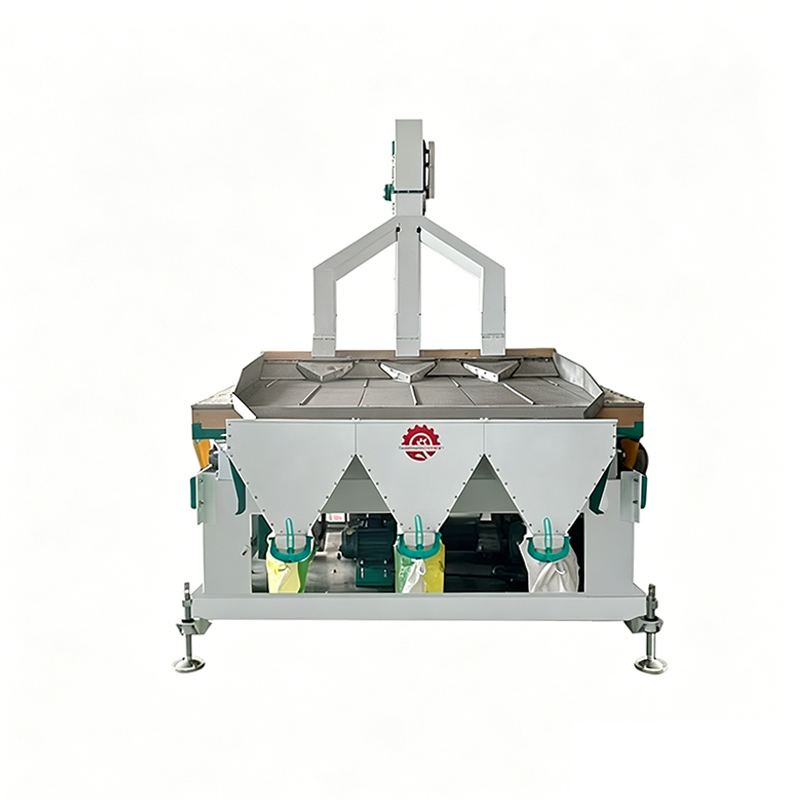
Removes “companion stones” (stones similar in size to the product)—the core function. It utilizes the difference in specific gravity between the material and the stones, combining a vibrating deck with airflow to separate stones and soil clods—which are similar in size to sesame seeds or soybeans—from the raw material. Stones of the same size that cannot be removed by air-screen separators are separated here through gravity-based stratification.
On the vibrating deck, the material is suspended and stratified by airflow; lighter sesame seeds or soybeans float to the top layer and flow toward the discharge outlet, while stones and heavy soil clods sink to the bottom layer and move toward the stone discharge outlet due to vibration.
For small sesame seeds, airflow and vibration amplitude are reduced to prevent the seeds from being blown away; for larger, heavier soybeans, airflow and amplitude are increased to ensure thorough stone separation.
It can also remove certain heavy impurities, such as metal particles and heavy mud clods, further enhancing the purity of the finished product.
Advantages
Specifically designed to handle companion stones that air-screen separators cannot remove; an essential piece of equipment for sesame and soybean processing that ensures extremely low residual stone content, meeting food export standards.
Highly adjustable parameters—including deck inclination, airflow, and vibration amplitude—allow for rapid setup tailored to either sesame or soybeans, ensuring consistent sorting performance.
Supports continuous operation; it can directly receive material from air-screen cleaners and integrate with bucket elevators to form a complete processing line, eliminating the need for manual stone picking.
Material loss is controllable; with proper calibration, the loss of good seeds mixed into the rejected stones is minimal.
Compact footprint; suitable for both small-to-medium processing plants and large-scale production lines.
Application Scenarios for Air-Screen Cleaners and Gravity Destoners
Air-screen cleaners utilize a combination of air separation and multi-layer vibrating screens to primarily remove large and small impurities, light debris, dust, and shriveled grains. Serving as initial cleaning or precision sorting equipment at the start of a production line, they are widely used in the processing of various granular crops.
In the processing of coarse grains and legumes (such as kidney beans, soybeans, mung beans, adzuki beans, chickpeas, and pigeon peas), they perform initial raw material cleaning—removing stalks, leaves, broken skins, soil clods, and shriveled beans—and sort by size, thereby reducing the load on subsequent destoning stages. For oil crops like sesame, rapeseed, and chili seeds, they screen out fine sand, soil, and chaff, separate broken fragments, and accommodate fine-mesh screens suited to the small size of the seeds.
In green coffee bean processing, they handle the pre-treatment stage by removing husk fragments, dust, shriveled beans, and insect-damaged (lightweight) beans. They grade beans by size and remove the majority of light impurities beforehand, ensuring a stable feed for the gravity destoner.
In seed processing, they are used for the precision selection of grain, vegetable, and flower seeds. They screen out shriveled seeds, weed seeds, and debris, and grade seeds to ensure purity, serving as a pre-treatment step prior to seed breeding and coating.
In grain storage and processing, they perform initial cleaning of wheat, corn, and paddy upon arrival at the plant—removing chaff, stalks, and dust—and handle basic cleaning before grain enters storage silos or during bulk pre-treatment at grain collection stations.
For dried fruits and agricultural by-products (such as almonds and peanuts), they sort the product and remove shell fragments, damaged items, and dust.
They are also used for the pre-treatment of feed ingredients, removing stalks and clumped impurities from corn and soybean meal.
These machines can operate as standalone units for small-scale processing or be integrated with bucket elevators, destoners, and color sorters to form complete automated production lines, making them suitable for everything from small family workshops and medium-sized processing plants to large-scale export facilities. Specific Gravity Destoner
The specific gravity destoner is designed to handle “co-sized” stones, heavy mud clods, and heavy impurities that air-screen cleaners cannot separate—materials where the size of the stones or clods closely matches that of the product, rendering screens ineffective. It achieves separation by utilizing specific gravity, vibration, and airflow, and is typically positioned after the air-screen cleaner for intensive impurity removal.
In the processing of coarse grains and legumes (such as soybeans, kidney beans, mung beans, and pigeon peas), it removes stones and mud clods of similar size to the beans; it is essential equipment for legume food processing and export. For small oilseeds like sesame and rapeseed, it removes fine sand and stones; sesame processing is particularly parameter-sensitive, requiring low airflow and low vibration amplitude to prevent seed loss.
In green coffee bean processing, it removes mixed stones and heavy soil clods, preventing hard objects from damaging the grinding discs of downstream hulling and polishing equipment, ensuring product quality, and meeting export standards for stone and grit content.
In grain processing (wheat, corn, and paddy rice), it removes stones from raw grain, protecting milling and grinding equipment from wear caused by hard objects.
In seed processing, it performs precision cleaning of various crop seeds, removing stones and heavy impurities to prevent stones from damaging downstream coating equipment.
In peanut processing, it removes sand, stones, and soil clods from peanut pods or kernels.
Post time: Aug-14-2026