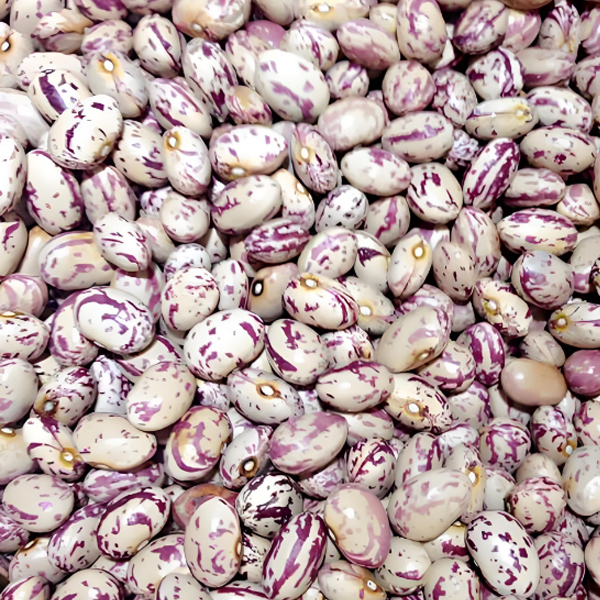
Pinto Bean (Scientific Name: Phaseolus vulgaris—a variety of the common bean), also frequently referred to as Pinto, Huayundou(Flowered Cloud Bean), or Banwendou (Mottled Bean).
1. Basic Characteristics
Appearance: Oval-shaped and plump; the base color is creamy white or light tan, covered in irregular reddish-brown or purple speckles (resembling camouflage).
Texture: Hard and dry when raw; once cooked, it becomes floury, soft, and creamy, easily mashing into a puree.
Aliases:
International Standard: Pinto Bean
Domestic (China): Banwendou, Huayundou, Naihuadou(Milk-Flower Bean), Hupidou (Tiger-Skin Bean)
2. Major Production Regions
Global Main Producers: United States (North Dakota, Michigan), Mexico, Brazil, China, Argentina.
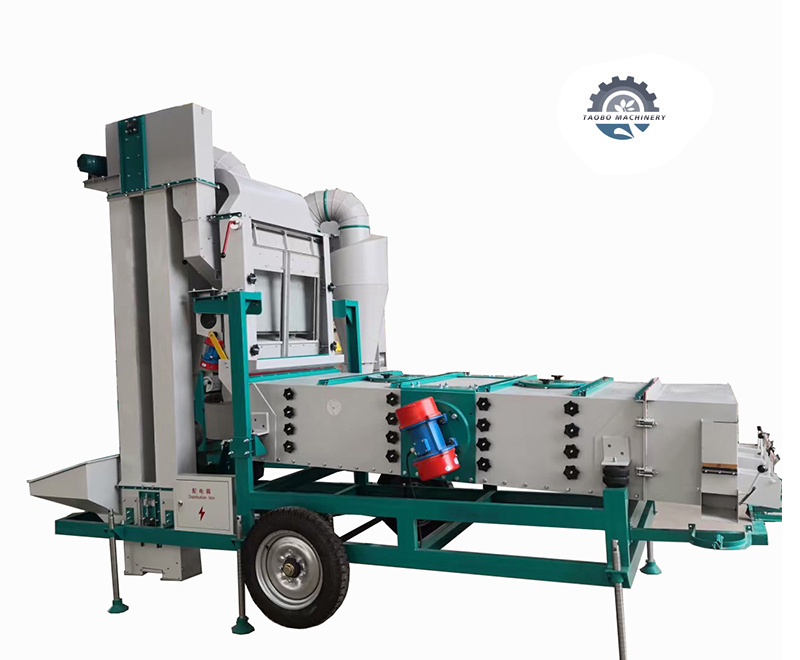
The core principle behind using an air-screen cleaning machine to process Pinto beans (Phaseolus vulgaris) lies in exploiting the differences in aerodynamic properties (specifically, suspension velocity) and geometric dimensions (width and thickness) between the beans and various impurities. Through the combined action of air separation and multi-layer vibrating screening, the machine achieves highly efficient impurity removal.
I. Core Working Principles
Air Separation Principle (Removal of Light Impurities)
Based on differences in suspension velocity. Pinto beans are plump and possess a high specific gravity (approximately 1.3–1.4 g/cm³), resulting in a high suspension velocity. Conversely, light impurities—such as dust, broken bean husks, shriveled grains, and straw—have a lower specific gravity and, consequently, a lower suspension velocity.
As the material passes through a vertical airflow field:
Light impurities are entrained by the airflow and directed into the dust collection system.
Qualified Pinto beans, whose gravitational force exceeds the lifting force of the airflow, fall unimpeded and proceed to the screening stage.
Screening Principle (Removal of Large and Small Impurities)
Based on differences in particle size.
Large Impurities (stones, clods of soil, long stalks, pods): These particles have a diameter larger than that of the Pinto beans; they are intercepted by the upper-layer screen mesh and discharged.
Small Impurities (broken beans, sand grains, fine soil dust): These particles have a diameter smaller than that of the Pinto beans; they pass through the screen perforations and are separated.
Qualified Pinto Beans: Their dimensions match the screen perforations; they remain on the screen surface and are conveyed to the finished product outlet.
II. Standard Workflow for Cleaning Speckled Beans
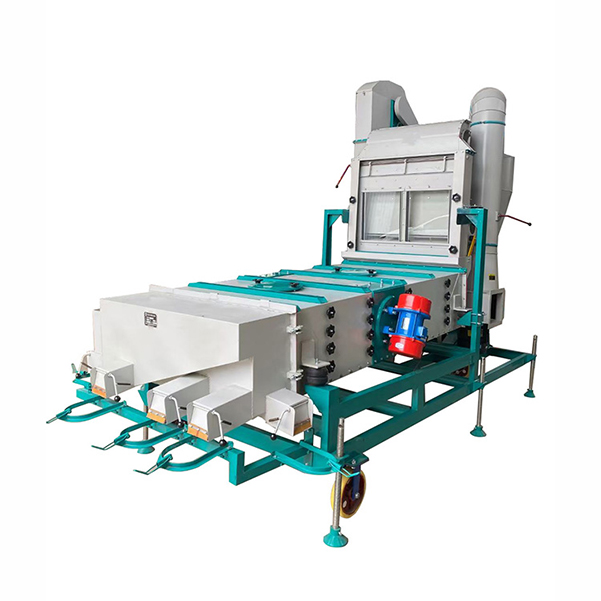
Step 1: Uniform Feeding and Pre-Aspiration (Pre-cleaning)
The speckled beans awaiting cleaning (raw grain) are conveyed by an elevator into the feed hopper, then fed by a feed roller in a uniform, thin layer into the front aspiration duct.
Function: As the material falls, the upward airflow generated by a fan extracts light impurities such as dust, leaf fragments, hulls, and shriveled grains.
Separation: Light impurities are drawn into the front settling chamber; as the airflow velocity decreases, they settle out and are discharged via a screw auger, while the cleaned beans fall onto the upper sieve deck.
Step 2: Upper Sieve (Removal of Coarse Impurities)
Sieve Screen: Round-hole or square-hole screen with an aperture size slightly larger than the diameter of the speckled beans (e.g., 5.5–6.0 mm).
The sieve body undergoes reciprocating vibration, causing the material to bounce and advance across the sieve surface.
Separation:
Coarse Impurities (stones, soil clods, whole pods): Larger than the sieve apertures, these remain on the sieve surface and slide toward the coarse impurity outlet.
Speckled Beans + Fine Impurities: Pass through the sieve apertures and fall onto the middle sieve deck.
Step 3: Middle Sieve (Clean Material Grading / Removal of Medium Impurities)
Sieve Screen: Slotted-hole screen (sorting by thickness, suited to the flattened shape of the beans), with an aperture size equal to or slightly smaller than the thickness of the standard-grade speckled beans (approx. 4.0–4.5 mm).
Separation:
Medium Impurities / Broken Beans: Immature grains, broken cotyledons, and small pebbles pass through the sieve apertures and fall into the fine impurity collection layer.
Pure Speckled Beans: Remain on the sieve surface and slide toward the rear aspiration duct.
Step 4: Rear Aspiration Duct (Fine Aspiration)
Before sliding toward the finished product outlet, the material passes once again through a zone of strong airflow.
Function: To remove light impurities, insect-damaged grains, diseased grains, and shriveled beans that were not completely removed during the preceding stages (these defective beans have a slightly lower specific gravity and are easily extracted by the airflow).
Separation:
Light Impurities / Sub-standard Grains: Drawn into the rear settling chamber and discharged. High-Purity Speckled Beans: Descend to the finished product outlet, completing the cleaning process.
Step 5: Bottom Sieve (Removal of Fine Impurities)
Collects broken beans and sand particles that have passed through the middle sieve; these undergo further separation via the bottom sieve. Fine impurities are discharged through the dedicated outlet, while some half-beans may be recovered.
III. Key Equipment Parameters for Processing Mottled Beans
Sieve Selection:
Upper Layer: Large-aperture round-hole sieve (for removing coarse impurities).
Middle Layer: Long-hole sieve (critical; designed to match the shape of mottled beans, effectively separating broken beans from whole beans).
Airflow Control:
Maintain moderate air pressure; avoid setting it too high, which could suction away plump beans, or too low, which would fail to remove light impurities completely.
Typically, an adjustable fan is utilized, allowing for fine-tuning based on the impurity content of the raw material.
Vibration Frequency and Amplitude:
Ensure that the material flows at a uniform speed across the sieve surface and undergoes thorough stratification, thereby maximizing cleaning efficiency.
IV. Summary of Removable Impurity Types
Light Impurities: Dust, bean hulls, grass clippings, shriveled grains, insect-damaged grains (removed via air separation).
Coarse Impurities: Stones, soil clods, bean pods, stalks (removed by the upper sieve).
Fine Impurities: Broken beans, sand grains, fine soil particles (removed by the middle/bottom sieve).
Through the aforementioned combined process of air separation and sieving, the air-screen cleaning machine can simultaneously perform impurity removal, destoning, removal of broken grains, and grading of mottled beans in a single pass, making it a core piece of equipment for the pre-processing stage of bean production.
Post time: Apr-02-2026