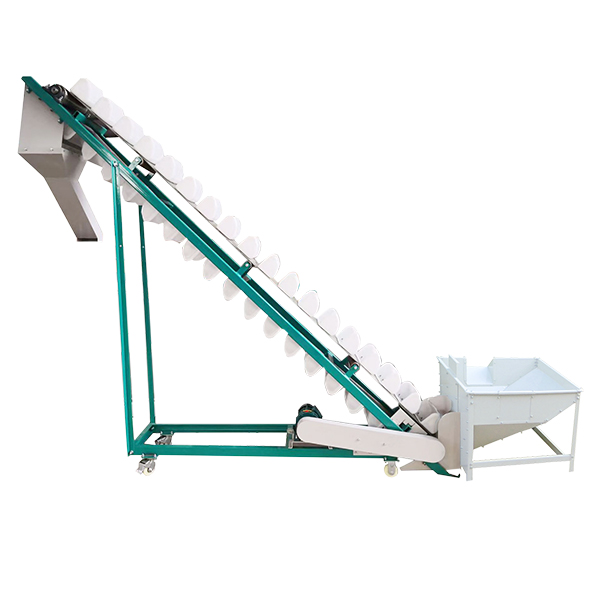
In grain cleaning and processing production lines, bucket elevators and inclined elevators are two core types of vertical/inclined material conveying equipment. They achieve the lifting and transfer of grains based on different structural designs, adapting to different process requirements, material characteristics, and site conditions.
I. Bucket Elevator
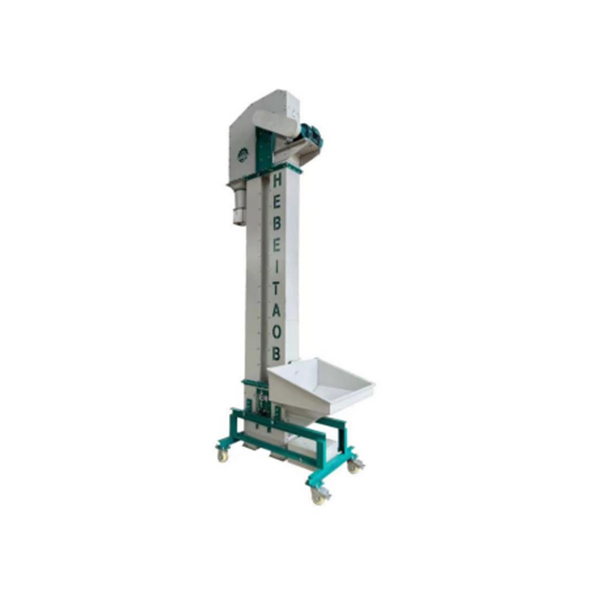
The bucket elevator is the most widely used vertical lifting equipment in the grain processing industry. It achieves material transfer through a closed-loop process of “bucket scooping – vertical conveying – centrifugal/gravity unloading,” and is primarily suited for large-volume, vertical grain lifting needs.
1. Working Principle
The bucket elevator mainly consists of buckets, traction components (chain or belt), a casing, a drive unit (motor + reducer), a tensioning device, and inlet/outlet ports. The working process consists of three steps:
Scooping Feed: The traction component (chain/belt) drives the buckets in a cyclical motion. The bottom buckets delve into the material pile at the inlet, “scooping” the material through the volumetric effect of the buckets. Grains (such as wheat and corn); Vertical conveying: The hopper filled with material moves upward along the inner wall of the casing with the traction component. The casing serves to protect, prevent spillage, and guide the material, preventing the grain from scattering during the lifting process; Discharge: When the hopper moves to the top discharge port, discharge is achieved in two ways: Centrifugal discharge: Suitable for grains with uniform particle size and good flowability (such as rice and barley). The hopper moves at high speed with the traction component, using centrifugal force to throw the material out of the hopper and into the discharge port; Gravity discharge: Suitable for grains that are lumpy, sticky, or fragile (such as wet corn and oats). After the hopper moves to the top, it flips over, and the material falls to the discharge port under its own gravity.
2. Core Advantages
High Efficiency: Large conveying capacity per unit time (10-1000 m³/h for standard models), meeting the continuous operation needs of large-scale grain processing production lines;
Strong Vertical Lifting Capacity: Achieves vertical lifting heights from 0-40m, significantly saving floor space and adapting to compact workshop layouts;
Low Material Loss: Fully enclosed casing design reduces dust and spillage during grain conveying, while preventing external impurities from contaminating the material;
Wide Adaptability: By changing the hopper type (deep hopper, shallow hopper, pointed hopper) and traction components, it can be adapted to grains with different characteristics;
Stable Operation: Mature structure, reliable transmission system, low failure rate, and moderate maintenance costs.
3. Structural Features
The overall structure is a closed vertical design, consisting of three parts: an upper housing (including the discharge port), a middle housing (conveyor section), and a lower housing (including the feed port). Hoppers are installed at fixed intervals on the traction components, which are supported by a head drive wheel and a tail tensioning wheel. The tensioning device adjusts the tightness of the traction components to prevent slippage. The inner wall of the casing is smooth, with a small gap between it and the hoppers, reducing material residue and frictional wear. Some models are equipped with anti-clogging devices and overload protection devices to improve operational safety.
4. Application Material Scenarios
Suitable materials: Granular, free-flowing grains and cereals (wheat, corn, rice, barley, sorghum, millet, etc.), and can also be used for non-sticky powdery grain products (such as wheat bran and rice bran).
II. Inclined Elevator
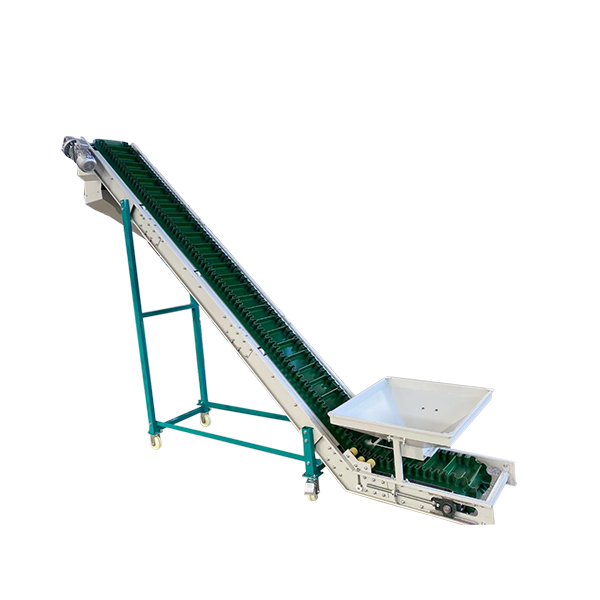
An inclined elevator is a continuous conveying device based on an inclined angle. It transfers materials along an incline through belt friction or scraper pushing. It is primarily suitable for short to medium distance, large-angle (non-vertical) grain conveying, especially suitable for scenarios with limited space or requiring connection to multiple devices.
1. Working Principle Depending on the conveying method, inclined elevators are mainly divided into two types, with slightly different working principles:
Inclined Belt Type:The core consists of a conveyor belt, drive roller, redirecting roller, support frame, and feeding/discharging device. The motor drives the conveyor belt in a cyclical motion. Grain falls onto the conveyor belt through the inlet. Utilizing the friction between the conveyor belt and the grain, the grain moves upwards along the incline. Upon reaching the top, it falls to the outlet as the conveyor belt turns. Some models have anti-slip textures or baffles added to the conveyor belt surface to prevent material slippage.
Inclined Scraper Type: The core consists of a scraper chain, trough, drive unit, and tensioning device. The scraper is fixed to a chain, which is driven by a motor to move along an inclined trough. Grains enter the trough and are pushed forward by the scraper, transported upwards along the slope to the discharge port. The scraper’s thrust overcomes the material’s gravity and friction.
2. Core Advantages
Strong Site Adaptability:Adjustable tilt angle (typically 15°-60°), no vertical installation required, suitable for workshops with insufficient height or requiring cross-area connections;
Flexible Conveying Distance:Achieves short-to-medium distance lifting of 3-30m, length can be customized according to site requirements, and supports horizontal + tilting combination conveying;
Convenient Feeding/Discharging: Multiple feed inlets or outlets can be set on the conveyor belt, facilitating connection with multiple cleaning devices for multi-functionality;
Minimal Material Damage: Belt conveyors use flexible friction drive, while scraper conveyors reduce material compression by adjusting scraper spacing, suitable for fragile grains (such as rice and oats);
Simple Maintenance: Relatively open (belt type) or semi-enclosed (scraper type) structure, convenient for troubleshooting and cleaning, and low replacement cost for wear parts (belt, scraper).
3. Application Material Scenarios
Suitable Materials: Various grains, miscellaneous grains, finished grains, and slightly sticky or fragile grain products. Not suitable for grains with extremely poor flowability (easily causes blockage).
Post time: Nov-21-2025