
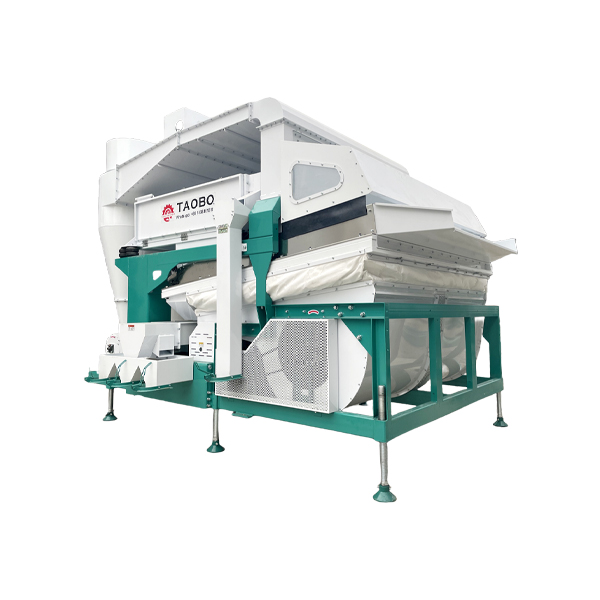
The core advantage of the air-screen gravity separator compared to ordinary air-screen separators lies in its added gravity separation function, achieving precise separation based on both size and density. This solves the problem of separating impurities of the same size but different quality, which ordinary air-screen separators cannot handle.
The core of the air-screen cleaning machine is “air separation + screening,” using airflow to remove light impurities and vibration screening to separate by size, suitable for basic cleaning; the air-screen gravity separator adds a gravity separation module to this, separating shriveled grains, insect-damaged grains, etc., by density, resulting in higher cleaning accuracy and suitability for fine selection needs.
Core Working Principle
Air-screen cleaning machine: Relies solely on aerodynamic characteristics (suspension velocity) and air separation, and geometric size differences and vibration screening to separate light impurities and impurities of unsuitable size.
Air-screen gravity separator: Integrates air separation, screening, and gravity separation technologies. After basic cleaning, a gravity table combining airflow and vibration separates materials by density, separating impurities of the same size but different densities.
Core Structure
Air-screen cleaning machine: Fan, vertical air screen, vibrating screen, dust removal system, no gravity separation module.
Air-screen gravity separator: Adds a gravity table and gravity separation drive device to the air-screen cleaning machine structure; some models have a dual gravity table design.
Cleaning Capacity and Accuracy
Air-screen cleaning machine: Can remove light impurities (dust, husks), large impurities (straw, stalks), and small impurities (broken grains, sand), but cannot effectively separate impurities with density differences such as shriveled grains, insect-damaged grains, and moldy grains of the same size. Accuracy is moderate, suitable for initial cleaning.
Air-screen gravity separator: In addition to basic impurities, it can accurately separate defective particles of the same size but different densities, resulting in higher purity, suitable for high-precision needs such as seed selection and fine processing of commercial grains.
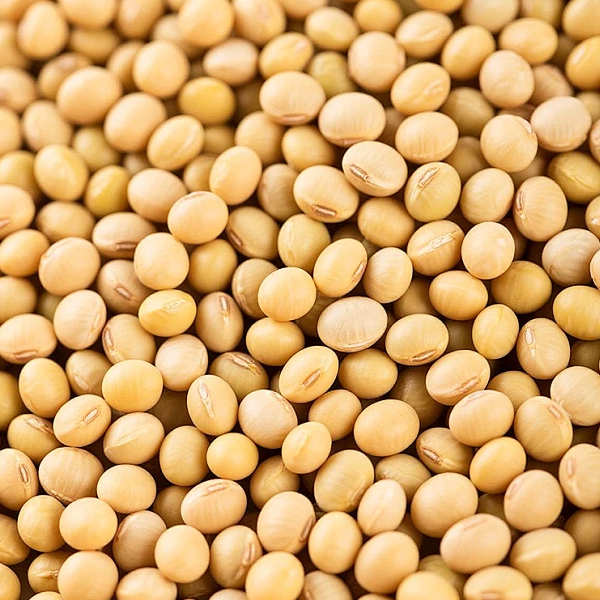
Higher cleaning accuracy, capable of removing inferior particles of the same size.
Ordinary air-screen cleaning machines can only remove light impurities using airflow and separate oversized and undersized impurities based on screen mesh size, but they cannot distinguish between shriveled grains, insect-damaged grains, moldy grains, and empty hulls of the same size. However, the air-screen gravity separator adds a gravity table to the air-screen system. Utilizing the density differences of the materials, the combined action of vibration and airflow causes the grains to stratify – full grains, being denser, sink to the bottom of the gravity table and move towards the discharge port; shriveled and insect-damaged grains, being less dense, float on the surface and are blown out. This “air-screen + gravity” combination can improve grain purity to a higher standard, especially meeting the quality requirements for seed selection and high-end commercial grain processing.
Wider range of applications, suitable for more demanding cleaning scenarios.
Ordinary air-screen cleaning machines are only suitable for initial rough cleaning after grain harvesting, such as removing straw, sand, and broken grains, and are mostly used for pre-treatment before storage by small and medium-sized farmers. The air-screen gravity separator, however, can perform both rough cleaning and fine processing and selection, adapting to high-end scenarios such as seed purification in seed breeding bases, quality control of export grains, pre-treatment of oil crops (to improve oil yield), and branded processing of miscellaneous grains. It can also handle small-particle grains (such as quinoa and millet) and high-density legumes (such as chickpeas and broad beans) that are difficult for ordinary air-screen cleaning machines to process.
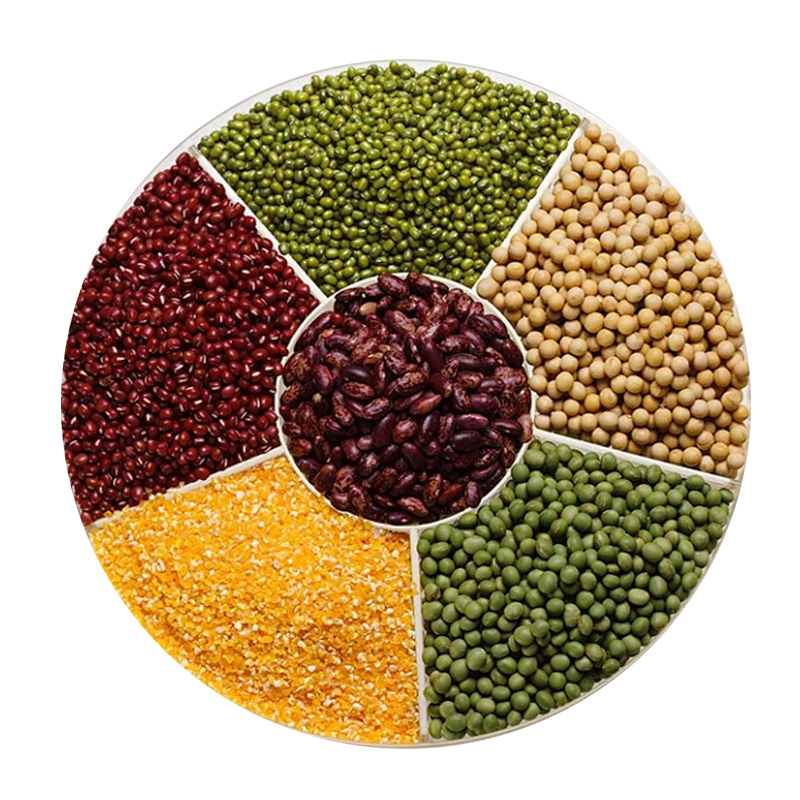
Which grains are suitable for cleaning with a wind-screen gravity separator?
1. Leguminous crops
For crops with plump grains and significant density differences, the advantages of the wind-screen gravity separator are particularly prominent. For example, soybeans, peas, broad beans, chickpeas, and lentils can be separated from undersized broken beans and small stones using the sieves, while the gravity table precisely removes shriveled beans, insect-damaged beans, and moldy beans. This is especially suitable for seed selection and high-end processing of commercial beans, significantly improving the commercial value and germination rate of legumes.
2. Cereal crops
For cereal grains such as wheat, rice, corn, sorghum, barley, and oats, this equipment solves the problem of traditional wind-screen separators being unable to separate “undersized grains of the same size.” Taking wheat as an example, it can effectively remove shriveled grains, insect-damaged grains, and weed seeds from wheat kernels; for corn, it can separate broken grains, moldy grains, and mixed corn cob fragments. It is commonly used for seed selection in seed breeding bases, fine processing before commercial grain storage, and quality control of export grains.
3. Miscellaneous grains
For small-grained miscellaneous grains such as millet, buckwheat, quinoa, and proso millet, the multi-layer sieves and adjustable gravity table of the wind-screen gravity separator can handle both size screening and density separation, removing impurities such as sand, weed seeds, and shriveled grains, meeting the quality requirements for fine processing and branded sales of miscellaneous grains.
4. Oilseed crops
For oilseed crops such as rapeseed, peanuts, and sunflower seeds, this equipment can prevent grain breakage during the cleaning process while removing empty shells, shriveled seeds, and impurities, improving the oil yield of oilseed crops and being suitable for the pretreatment stage of oil processing enterprises.
When using a wind-screen gravity separator, the sieve hole size, wind speed, and the vibration frequency and tilt angle of the gravity table must be adjusted according to the size and density characteristics of different grains to achieve optimal cleaning results.
Post time: Jan-14-2026