
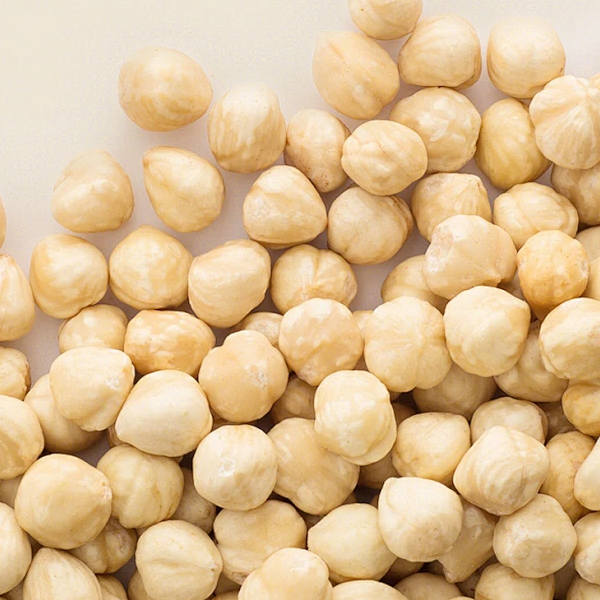
Ethiopia is a major global producer of sesame and chickpeas. Sesame is the country’s second-largest agricultural export crop, while chickpeas are its core legume. Both are primarily grown by smallholder farmers, but their main production areas and cultivation patterns differ significantly.
1. Ecological and Layout Differences:
Sesame: Adapted to low-altitude, hot, semi-arid regions. Main production areas are concentrated in the northwestern border region. Well-drained soil is required. Rainfall is concentrated (June-September), making rain-fed agriculture crucial; waterlogging is a major concern.
Chickpeas: Adapted to mid-to-high-altitude temperate climates. Main production areas are in the central plateau region. Black soil retains water and fertilizer, making it suitable for crop rotation with wheat. It utilizes residual fertilizer and fixes nitrogen, enhancing system fertility.
2. Crop Systems and Rotation/Intercropping:
Sesame: Primarily monoculture, but can be intercropped/marinated with sorghum (approximately 39%) to optimize space utilization. Commercial farms are gradually expanding in Benshangul-Gumaz.
Chickpeas: Crop rotation is the core model; rotation with wheat reduces disease and increases subsequent crop yields. Smallholder farmers mostly use rain-fed crops, with drip irrigation being tested in some areas to improve yield.
3. Variety and Input Management
Sesame: Improved varieties are being promoted, but self-saved seeds result in low purity, with yields only reaching 50% of potential. Fertilization is mainly organic, with low pest and disease pressure, primarily preventing capsule cracking.
Chickpeas: Desi type is prevalent, and improved variety adoption is low. Root rot and Ascochyta leaf spot are frequent, requiring seed coating and crop rotation. Rhizobium inoculation significantly improves nitrogen fixation efficiency.
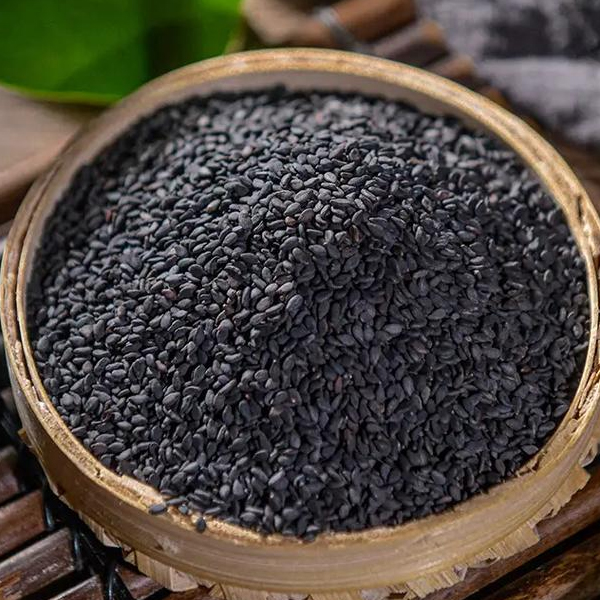
4. Harvesting and Post-Harvest Processing
Sesame: Manual harvesting → field drying → threshing → winnowing + color sorting to remove shriveled and discolored kernels, ensuring export quality. Smallholder farmers rely on cooperative cleaning equipment.
Chickpeas: Manual harvesting → sun-drying → threshing → winnowing and gravity separation to remove impurities and insect-damaged kernels; high seed storage losses necessitate improved drying and storage facilities.
5. Production, Sales, and Efficiency
Sesame: High export ratio; significant shortage of cleaning and grading equipment affects price consistency; commercial farms can achieve yields of up to 600 kg/hectare, while smallholders achieve approximately 300 kg/hectare.
Chickpeas: Primarily consumed domestically; exports concentrated in East Africa/Middle East; significant potential for yield improvement (4-6 tons/hectare), relying on improved varieties, mechanization, and pest and disease control.
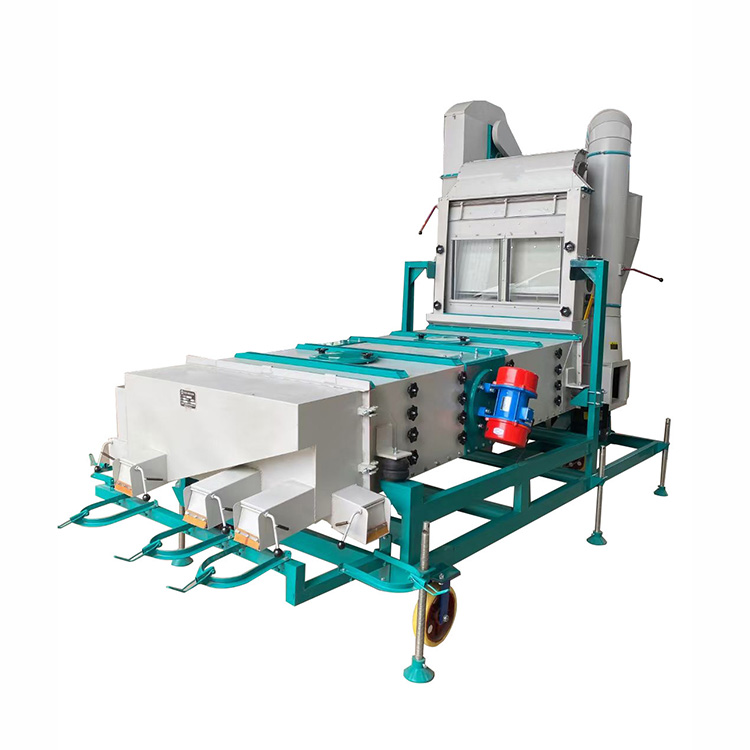
The air-screen cleaner is a core piece of equipment that combines air-powered cleaning with screening to remove impurities and grade materials such as grains, beans, and oil crops. It is widely applicable to the post-harvest cleaning needs of crops like sesame and chickpeas in Ethiopia.
Core Working Principle: The air-screen cleaner’s cleaning process consists of two steps, working synergistically:
Screening (Core Grading Step): The equipment is equipped with multiple layers of screens with different apertures (commonly 2-3 layers), which vibrate reciprocatingly or swirlingly.
After the material is evenly fed onto the screen surface, impurities smaller than the screen apertures (such as soil particles, shriveled seeds, and broken straw) pass through and fall; larger impurities (such as large stones, long straws, and large weed seeds) are conveyed to the discharge port; the target crop, matching the size of the screen apertures, remains on the screen surface and proceeds to the next step of air-powered cleaning.
Suitable parameters:
Chickpeas (desi type, small grains): sieve aperture 3-5mm, moderate sieve vibration frequency to avoid grain breakage;
Sesame: sieve aperture 0.8-1.2mm, fine mesh sieve required to prevent sesame seeds from leaking out.
Air-powered cleaning (auxiliary light impurity removal): The blower generates an adjustable airflow that passes the material vertically or obliquely through the sieve surface.
Light impurities (such as dust, shriveled shells, and short broken leaves) are blown away by the airflow and fall into the light impurity collection area; heavier target crop grains are affected by gravity and continue to be conveyed forward, eventually falling into the finished product collection bin.
Post time: Dec-29-2025