
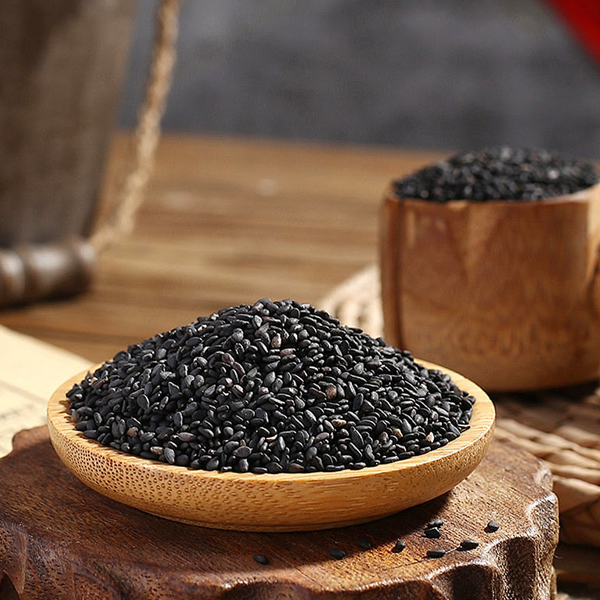
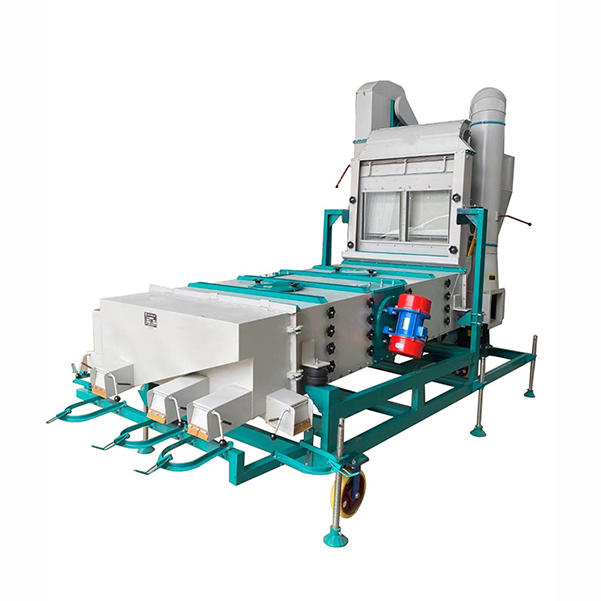
Air-screen cleaners and grading screens have distinct roles in cleaning sesame and beans. The former focuses on “comprehensive impurity removal + preliminary grading,” while the latter focuses on “precise size grading + fine impurity removal.” They are often used together to form a complete cleaning process.
The core functions of the air-screen cleaner (primarily cleaning, secondarily grading):
Air-screening for light impurities: Utilizing aerodynamic principles, it separates light impurities (such as dust, shriveled shells, broken straw, and chaff) from sesame and beans through vertical/horizontal airflow. Two air-screening processes (combined models) significantly improve cleanliness, especially suitable for dusty materials like sesame. Light impurities are then centrally discharged via a cyclone dust collector, reducing dust pollution.
Screening for large and small impurities: Vibrating screen layers (2-4 layers, replaceable screen plates) separate impurities according to geometric dimensions. The upper layer removes large impurities (such as large clods of soil, straw fragments, and irregularly shaped large particles), while the lower layer removes small impurities (such as small stones, broken particles, and mud). Simultaneously, it preliminarily separates the material into large, medium, and small particles, combining cleaning with basic grading.
Destoning/Auxiliary Gravity Sorting (Some Models): Equipped with a destoning mechanism, it can separate heavy impurities such as sand and soil particles; it achieves comprehensive cleaning of “light impurities + large impurities + small impurities + heavy impurities,” laying the foundation for subsequent grading or color sorting.
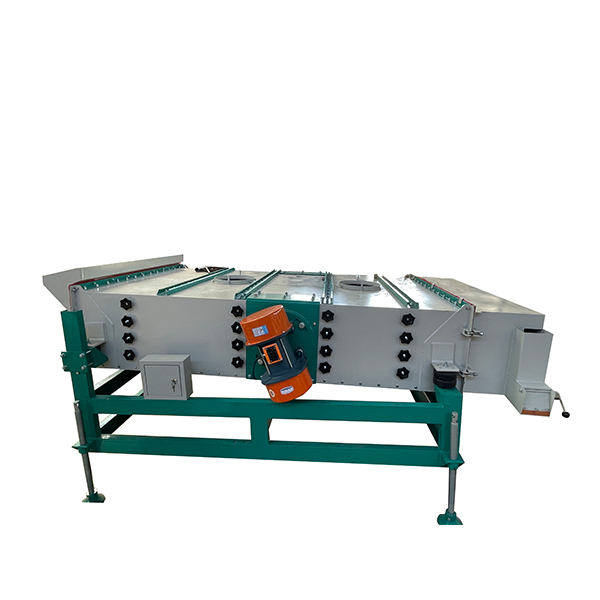
Core Function of Grading Screen (Vibrating Grading Screen) (Grading as the primary function, fine impurity removal as a secondary function)
Precise Size Grading: Based on a multi-layer precision vibrating screen (3 layers or more), it precisely grades sesame seeds and beans according to particle width/thickness (e.g., sesame seeds are divided into large, medium, and small grains; beans are divided into different specifications and grades). The screen aperture can be customized to meet the needs of commercial grain grading and seed selection.
Fine Impurity Removal: Further removes residual small impurities (such as broken particles and small stones) and light impurities not cleaned by the air sieve during the grading process, improving the uniformity and cleanliness of the finished product; for small particles such as sesame seeds, the screen inclination angle and amplitude can be adjusted to reduce breakage and improve screening efficiency.
Post-processing: Graded materials are easier to process in subsequent color sorting, packaging, storage or deep processing (such as sesame oil extraction, bean processing), ensuring product quality consistency and increasing added value.
Core Application Scenarios of Air Screen Cleaners
Air screen cleaners, with their core function of “comprehensive impurity removal + preliminary grading,” are best suited for the initial processing stage of materials, especially for raw materials with high impurity content and complex states after harvest. They can efficiently clean various types of impurities, laying the foundation for subsequent processing.
Post-harvest field raw material initial cleaning: This is its primary application scenario. On farms, cooperatives, or grain purchasing points, freshly harvested sesame, soybeans, peas, wheat, corn, and other materials often contain a large amount of dust, shriveled husks, straw, large clods of soil, small stones, and other light and heavy impurities. Air screen cleaners, through a combination of air separation and screening, remove most of the impurities in one pass, significantly improving material purity and preventing impurities from affecting the operation of subsequent storage or processing equipment, reducing equipment wear and malfunctions.
Pre-treatment before seed processing: In seed breeding bases, raw seeds to be selected often contain shriveled, broken, and various impurities. Air-screen cleaners can remove most of these impurities and shriveled seeds, initially screening out plump particles. This reduces the processing load for subsequent fine processing steps such as gravity sorting, color sorting, and coating, improving the efficiency and accuracy of seed selection.
Preliminary cleaning of raw materials in small and medium-sized grain and oil processing plants: In small and medium-sized processing plants such as sesame oil pressing and soybean oil pressing, raw materials must be cleaned before entering the pressing or leaching process; otherwise, impurities will affect the quality of the oil and damage the oil pressing equipment. Air-screen cleaners can quickly remove light, large, and small impurities from raw materials. Especially for oilseeds with high dust content, such as sesame, the dual-stage air-screen structure can significantly reduce dust content and improve the workshop working environment.
Core Application Scenarios of Grading Screens (Vibrating Grading Screens)
Grading screens, with their core function of “precise size grading + fine impurity removal,” are best suited for the material refining stage, especially for materials that need to be graded according to specifications after initial cleaning. They can achieve high-precision particle size grading, meeting the quality requirements of commercial grains, seeds, and deep-processed raw materials.
Grading of Commercial Grains: In grain wholesale markets, large grain depots, and grain and oil processing enterprises, commercial grains such as sesame seeds, soybeans, mung beans, and red beans need to be graded according to particle size to achieve premium pricing. Grading screens, through multi-layer precision vibrating screen surfaces and customizable screen apertures, accurately separate materials into different grade sizes. For example, sesame seeds are divided into large, medium, and small grains, and soybeans are divided into grades based on diameter, increasing the added value and market competitiveness of commercial grains.
Fine Grading of Seeds: In the seed processing field, grading screens are one of the key pieces of equipment for seed selection. After air sieving and gravity selection, seeds need to be further graded according to particle size to select seeds of uniform size, ensuring uniform germination and growth after sowing. For small seeds such as sesame and beans, the grading sieve can reduce seed damage and achieve high-precision grading by adjusting the sieve surface inclination angle, amplitude, and vibration frequency.
Post time: Jan-08-2026