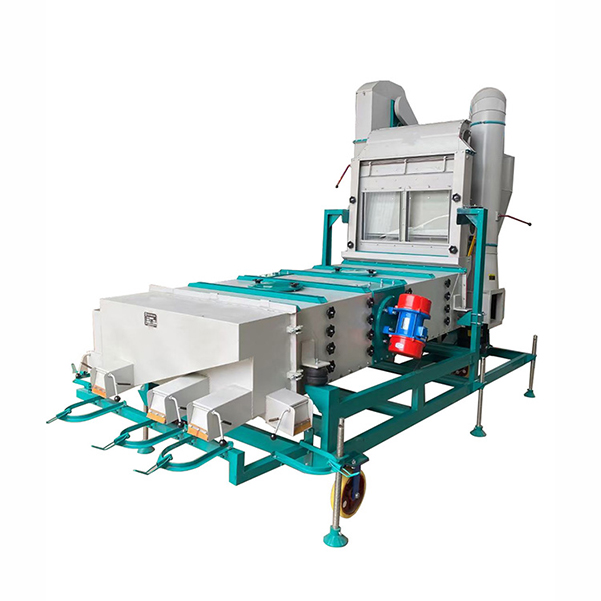
I. Soybeans Air Screen Cleaner (Primary Soybean Cleaning Equipment)
Utilizes a combination of airflow and multi-layer screening to classify and remove the vast majority of light, oversized, and undersized impurities from the soybeans.
Air separation for light impurities: An internal circulating airflow removes lightweight debris, such as dust, broken seed coats, shriveled beans, insect-damaged empty shells, straw fragments, stem and leaf debris, and lightweight moldy beans.
Screening and impurity removal:
Upper screen (large apertures): Removes impurities larger than the soybeans, such as soil clods, clumps of weed seeds, twigs, hemp rope fragments, mud clumps, and large stones;
Lower screen (small apertures): Filters out impurities smaller than the soybeans, such as fine sand and soil, broken bean fragments, tiny weed seeds, and small gravel;
Material classification: Separates whole, plump soybeans as the primary finished product, while collecting semi-shriveled or broken beans separately for subsequent sorting or independent sale;
Pre-cleaning for load reduction: Removes over 80% of visible impurities upfront, easing the workload on downstream gravity separators and color sorters, and preventing rapid clogging of screens and air ducts.
Precautions for Operating and Adjusting Soybean Air Screen Cleaners
1. Key Points for Feed Control
Ensure uniform and continuous feeding
Fluctuating feed rates directly reduce impurity removal efficiency. Excessive flow creates a material layer that is too thick for air to penetrate, preventing the stratification of impurities; conversely, insufficient flow causes material to bounce across the screen, leading to the loss of whole soybeans along with the waste. Utilize an upstream buffer hopper and a variable-frequency feed auger to maintain a thin, even layer of material across the screen surface.
Adjust flow based on raw material moisture
Dry soybeans flow well, allowing for a higher feed rate; however, damp soybeans—or those with sticky mud or excess pod fragments—require a reduced flow rate to prevent screen blinding (clogging) and the adhesion of stalks or weeds to the screen apertures.
Strictly prevent large debris from entering the equipment
Intercept items such as sack ropes, tree branches, large clods of soil, and woven bag fragments using a pre-cleaning screen to avoid clogging the inlet, scratching the screen plates, or jamming the vibration mechanism.
2. Screen Selection and Installation
Matching aperture sizes for upper and lower screens
Upper screen (for large impurities): Select an aperture size larger than the soybeans themselves to retain the beans while allowing grass clumps and large mud clods to pass through; typically, a round-hole screen with a diameter of 8–10 mm is used.
Lower screen (for fine impurities): Select an aperture size smaller than the soybeans to allow sand, soil, broken beans, and small weed seeds to pass through; typically, a round-hole screen with a diameter of 3–4 mm is used. If there is a high proportion of broken beans, switch to a screen with slightly smaller apertures.
Screen inclination angle and amplitude
Soybean kernels are relatively heavy, so the screen inclination angle should not be excessive—typically 3° to 6°. An angle that is too steep causes material to flow too quickly, resulting in incomplete impurity removal; an angle that is too shallow causes material accumulation and screen clogging. Maintain a moderate vibration amplitude to prevent excessive bouncing, which could cause mixing of the beans with the impurities.
Ensure proper screen sealing
There must be no gaps in the screen frame seals or side baffles; gaps allow soybeans to mix with the waste stream, resulting in product loss. Immediately replace any screen plates that are damaged or deformed.
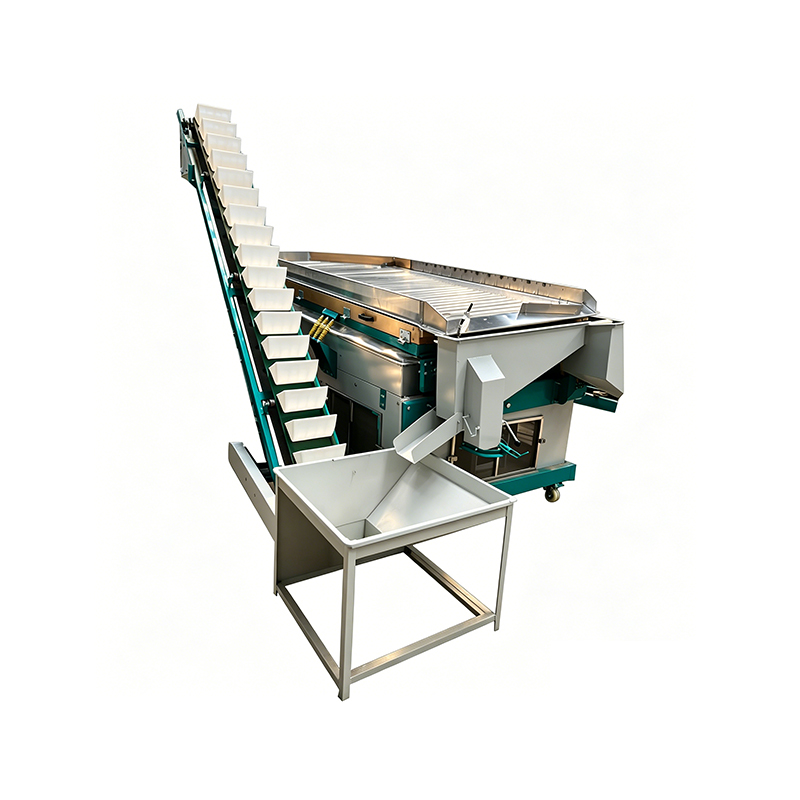
II. Beans Gravity Separator
Utilizing a combination of specific gravity differences, reciprocating vibration, and vertical airflow, this machine is designed to remove stones and mud clods that are similar in size to soybeans—impurities that air-and-screen cleaners cannot separate.
Separation of stones and gravel: Stones and mud clods similar in size to soybeans cannot be removed by screens; however, due to their significantly higher specific gravity compared to soybeans, they rise to the surface during vibration and air separation and are discharged through the stone outlet.
Removal of heavy impurities: Simultaneously eliminates high-density objects such as metal fragments, soil lumps, hardened mud clumps, and glass shards.
Soybean purification: Light, plump soybeans flow toward the discharge end, achieving complete separation from stones and ensuring clean beans; this prevents damage to processing equipment—such as grinding rolls and polishing machines—caused by stones.
Auxiliary removal of heavy, moldy beans: Certain heavy, moldy beans—which have absorbed water, clumped together, or turned black—possess a higher specific gravity; these are discharged along with the stones, thereby improving the overall quality and appearance of the finished soybean product.
Complete Workflow of the Soybean Gravity Separator
1. Feeding and Spreading Stage (Preparation)
Soybeans, having undergone air-screen cleaning, are conveyed via a bucket elevator to the buffer hopper above the gravity separator; the hopper outlet is equipped with a variable-frequency feed gate or a vibrating feeder.
Material is spread evenly and thinly onto the feed end of the inclined, reciprocating vibrating deck;
A distribution plate breaks up clumps of soybeans, ensuring uniform material thickness across the deck surface without piling or uneven distribution;
A bottom-mounted fan continuously blows air upwards; the airflow passes through the deck’s scale-like perforations, causing the soybeans to float slightly and begin layering.
2. Air-Vibration Layering Stage (Core Separation Process)
The deck undergoes small-amplitude reciprocating vibration while air is blown vertically upwards from below; the combined action of these two forces achieves layering:
Light, plump soybeans: Due to lower density, they are suspended by the airflow and—driven by the deck’s vibration—flow laterally toward the “clean bean” discharge outlet at the lower end;
Heavy impurities (stones, mud clods, heavily moldy beans, metal scraps): With densities far exceeding that of soybeans, they cannot be lifted by the air and remain in close contact with the scale-like screen plate; the friction from the deck’s vibration drives these heavy objects to move “uphill” toward the higher end of the deck;
Intermediate layer: Contains a small amount of shriveled or broken beans, which flow out along with the main stream of good soybeans.
Core logic of layering: Airflow facilitates material suspension and layering, while vibration drives the separation of light and heavy materials through movement in opposite directions.
3. Heavy Material “Uphill” Separation Stage (Destoning Process)
Stones and mud clods continue moving toward the high end of the deck, gradually accumulating in the stone discharge zone:
An adjustable baffle at the high end of the deck regulates the distance the stones travel uphill;
Any soybeans mixed in with the stones are blown back into the main material layer by a counter-airflow, minimizing product loss;
Once a sufficient quantity accumulates, the stones and clods are continuously discharged through side or top outlets for separate collection. IV. Clean Bean Discharge Stage
The cleaned, plump soybeans—having been separated into layers—slide down the inclined surface toward the main discharge outlet at the lower end. They flow by gravity into the next bucket elevator for transport to color sorting, polishing, or the finished product silo.
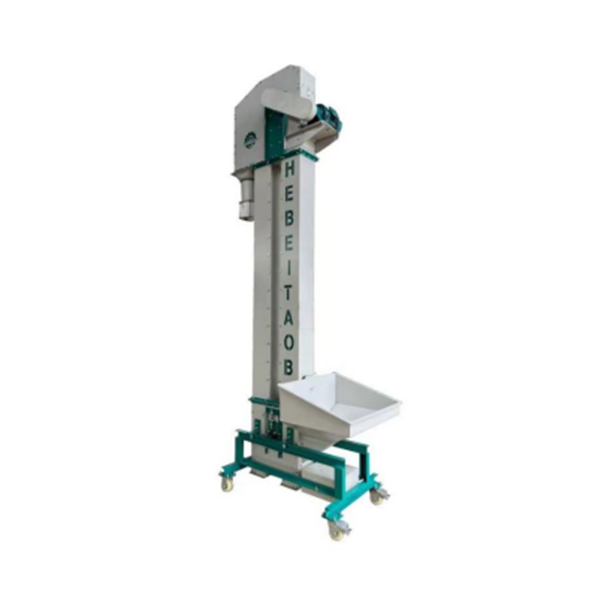
III. Bean Bucket Elevator
This unit serves as an auxiliary material-handling component for the entire processing line, linking various primary cleaning machines and acting as the medium for material transfer.
Conveying and Transfer: It transports pre-cleaned soybeans from a low-level intake to the feed inlets of downstream equipment—such as air-screen cleaners, gravity destoners, and storage silos—enabling continuous, automated feeding and eliminating the need for manual material handling.
Buffering and Flow Regulation: The elevator’s inlet can temporarily buffer a small quantity of soybeans, ensuring a steady, uniform feed rate to downstream equipment and preventing fluctuations in cleaning performance caused by inconsistent input volumes.
Enclosed Dust Control: Featuring a fully sealed structure, the unit prevents dust from escaping during transport; this minimizes airborne bean-skin fragments and dust, improves the workshop environment, and prevents material loss due to spillage.
Multi-Stage Transfer: As the production line’s primary machines are arranged at varying heights, multiple elevators are utilized to facilitate material circulation, re-screening, and transfer for secondary gravity-based precision sorting.
The beans bucket elevator serves as an indispensable conveying link in the soybean cleaning production line. While it does not directly remove impurities, the sorting performance, production efficiency, operating costs, and final product quality of all cleaning equipment rely on its stable conveying capabilities; it is the foundational equipment enabling the automated and stable operation of the entire line.
1. Vertical elevation across equipment height differences: The feed inlets of the pre-cleaning screen, air-screen cleaner, gravity separator, storage silo, and color sorter are located at varying heights; soybeans cannot move from a lower position to a higher feed inlet via gravity alone.
The bucket elevator lifts soybeans vertically from the discharge point of one machine to the inlet of the next, creating a continuous material flow path across the line. It eliminates the need for manual shoveling or transferring, enables uninterrupted production, and acts as the central material transport hub for the entire system.
2. Fully enclosed casing: Soybean skins and dust are prevented from scattering during the lifting process, thereby reducing airborne dust in the workshop; when paired with a dust collection system, it meets environmental production standards.
3. No open transfer points: This design eliminates soybean spillage and losses caused by trampling, thereby reducing raw material waste.
4. Prevention of re-contamination: It isolates the soybeans from external soil and weeds, ensuring that beans already cleaned in the preceding stage do not become contaminated again.
Post time: Jun-15-2026