Poland’s main economic food crops are wheat, rye, triticale, barley, maize, and oats. Legumes are centered on peas, broad beans, and lupins. Other important cash crops include rapeseed and sugar beets.
Core Economic Food Crops: Wheat is Poland’s most widely cultivated and highest-yielding economic food crop, with winter wheat being the largest. Its cultivation spans the fertile central and southern regions, meeting domestic demand for bread and flour, and is also a significant EU wheat export. Rye, a native Polish wheat variety, is cold-hardy and well-suited to the cool climates of the north and east, boasting top global production. It is primarily used for traditional rye bread and also serves some animal feed. Triticale, a hybrid variety, is Poland’s dominant crop, leading the world in both production and cultivation area. It is primarily used for animal feed and biofuel production, with a smaller portion used as a staple food. Barley, mainly two-row and six-row varieties, is a crucial ingredient in beer brewing and a core feed crop for livestock. Oats, primarily high-protein varieties, rank among the top five globally in production, catering to both animal feed and health food processing needs.
Besides wheat, corn is mainly produced in early-maturing forage varieties, concentrated in the central and southern regions with abundant heat. It is a core energy feed for livestock in Poland and is also used in starch and ethanol processing. Rapeseed is Poland’s largest oilseed crop, with a wide planting area and mainly low-erucic acid and low-carbohydrate varieties. Rapeseed oil supplies domestic food and industrial needs, while rapeseed meal is used as a feed protein source. Poland ranks eighth globally in production. Sugar beets are a core sugar crop, ranking sixth globally in production. They are a major raw material for the domestic sugar industry, and byproducts can be used for ethanol production. Both of these crops are rotated with grains and are distributed in the main producing areas in the central and western regions.
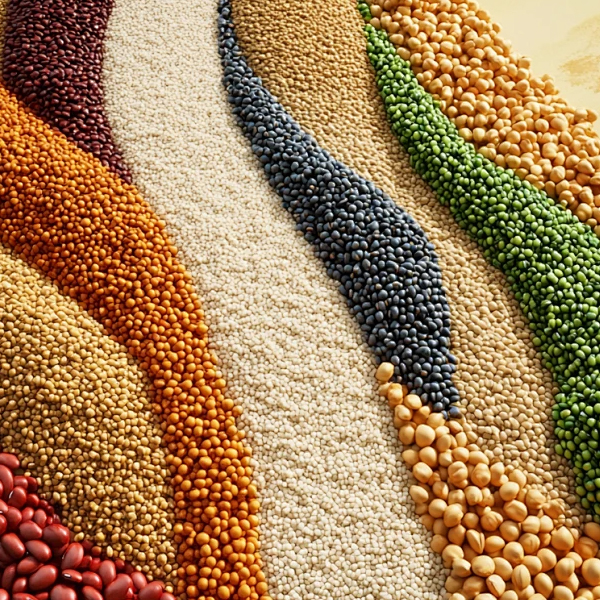
Major Legume Crops: Legumes in Poland are primarily for feed. Peas, broad beans, and lupins are the three main categories, accounting for over 90% of the country’s total legume planting area and production. They are mainly concentrated in the Lublin, Mazowieckie, and Greater Poland provinces, suitable for crop rotation and soil improvement agricultural models. Peas are the most widely planted and highest-yielding legume, used for both feed and food. They provide protein feed for livestock and are also used in canned and frozen food processing. Broad beans are the second most produced, with a combination of local varieties and varieties introduced from the EU. In addition to their use as feed, they are also an important export legume of Poland, sold to neighboring EU countries. Lupins, mainly sweet lupins, are high in protein and are a core feed protein raw material for replacing imported soybeans in China. At the same time, due to their strong nitrogen-fixing ability, they are often used as green manure and in crop rotation, and are suitable for the soil conditions of most producing areas in the country.
1. Defective or moldy parts and immature grains of grains and legumes themselves, such as broken grains/beans, shriveled grains, insect-damaged grains, moldy grains, as well as detached rice husks, wheat awns, bean pods, corn cob fragments, and straw fragments. These impurities are of the same origin as the target crop and are natural byproducts of harvesting and threshing.
2. Field weed impurities: Seeds, stems/leaves/roots of weeds that grow alongside crops in the planting field, such as oat grass seeds and brome seeds in wheat fields, quinoa seeds and barnyard grass seeds in legume fields, as well as dried and fragmented stems and roots of various weeds. These impurities are collected along with the crops during sowing and harvesting and are the main contaminants in the field.
3. Soil clods, sand, pebbles, cinders, small clods of soil, and fine silt in the field are impurities that are brought in with the roots and stems of crops during plowing and harvesting, and are also the core type of inorganic impurities.
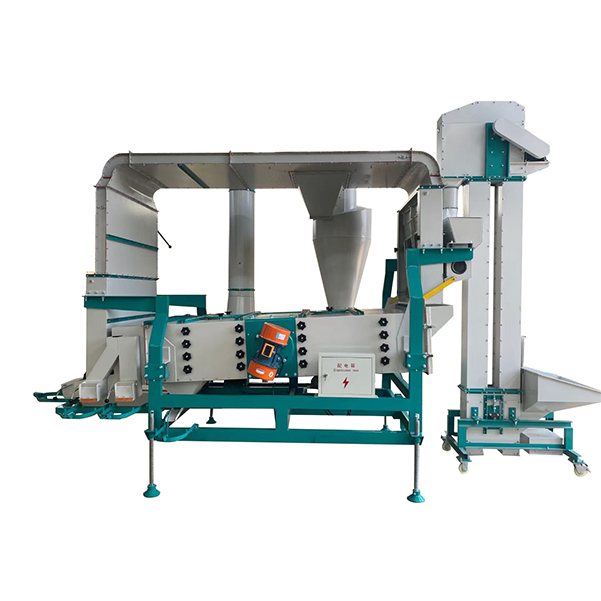
How does an air-screen cleaning machine remove impurities from grains and beans?
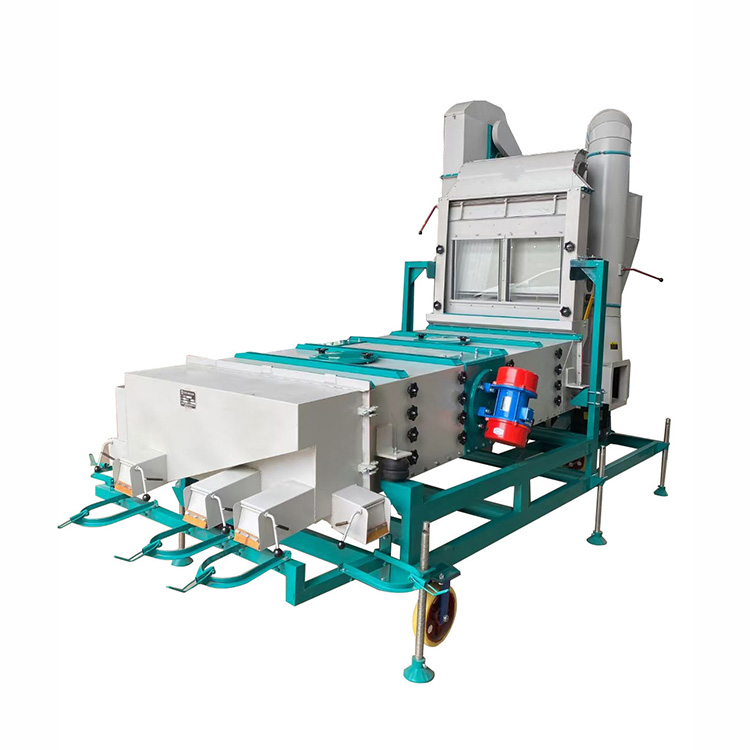
The air-screen cleaner is a fundamental core piece of equipment for cleaning grains and legumes. It utilizes the differences in aerodynamic characteristics (suspension velocity) and physical dimensions (particle size, shape) between materials and impurities. Through the coordinated operation of two core processes—air-powered cleaning and screening—it removes various impurities from grains and legumes in layers and batches. The entire process is continuous and suitable for the initial cleaning and fine selection of most grains and legumes, including wheat, corn, peas, broad beans, and soybeans.
Core Working Principle: Two Key Features, Dual Sorting All cleaning actions of the air-screen cleaner are designed around the two core differences between materials and impurities, which is also the key to its adaptability to various grains and beans:
Air Sorting Principle: Different materials have different suspension velocities (suspension velocity refers to the minimum airflow velocity that can lift a material). Plump grains and beans have a higher suspension velocity, while light impurities (such as straw fragments, shriveled grains, wheat awns, and bean pods) have a lower suspension velocity. By adjusting the directional airflow generated by the blower, light impurities can be blown away from the grains, achieving separation of light and heavy materials.
Screening and Sorting Principle: Plump grains and beans have a fixed particle size, thickness, and width, while large impurities (such as large clods of soil, coarse straw, and large stones) are larger than the grains, and small impurities (such as sand, fine soil, and broken grass seeds) are smaller than the grains. By changing the screen with different aperture sizes and shapes, grains can pass through the screen holes (or be intercepted by the screen surface), achieving separation by size.
The two principles work together to first remove light impurities, then separate large and small impurities, and finally retain qualified kernels that are uniform in size and full in weight.
Post time: Jan-26-2026