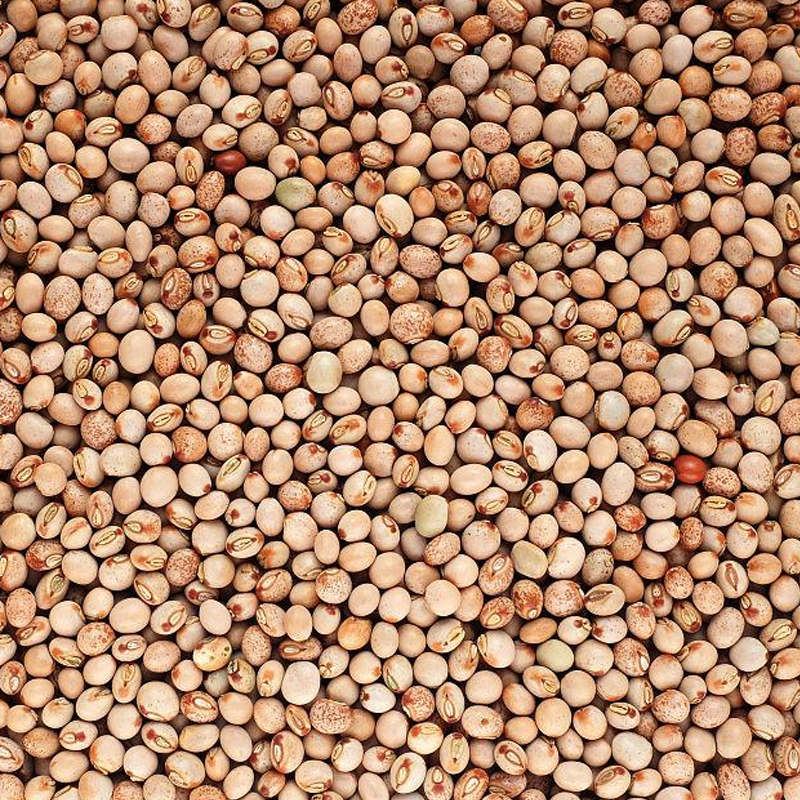
Pigeon peas—known locally as Mbaazi—are among the most significant pulse exports from Tanzania and a cornerstone of the continent’s pulse export sector. According to data from the Tropical Legumes Project and international research, Tanzania’s annual production of pigeon peas stands at approximately 316,000 metric tons (based on 2018 figures), ranking it among the top producers in Africa. This output accounts for roughly 4% of global production, with Tanzania—alongside Malawi, Kenya, Mozambique, and Uganda—forming a key export cluster for the crop. Across Eastern and Southern Africa, the total area dedicated to pigeon pea cultivation spans approximately 560,000 hectares.
In terms of exports, Tanzania is Africa’s largest exporter of pulses. In 2024, the total volume of pulse exports reached approximately 590,400 metric tons, generating roughly $392 million in foreign exchange earnings; pulses rank as the country’s third-largest agricultural export category, trailing only horticultural products and tobacco. Specifically, pigeon pea exports reached 341,100 metric tons in 2024, while the volume for the first ten months of 2025 stood at approximately 258,000 metric tons—a 19% year-on-year decline, yet still the second-highest level in history. India is the primary buyer, absorbing over 99% of these pigeon pea exports, with the remainder destined for markets such as Kenya and the United Arab Emirates. Overall, the characteristics of Tanzania’s pigeon pea sector—stable production, a strong export orientation, heavy reliance on the Indian market, and a supply base dominated by smallholder farmers—drive robust demand for processing equipment, particularly for cleaning, destoning, and grading. Furthermore, the purity level and impurity content of the product directly influence both the transaction price for exports to India and the customs clearance process.
II. Working Principle of the Air Screen Cleaner for Pigeon Beans
Pigeon beans are round or slightly elliptical, with a diameter of approximately 4–8 mm. They have a high specific gravity and a relatively hard seed coat. Impurities in the raw material typically include pod husks, stalk segments, stems and leaves, clods of soil, stones, fine sand, shriveled beans, insect-damaged beans (e.g., by pod borers), moldy beans, broken bean cotyledons, and weed seeds.
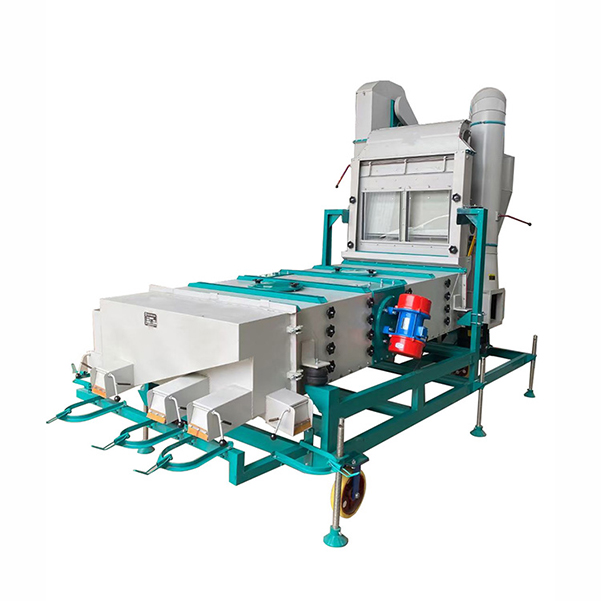
The air-screen cleaner operates by integrating two physical separation principles—screening and air-based separation (aspiration)—into a single unit. The process involves no mechanical impact or compression.
Screening Process: Pigeon beans enter the hopper uniformly and are spread into a thin, stable layer via a vibrating feeder onto the top screen deck. Driven by an eccentric mechanism, the screen assembly vibrates, causing the material to tumble and advance along the screen surface. The apertures of the top screen are slightly larger than the beans, allowing the beans to pass through while retaining larger impurities—such as pod husks, stalks, stems, leaves, large soil clods, and stones—which are then discharged through an outlet. The bottom screen features apertures smaller than the beans but larger than fine debris; it retains the pigeon beans while allowing fine sand, soil particles, small pod fragments, and weed seeds to pass through.
Air-based Separation (Aspiration) Process: A fan generates a controlled, directional airflow that acts upon the moving material. Impurities with a low specific gravity and a large surface area—such as dust, broken pod husks, chaff, shriveled beans, and lightweight weed seeds—are carried away by the airflow into a settling chamber and dust collection system. Meanwhile, the plump, high-density pigeon beans continue their downward movement toward the product discharge outlet. The airflow volume can be adjusted via dampers or a variable-frequency drive (VFD), allowing settings to be tailored to the specific impurity content of each batch.
III. Specific Advantages of the Air screen cleaner
First, it offers dual-action efficiency, simultaneously addressing large, fine, and lightweight impurities. Impurities in pigeon peas span three distinct categories: large debris (such as pod fragments and stalk pieces), fine particles (like sand and small fragments), and lightweight matter (such as shriveled grains, dust, and husks). By combining mechanical screening—which captures large and small particles—with air-based separation—which removes lightweight debris—the machine performs both coarse and intermediate cleaning in a single pass. This streamlined process minimizes material handling, thereby reducing the risk of secondary breakage and dust generation.
Second, its gentle, low-damage operation preserves the integrity of the beans and maintains high germination rates. The material is transported solely through vibration and air-cushioned suspension, with no mechanical impact or compression. This keeps the breakage and skin-peeling rates for the pigeon peas at a minimal level—a critical requirement for beans destined for export (which demand high grain integrity) or use as seed (which require high germination rates).
Third, the machine features adjustable parameters and quick-change screens, making it highly adaptable to the diverse, multi-batch raw materials supplied by smallholder farmers. Pigeon peas from Tanzania often arrive in various batches with significant differences in impurity levels, moisture content, and grain size. Key settings—such as airflow volume, vibration amplitude, and feed rate—can be adjusted independently, and screen apertures can be swapped out rapidly. This allows for on-site fine-tuning based on the specific condition of each incoming batch, ensuring consistent performance across different lots.
IV. Working Principle of Gravity Separators for Pigeon Peas
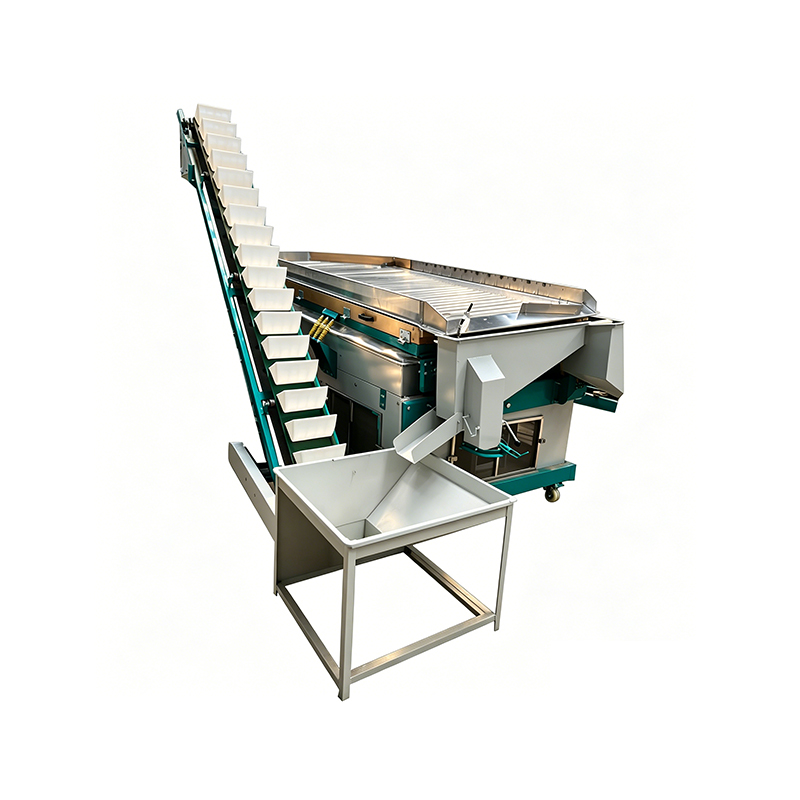
Gravity separators (also known as gravity destoners or gravity graders) are specifically designed to address challenges that air-screen cleaners cannot handle: the separation of particles with similar dimensions but different specific gravities—such as stones, sand, soil clods, and glass fragments, as well as defective beans (insect-damaged, shriveled, or moldy).
The process relies on a triple-action mechanism: upward airflow-induced fluidization, deck vibration, and inclined conveyance. As the material enters the deck, a fan forces air upward through a perforated screen, creating a uniform airflow that fluidizes the material bed. Denser particles—like stones and sand—sink to the surface of the deck, while the lighter, sound beans rise to the top. Simultaneously, an eccentric mechanism drives the deck to vibrate, and the deck is set at a specific incline. Consequently, the dense stones move upward along the slope toward the stone discharge outlet, while the sound beans move downward along the slope toward the product outlet. Key parameters—airflow volume, vibration amplitude, frequency, and deck inclination—must be precisely calibrated based on the specific gravity of the material.
V. Key Advantages of Gravity Separators
First, they ensure the complete removal of “co-sized” stones, meeting strict export inspection standards. Pigeon peas exported to India for *dal* (split pulse) processing are subject to rigorous limits on stone content. The presence of stones not only causes equipment wear but also results in a gritty texture in the final product. Gravity separators efficiently remove stones and sand that are similar in size to the beans, ensuring the stone content remains within export-required limits.
Second, they enable purification based on specific gravity, effectively eliminating insect-damaged and shriveled beans. Pigeon peas from Tanzania are frequently affected by pod borers; insect-damaged beans are hollowed out and have a significantly lower specific gravity, as do immature, shriveled beans. Gravity separation identifies and removes these “internally damaged” beans, enhancing the overall plumpness and uniformity of the final product—factors that directly influence export grading and pricing.
Third, they reduce the operational load on downstream equipment and improve the efficiency of the entire processing line. By the time the beans—already refined through gravity-based sorting—enter the optical sorter, they are exceptionally clean. This allows for more accurate identification of off-colored items and more precise air-jet ejection, simultaneously boosting both the purity of the final product and the overall processing capacity, consistently achieving a purity level of over 99.5%.
An optimal cleaning configuration for pigeon peas consists of an air-screen cleaner, a destoner, a grading screen, a gravity separator, and an optical sorter, followed by a weighing and packaging unit—all supported by bucket elevators, storage silos, and a dust collection system. The air-screen cleaner removes pods, stalks, fine sand, and light impurities; the destoner eliminates stones and grit; the grading screen sorts the peas by size (with larger grains designated for export and smaller ones for domestic sale or further processing); the gravity separator refines the product; and the optical sorter removes discolored or moldy beans. This setup is particularly effective in markets like Tanzania, which are characterized by smallholder-sourced raw materials, an export-oriented focus, and a strong reliance on the Indian market. A more thorough initial cleaning enhances the efficiency of all downstream equipment, ensuring greater consistency in the purity and grading of the final product.
Located in Shijiazhuang, Hebei Province, Hebei Taobo Machinery operates a 10,000-square-meter standardized production facility equipped with CNC machining technology and a professional R&D and commissioning team. With products exported to over 50 countries, the company has accumulated extensive on-the-ground project experience, particularly in the African pulse-processing market. We provide customized production line layouts tailored to specific client requirements—including raw material impurity profiles, local power supply voltages, facility constraints, and export standards. Our comprehensive service package encompasses export-grade wooden crating, on-site installation guidance, and operator training. To address the specific challenges associated with pigeon beans—such as their large size, tough seed coats, the presence of stones similar in size to the beans, and high rates of insect damage or shriveled grains—we have optimized our screen specifications, fan parameters, and gravity separator deck structures. Unlike standard grain-processing lines, our systems ensure minimal breakage and high-precision sorting.
Post time: Nov-19-2026