
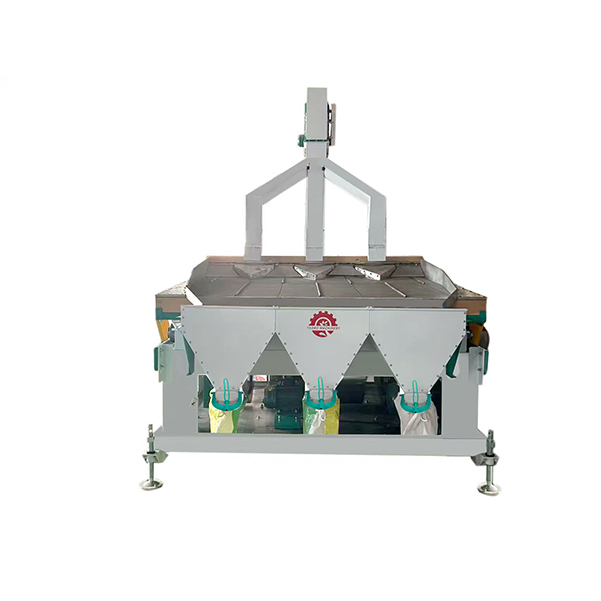
The destoner utilizes a combination of air buoyancy, vibration, and specific gravity differences for separation. Since the density of stones, sand, and soil is significantly higher than that of grains and legumes, the machine employs reciprocating screen vibration alongside an upward airflow from the bottom; this causes the material to become fluidized and stratified, with heavy stones and sand sinking to rest against the screen mesh while lighter grains float in the upper layer. Vibration drives the stones to move up the inclined screen surface for discharge, while the grains flow downward; this process effectively removes “companion stones”—stones and sand particles similar in size to the grain—that cannot be eliminated through standard screening or air separation alone.
II. Core Structural Components
Feeding and Material Spreading Mechanism: Includes a feed hopper and a spreading baffle; ensures material is distributed evenly across the screen surface with consistent thickness, a prerequisite for stable stratification.
Vibrating Screen Body: Features an internal stainless steel woven mesh to support the material and capture heavy impurities; equipped with an eccentric vibration motor with adjustable amplitude.
Air Supply System: Comprises a centrifugal fan, air ducts, and airflow control dampers; generates an upward airflow while regulating air pressure and volume.
Screen Frame Tilt Adjustment Assembly: Allows for manual fine-tuning of the screen surface inclination angle.
Stone Recirculation and Refinement Zone: Utilizes a reverse airflow device to recover grain trapped within the stones, thereby minimizing loss.
Discharge Outlets: Separate outlets for cleaned grain and discharged stones.
Using a Gravity Destoner for Kidney Beans and Sesame: Workflow and Functional Roles
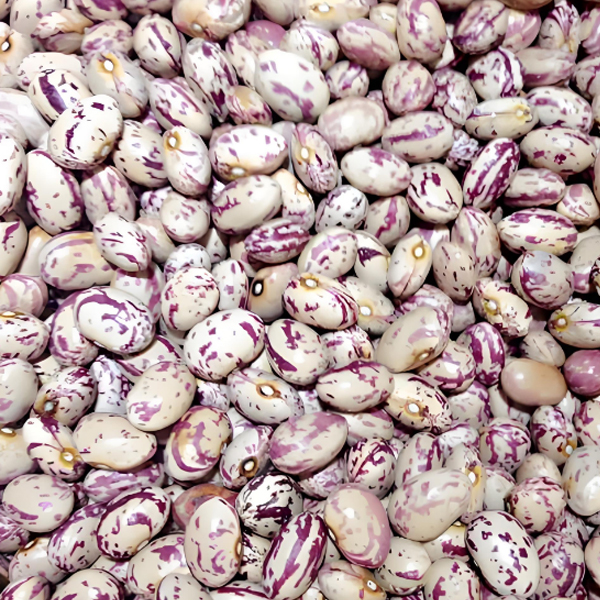
Both applications utilize the core principle of gravity-based separation via vibration and airflow; however, due to significant differences in particle size and weight, the specific parameters for airflow, vibration amplitude, and deck inclination differ. While the process flow is identical, the operating settings vary to effectively remove “peer stones”—stones and clods of earth similar in size to the seeds—which are heavy impurities that standard screening or air separation cannot eliminate.
I. Universal Pre-processing Step (Essential; skipping this significantly reduces destoning efficiency)
Raw kidney beans and sesame seeds must first undergo pre-treatment in an air-screen cleaner:
Upper coarse screen: Removes large impurities such as stalks, pods, weeds, and large soil clods;
Lower fine screen: Removes fine sand/soil, broken fragments, and shriveled seeds;
Air suction/dust removal: Extracts dust, lightweight shriveled seeds, and debris;
Once pre-treated and cleaned, the material is evenly fed into the destoner’s inlet via a conveyor (elevator) to prevent mixed impurities from disrupting the gravity-based separation process.
II. Integrated and Unified Workflow
1. Uniform Material Feeding
Material enters from the top hopper; an internal distribution plate spreads the material evenly across the full width of the screen. An observation window allows for real-time monitoring of the feed rate, as a proper material layer thickness is essential for stable stratification:
Kidney beans (large and heavy): Maintain a slightly thicker material layer.
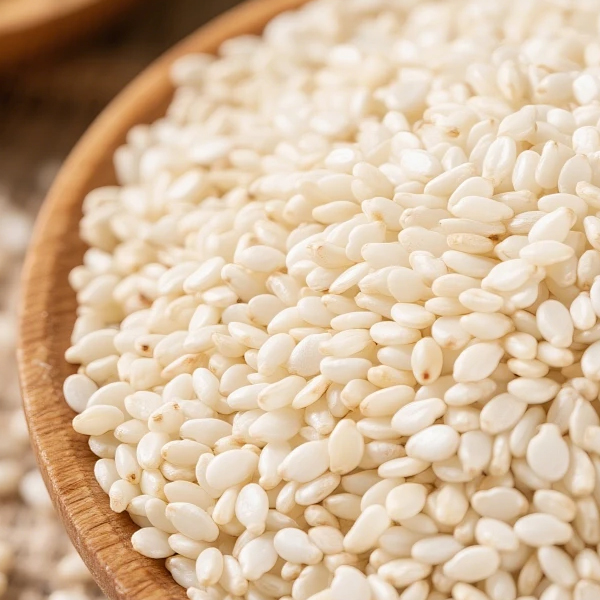
Sesame seeds (tiny and lightweight): Maintain a thin, light layer to prevent the airflow from being stifled and ensuring proper fluidization.
2. Bottom Airflow Fluidization + Automatic Density-Based Stratification (Core Process)
A fan continuously blows air upward from beneath the screen mesh; combined with the screen body’s slight reciprocating vibration, the material enters a suspended, fluidized state and automatically stratifies based on density differences:
Lower layer (in contact with the 304 stainless steel mesh): Stones and soil clods, being much denser than the seeds/grains, settle and cling to the screen surface.
Upper layer: Plump kidney beans or sesame seeds remain suspended in the airflow layer, not touching the screen mesh.
Parameter adjustments:
Kidney beans (heavier): Require higher air pressure and larger vibration amplitude.
Sesame seeds (tiny and prone to drifting): Require lower air pressure and gentle vibration amplitude to prevent the seeds from being blown away or suffering breakage and hulling.
3. Differential Counter-Directional Separation
The screen surface is set at a slight incline; combined with directional reciprocating vibration, the two types of material move in opposite directions:
Upper layer (clean grain/seeds): Suspended and free from friction, they slide down the inclined screen surface under gravity and are discharged through the clean grain outlet at the front of the machine.
Lower layer (stones and soil clods): In close contact with the screen surface and subject to high friction, they are propelled by vibrational inertia to “climb” the slope toward the stone collection zone at the rear of the screen.
4. Purification via Reverse Airflow in the Selection Zone (Key to Minimizing Loss)
A localized reverse airflow is applied in the stone collection zone: it blows any stray kidney beans or sesame seeds mixed in with the stones back into the main material layer, significantly reducing grain loss. As stones accumulate, the waste material is periodically discharged through the stone outlet. 5. Downstream Integration
Once the cleaned kidney beans or sesame seeds are discharged, they can proceed directly to color sorting, polishing, and packaging; stones and mud/debris are collected and removed separately.
III. Specialized Cleaning Functions and Configuration Highlights for Kidney Beans
Core Functions
Precisely removes stones and hard soil clods of similar size to the beans, preventing damage to teeth during consumption and protecting machinery—such as dehullers, polishers, and packaging equipment—from abrasion or impact.
Simultaneously removes mud clumps and severely moldy, hardened beans, enhancing the product’s visual quality and meeting purity standards for domestic supermarkets and export markets (purity levels up to 99.5%).
Protects downstream processing machinery; prevents hard stones from damaging screens or roller equipment, thereby extending the overall service life of the machine.
Parameter Highlights
Features a steeper screen inclination, high air pressure, moderate vibration frequency, and a large-aperture stainless steel woven screen; designed to accommodate large, rounded kidney beans while minimizing screen clogging.
IV. Specialized Cleaning Functions and Configuration Highlights for Sesame Seeds
Core Functions
Removes fine sand, small stones, and mud pellets, effectively eliminating the major issue of grit—which causes discomfort when chewing—during roasting or sesame oil extraction; an essential process for sesame oil and roasted sesame processing plants.
Utilizes gentle vibration and low-pressure airflow to strictly minimize breakage and unwanted dehulling, preserving the integrity of the seed coat and ensuring optimal oil yield, aroma, and color.
Removes high-density insect-damaged seeds and carbonized particles, elevating the hygiene standards of roasted or hulled sesame products to comply with food processing regulations.
Parameter Highlights
Features low air pressure, gentle amplitude, a shallower screen inclination, and a fine-mesh stainless steel screen; utilizes soft airflow for fluidization to prevent the loss of tiny seeds or kernel breakage.
Post time: Aug-11-2026