
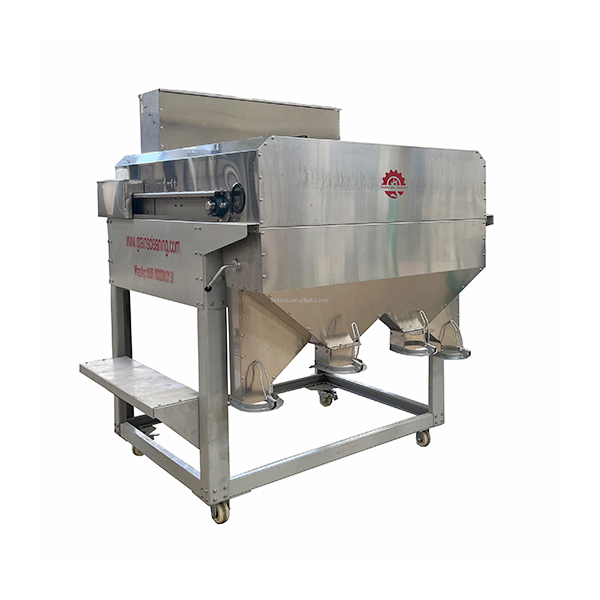
Wheat and soybeans are inherently non-magnetic organic materials, whereas soil clods harvested from the field contain weakly magnetic minerals—such as iron oxides and ferrites—that ordinary magnets cannot capture. This equipment utilizes a high-intensity rare-earth permanent magnet roller (generating a field of 14,000–18,000 Gauss) to create a confined, powerful magnetic field, achieving separation based on the difference in parabolic trajectories.
As the material is conveyed at high speed to the magnetic roller at the discharge end, it is projected forward in a parabolic arc. Clean wheat and soybeans, unaffected by magnetic force, travel further due to inertia; conversely, magnetic soil clods are deflected downward by the strong magnetic pull, resulting in a shorter horizontal projection distance. An adjustable splitter baffle separates the two distinct trajectories, directing clean grain into the finished product outlet and soil clods into the waste discharge outlet, thereby completing the separation process.
II. Complete Workflow
Uniform Feeding and Spreading
Wheat or soybeans are fed into the top hopper by an elevator. A grain-spreading mechanism and a variable-frequency distribution device spread the material evenly across the conveyor belt, ensuring a thin, uniform layer to prevent stacking—which could shield the material from the magnetic field—and guaranteeing that every grain and soil clod is exposed to the field. A pre-filtering magnet captures strongly magnetic debris (such as iron nails or filings) beforehand, protecting the conveyor belt and main magnetic roller from scratches caused by hard objects.
Conveyance into the High-Intensity Magnetic Field Zone
The variable-speed conveyor belt moves the material at a constant rate—with speed adjustable based on the specific gravity of the wheat or soybeans—carrying the material smoothly through the confined, high-intensity magnetic field zone above the magnetic roller.
Forward Projection and Trajectory Divergence
Upon leaving the end of the belt, the material is projected forward; non-magnetic wheat and soybeans maintain their original trajectory and fall at a greater distance, while weakly magnetic soil clods are pulled downward by the magnetic roller, forcing their flight arc lower and causing them to drop sooner.
Discharge via Splitter Baffle
A manually adjustable splitter baffle precisely separates the two falling paths, directing clean wheat/soybeans to one side and collecting soil clods and impurities on the other. Impurities automatically detach and are discharged as they leave the magnetic field.
Permanent magnets enclosed within the belt remain stationary; as the belt continues to rotate and move out of the magnetic field zone, the attracted impurities lose magnetic retention and automatically drop into the waste collection bin, eliminating the need for manual, continuous cleaning of the magnetic roller surface.
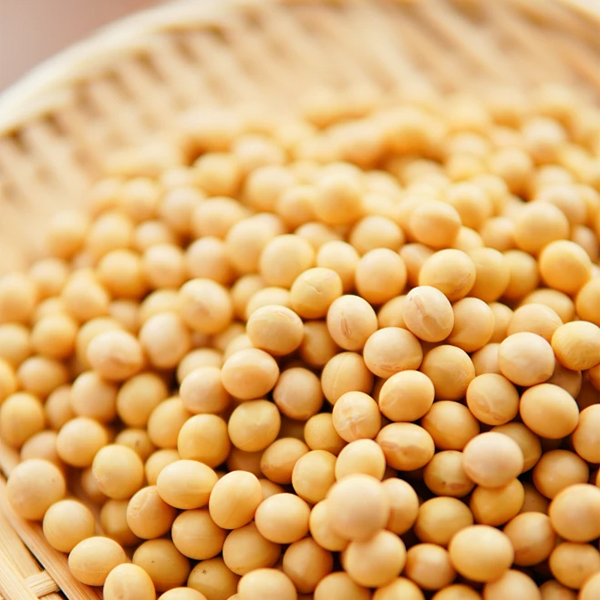
Key Differences in Magnetic Soil Removal: Wheat vs. Soybeans
While the fundamental separation principle remains unchanged (utilizing differences in horizontal projection trajectories combined with high- and low-intensity magnetic separation to isolate soil clumps), the differences arise entirely from the physical properties of the two crops. These differences manifest in material spreading, belt speed, diverter baffle positioning, feed flow rate, pre-processing steps, and breakage prevention measures.
1. Differences in Basic Material Properties
Wheat grains are small, have a low thousand-kernel weight, and possess high fluidity, making it easy to form a thin, uniform layer. Soybeans, conversely, have a higher individual kernel weight, a wider range of particle sizes, high sphericity, and greater inertia; they naturally travel further when projected horizontally. Soybeans are prone to “bridging” (forming voids between grains), which can lead to uneven layer thickness. Soil clumps mixed with wheat tend to be smaller, whereas those accompanying soybeans are generally larger and heavier.
2. Conveyor Belt Speed (Variable Frequency Control)
For Wheat: Higher belt speed. Due to the low weight of wheat grains, low speeds can cause them to clump or pile up. Increasing the belt speed ensures sufficient initial velocity for horizontal projection, thereby widening the gap between the landing points of the grain and the magnetic soil clumps.
For Soybeans: Lower belt speed. Soybeans have significant mass and inertia; excessive speed can cause heavy, magnetic soil clumps to be projected too far, preventing sufficient trajectory separation from the soybeans and resulting in soil contamination in the final product. Lowering the speed extends the duration of magnetic field exposure, allowing the magnetic force to effectively alter the flight arc of the heavy soil clumps.
3. Material Spreading and Layer Thickness Control
Wheat: The material layer should be relatively thin and spread across the full width of the belt, with flow rates potentially increased. Because wheat grains are small, an overly thick layer can obscure small soil clumps at the bottom, hindering magnetic penetration and reducing soil removal efficiency. The spreading diverter baffle should be adjusted for a wide, uniform spread pattern.
Soybeans: The material layer must be thinner, and the feed flow rate appropriately reduced. Large soybean grains create significant gaps when stacked; a thick layer can cause grains to tumble and bounce, disrupting the horizontal projection trajectory. Vibration feeder frequency should be lowered to prevent soybeans from colliding with one another, which could cause skin breakage or splitting. 4. Variation in Diverter Baffle Position
Wheat Processing: The baffle is positioned further back. Light wheat kernels are projected further, while magnetic soil clods fall closer to the source due to magnetic attraction; shifting the baffle rearward separates these two landing zones, thereby reducing product loss.
Soybean Processing: The baffle is moved forward. Soybeans naturally land further away when projected, whereas heavier magnetic soil clods are pulled down early by magnetic force; moving the baffle forward ensures that heavy clods fall accurately into the impurity discharge chute while clean soybeans enter the finished product bin, preventing heavy clods from clearing the baffle and contaminating the final product.
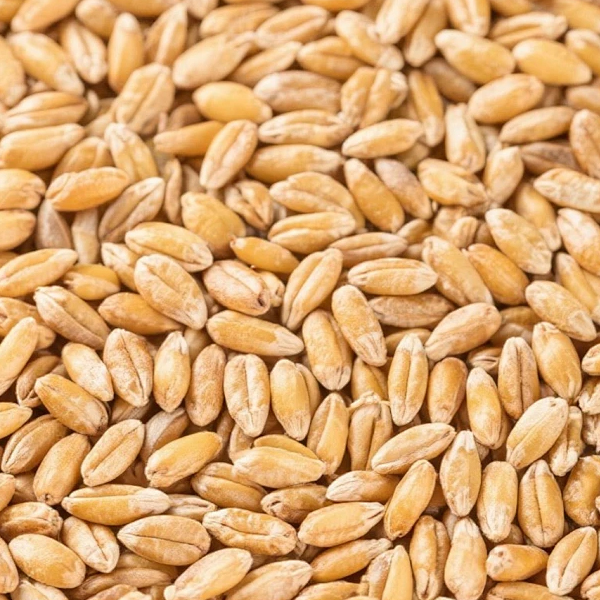
5. Throughput and Breakage Prevention Requirements
Wheat: Higher throughput per machine is permissible; wheat kernels are highly resistant to crushing and impact, posing a low risk of breakage, allowing for full-load operation.
Soybeans: Rated throughput is reduced, and gentle, low-speed conveying is maintained throughout the process; soybean skins are prone to damage from impact, and broken beans complicate subsequent color sorting and polishing. Consequently, the entire feeding system and belt speeds are calibrated to prioritize preserving the integrity of the beans.
6. Differences in Upstream and Downstream Processing Lines
Wheat Cleaning Line: Air-screen cleaning → Gravity destoning → Magnetic soil removal → Wheat scouring/polishing; after soil removal, wheat undergoes scouring to remove surface hairs and impurities in the crease, while magnetic separation targets fine magnetic soil particles.
Soybean Cleaning Line: Air-screen cleaning → Gravity destoning → Magnetic soil removal → Color sorting; soybeans do not require a scouring step. Magnetic separation focuses on removing large soil clumps similar in size to the beans to prevent them from damaging the color sorter’s lenses.
7. Comparison of Commissioning and Assessment Methods
Wheat Commissioning Observations: Falling material shows clear stratification—light wheat drifts further away, fine soil particles drop earlier, and the finished product is virtually free of soil specks.
Soybean Commissioning Observations: Ensure beans remain intact without skin breakage; ensure all large soil clumps drop out early; ensure the discharge stream consists of clean beans free from dark soil clumps; and minimize product loss by preventing good beans from being rejected along with impurities.
Post time: Sep-01-2026