
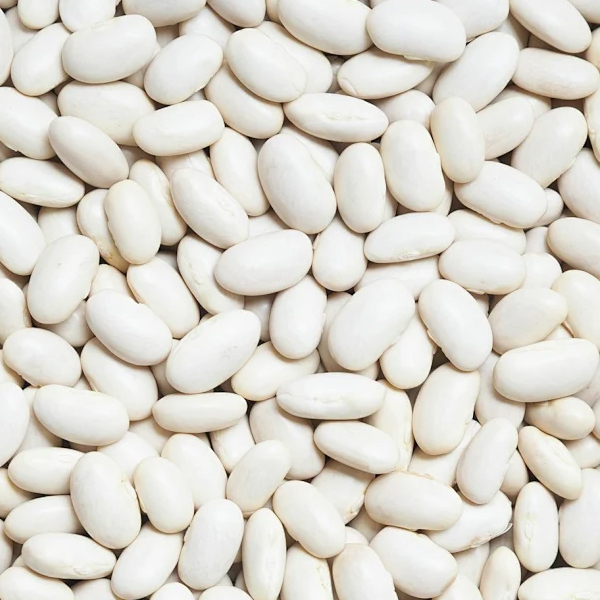
I. Types of Impurities in White Kidney Bean Raw Material
White kidney beans are large, flat, and elongated; they are typically harvested and sun-dried. Impurities include light impurities, large impurities, small impurities, heavy impurities of similar size (“co-sized” heavy impurities), defective kernels, and foreign seeds. Processing for food-grade export requires the removal of these impurities, with different types requiring specific equipment.
Light Impurities (Removed via air separation in an air-screen cleaner)
Bean skin fragments, shriveled beans, insect-damaged light kernels, broken cotyledons, pod fragments, stem/leaf debris, dust, grass clippings, and weed seeds. These impurities have low specific gravity and are separated using negative-pressure airflow; dust content is often high due to the sun-drying process.
Large Impurities (Intercepted and discharged by the upper screen of the air-screen cleaner)
Pods, bean stalks, weed roots/rhizomes, large soil clods, twigs, woven rope fragments, and large stones. These are larger than the bean kernels and cannot pass through the upper screen mesh, so they are intercepted and discharged directly from the screen surface.
Small Impurities (Sifted out by the lower screen of the air-screen cleaner)
Fine sand/soil, mud powder, tiny broken cotyledon fragments, and small gravel. These have a smaller particle size than standard white kidney beans and fall through the lower screen mesh for separation.
Heavy Impurities of Similar Size (Cannot be removed by air-screen cleaners; require a gravity destoner)
Stones, mud balls, and hard soil granules similar in size to the beans. Because their dimensions match the beans, they cannot be separated by screens or airflow; these are the most strictly controlled impurities for export orders and the primary cause of grittiness in the finished product. High-density moldy kernels and hard, insect-damaged kernels are also separated at this stage.
Defective Kernels (Key focus for food-grade and export quality control)
Broken cotyledons, insect-damaged kernels, sprouted kernels, moldy kernels, kernels with disease spots, frost-damaged/shriveled kernels, and misshapen small beans. Broken cotyledons can easily increase during vibration in transport; grading screens can separate small broken fragments, while defective beans with significant density differences are removed by gravity separators. High-end orders may also require subsequent color sorting to remove beans with discoloration or mold spots. Foreign Impurities
Seeds of other legumes and grains, as well as metallic impurities (iron filings); iron filings require magnetic separation equipment for removal.
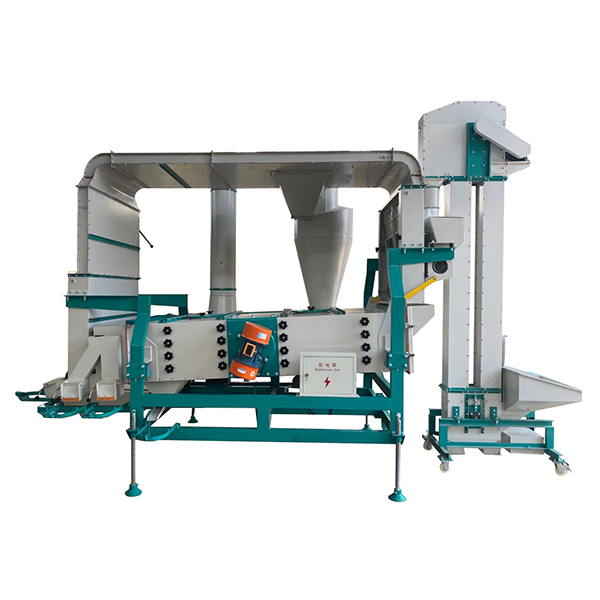
White kidney beans are characterized by their relatively large size and elongated, flat shape; they command high standards for commercial appearance and are primarily destined for export, canning, or deep processing. Requirements regarding breakage prevention, removal of stones (especially those similar in size to the beans), size uniformity, and color purity are significantly stricter than those for standard soybeans. The three pieces of equipment serve distinct functions, and the standard operational sequence—Air-Screen Cleaner → Gravity Destoner → Grading Screen—must be strictly followed without altering the order.
II. Air-Screen Cleaner (First Stage: Initial Impurity Removal)
Workflow within the white kidney bean processing line:
Material is fed via an elevator into the air-screen cleaner and passes through an aspiration channel; a negative-pressure airflow separates light impurities such as dust, bean skin fragments, shriveled beans, insect-damaged (lightweight) beans, and plant debris.
Material falls onto a specialized double-layer vibrating screen with round perforations: the upper screen (large holes) catches large impurities like pod fragments, stalks, large soil clods, and grass clumps; the lower screen sifts out fine soil, broken bean cotyledons, and small stone fragments.
Intact, high-quality white kidney beans discharge from the middle outlet and are evenly fed into the next stage—the gravity destoner.
Reference specifications for specialized white kidney bean screens: upper layer round holes φ12–14mm, lower layer round holes φ7–8mm. Round holes are preferred to prevent beans from getting stuck or suffering skin cracks/damage caused by elongated slots. Airflow and vibration amplitude are set to moderate levels to minimize bean breakage.
Core Functions:
Removes light, large, and fine impurities to complete basic initial cleaning, serving as a preliminary step to reduce the load on the rest of the line.
Screens out broken beans and soil beforehand, preventing large amounts of debris from entering the gravity destoner, clogging screen meshes, or disrupting fluidization and stratification, thereby ensuring stable destoning performance.
Ensures uniform material distribution, providing the gravity destoner with a clean feed of relatively consistent particle size.
Features enclosed dust removal to eliminate floating dust introduced during the sun-drying of the raw beans. Advantages for White Kidney Bean Processing
Combines air separation and screening for high efficiency; protects downstream destoners—an essential pre-processing step for white kidney bean lines;
Screens are easy to change; features specialized round-hole screens tailored to the large, elongated shape of white kidney beans, minimizing impact and breakage during screening;
Equipped with an integrated dust removal system, making it suitable for food-grade processing environments geared toward export;
Capable of performing standard preliminary cleaning as a standalone unit; suitable for independent use in low-capacity operations.
Limitations: Cannot separate stones or mud clods that are similar in size to the white kidney beans.
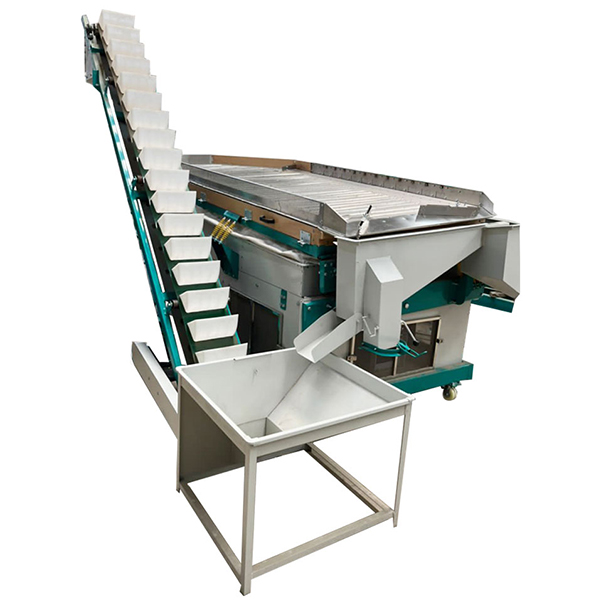
III. Specific Gravity Destoner (Second Stage: Core Destoning & Density-Based Sorting)
Workflow within the white kidney bean processing line:
Cleaned beans (post-air-sieve pretreatment) are fed evenly onto the specific gravity screen deck; upward airflow from the bottom combined with the screen’s reciprocating vibration creates a fluidized, stratified state;
Lower-density white kidney beans float in the upper layer and slide down the inclined screen surface toward the clean product outlet;
Higher-density stones and hard soil clods settle against the stainless steel mesh and—driven by vibration—move “uphill” in the opposite direction to the stone collection zone;
A reverse airflow in the precision sorting zone blows any entrained beans back into the main product layer, minimizing loss, while stones and grit are periodically discharged through the stone outlet;
Operating parameters for white kidney beans: Air damper at 70%–80%, medium-to-high amplitude, 3°–4° inclination, and medium material bed thickness—optimized for the beans’ large size and relatively high unit weight.
Core Functions
Primary Value: Removes stones, soil clods of similar size, and high-density impurities that air sieves cannot catch. This addresses the critical risk of grit contamination, protects downstream equipment (polishing, color sorting, canning), prevents “grittiness” in the final product, and meets export purity standards;
Simultaneously separates high-density defective beans, such as hard moldy beans, “stony” (hard/undeveloped) beans, and heavily insect-damaged beans;
Dry cleaning process (no water added); preserves the beans’ moisture content and eliminates the need for re-drying.
Advantages for White Kidney Beans
Specifically targets the stone/grit residue issues most strictly controlled in white kidney bean exports; achieves high destoning efficiency with product purity reaching 99.5%;
Adjustable parameters accommodate the fluidization of large-grain beans; the reverse airflow structure minimizes product loss (beans being carried out with the stones);
Stainless steel screen surface complies with food hygiene standards, making it suitable for food-grade, canning, and export applications.
Important Distinction: The specific gravity machine sorts by density, not by size; it cannot replace a grading screen used for size classification.
IV. Grading Screen (Post-processing Stage: Size-Based Classification)
Typically positioned after the destoning stage; while clients often confuse it with the previous two machines, its function is entirely distinct. Workflow within the White Kidney Bean Processing Line
White kidney beans—having already been cleared of sand, stones, and impurities via air-screen cleaning and destoning—are fed into a multi-layer grading sieve;
Using multi-layer screens with varying aperture shapes (round or elongated) and sizes, the beans are sorted into 2–3 size categories based on length and thickness: large, medium, and small/broken beans;
Beans of different specifications are discharged separately for packaging or further processing, while small or irregularly shaped beans are rejected.
Core Functions
Grades and categorizes beans by geometric dimensions to ensure uniform particle size—a critical step for export pricing, graded sales, and canning;
Performs a secondary removal of residual broken cotyledons and small, irregularly shaped or foreign beans;
Improves visual uniformity and meets specific customer order requirements, thereby enhancing premium pricing potential.
Typical grading sieve apertures: e.g., a three-layer setup of 12mm/10mm/8mm to separate beans into large, medium, and small grades.
Advantages for White Kidney Beans
Sorts purely by size with high grading precision; ideal equipment for export orders and graded sales;
Independent grading operation does not interfere with impurity removal or destoning processes;
Multi-layer screens allow for flexible aperture combinations to produce multiple specifications as needed.
Limitations: Cannot remove stones of similar size to the beans or light/shriveled impurities; must be positioned after the air-screen cleaner and destoner, as it cannot replace those initial cleaning units.
Post time: Aug-20-2026