
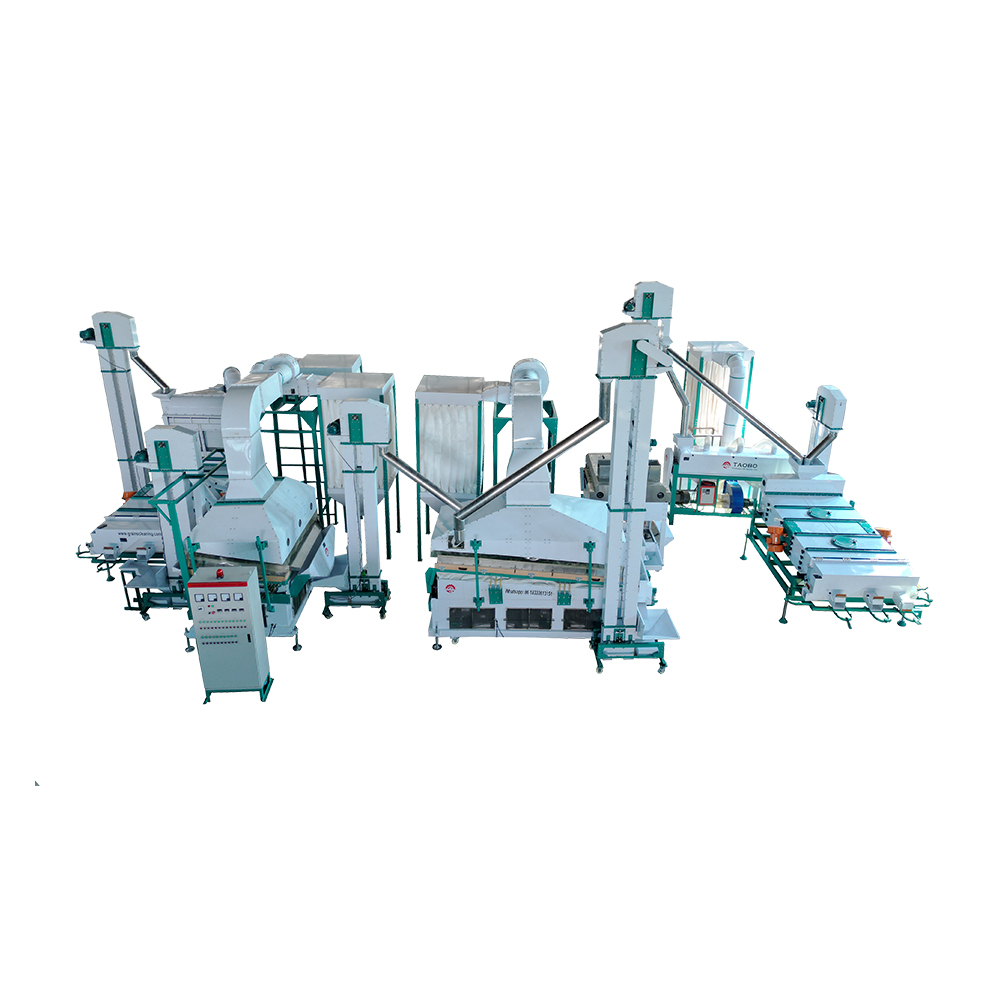
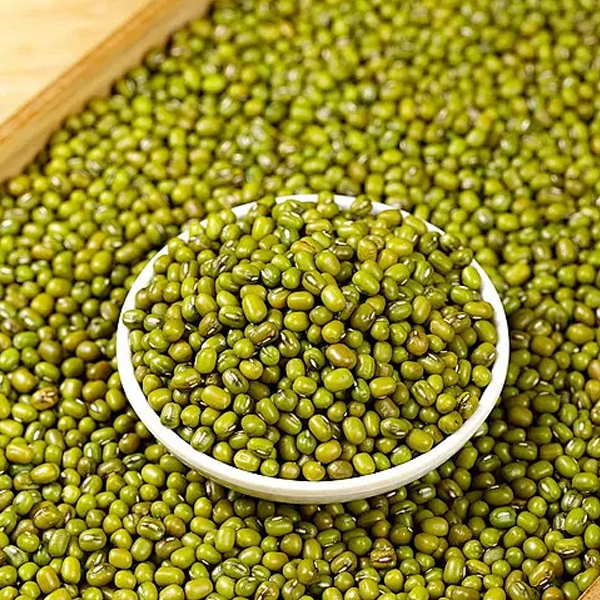
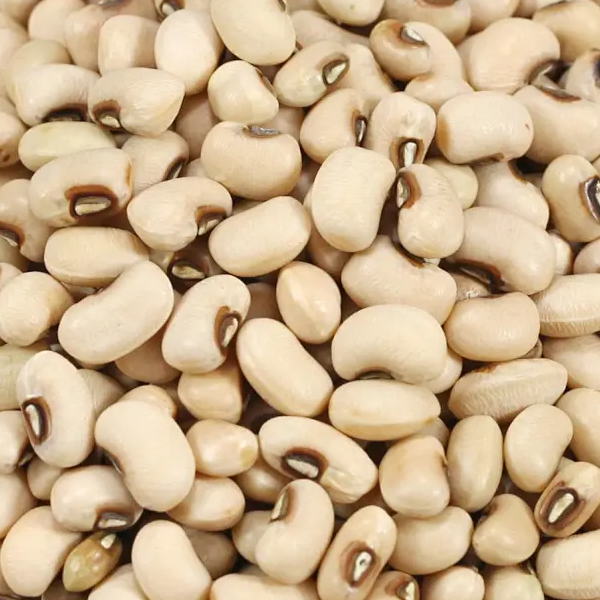
The complete bean cleaning production line follows a processing logic that proceeds from coarse to fine, removing impurities in stages and employing physical separation methods. It utilizes five key differentiating factors—particle size, weight, density, magnetic properties, and color—to achieve multi-stage purification, transforming raw field crops into commercial-grade beans, premium export-quality beans, or seed beans. Production capacity can be flexibly customized, ranging from compact, simple lines and standard commercial lines to comprehensive, high-end lines for export or seed processing; the system is suitable for all types of edible beans, including mung beans, adzuki beans, kidney beans, chickpeas, soybeans, black beans, pigeon peas, and lentils.
I. Complete Standard Process Flow (High-end Export/Seed Solution)
Raw Material Intake Hopper → Bucket Elevator → Pre-cleaning Screen → Elevator → Double air Screen Cleaner → Elevator → Destoner → Elevator → Gravity Separator → Magnetic Separator → (Bean Polisher) → Finished Product Grading Screen → Finished Product Hopper → Quantitative Packaging Machine; the entire line is equipped with a negative-pressure dust extraction system and an electrical control cabinet to ensure continuous, automated production.
1. Primary Scalper/Screen
Serving as the initial pre-treatment unit in the processing line, this machine primarily handles large impurities found in raw materials. It utilizes a rotating cylindrical screen to remove oversized contaminants—such as bean stalks, large soil clods, woven bag fragments, large stones, and weed clumps—thereby protecting downstream precision equipment from damage caused by heavy debris, reducing the load on subsequent machinery, and providing an ideal first step for cleaning bulk incoming materials.
2. Air-Screen Cleaner (Dual Air-Screen System)
A core piece of cleaning equipment for legumes, combining vibrating screen separation with both vertical and horizontal air classification. Multi-layer interchangeable screens grade beans by size, separating fine dust, broken beans, small stones, and large shriveled beans; meanwhile, adjustable airflow removes light impurities such as bean hulls, shriveled grains, moldy/light beans, dust, and straw fragments. Capable of both size grading and light impurity removal to ensure basic purity, it is a standard machine in legume processing lines. Adjustable parameters include vibration amplitude, machine inclination, feed rate, and fan airflow; interchangeable screens allow for the processing of various legume types, including soybeans, kidney beans, mung beans, and chickpeas.
3. Destoner / Gravity Separator
Designed to remove “co-sized” impurities—such as stones, mud clods, and heavy debris—that are similar in size to the beans and cannot be separated by standard screens. Utilizing the principles of airflow and gravity-based vibration separation, the material stratifies on an inclined perforated deck; heavier stones sink to the screen surface and are conveyed out, while sound beans float and flow toward the finished product outlet. This equipment effectively removes the most difficult-to-separate impurities (stones of similar size), significantly reducing the stone content in the final product—an essential step for food-grade legume processing.
4. Magnetic Separator
Uses strong magnetic force to capture metal impurities and soil clods—such as iron nails, screws, filings, and broken metal parts—mixed into the product stream. Typically installed at the discharge point of an elevator or the inlet of a storage hopper, it prevents hard metal objects from entering and damaging expensive components in downstream equipment like color sorters and polishers, thereby ensuring both equipment safety and food hygiene. 5. Bean Polisher
This is a piece of finishing and cleaning equipment. It uses internal polishing rollers to abrade the bean surfaces, removing surface dust, mud spots, black spots, and residual seed coats. It cleans away dirt from the skin, enhances the beans’ luster, improves their visual quality and market appeal. It is primarily used for processing premium-grade beans intended for export; this step may be omitted for standard feed-grade beans.
6. Dust Removal System
This is an auxiliary cleaning system that centrally collects dust and bean-coat fragments from various dust-generating points along the production line. It controls workshop dust pollution, recovers small amounts of usable broken beans, and improves the production environment.
7. Grading Screen
If the client requires beans to be sorted into different size categories (large, medium, and small), an independent grading screen is added after the main cleaning stage. It utilizes screens with varying aperture sizes to sort the finished beans into multiple specifications, meeting diverse market pricing requirements.
Working Principle of the Gravity Separator
Density-based separation is achieved through a combination of directional reciprocating vibration and a uniform fluidizing airflow passing through the deck. Material is spread evenly across an inclined separation deck featuring a permeable mesh surface; an upward airflow fluidizes the layer of beans, causing them to become suspended. High-quality, plump, and dense beans sink to rest against the deck surface, where vibration propels them upward toward the high end of the deck. Conversely, lighter beans—such as those that are insect-damaged, shriveled, moldy, or immature—float in the upper layer and flow downward along the incline to the discharge point. Intermediate mixed material can be recirculated for a second pass. The machine sorts the product into multiple discharge categories—such as premium heavy beans, medium-grade beans, light/inferior beans, and debris—thereby achieving quality-based grading.
Explanation of Capacity Grading for Bean Cleaning Production Lines
Capacity is measured in tonnes per hour (t/h). Output is not a fixed figure but depends on the bean variety, raw material impurity levels, system configuration complexity, and target purity. The same equipment yields higher capacity for large-grain soybeans and lower capacity for small-grain mung beans or adzuki beans; adding processes such as gravity separation, polishing, and color sorting will slightly reduce the line’s effective capacity.
I. Small-Scale Basic Production Line
Standard hourly capacity: 1–2 t/h
Simplified configuration: Hopper + Air-screen cleaner + Gravity destoner + Packaging machine
Suitable for standard commercial beans for the domestic market, performing only basic impurity removal; processes 8–16 tonnes of raw grain per 8-hour workday.
Smaller standalone model: 0.5–1 t/h; suitable for ad-hoc processing by individual growers.
II. Medium-Scale Standard Commercial Bean Production Line (Grain trading companies, food ingredient plants)
Standard hourly capacity: 3–5 t/h
Complete basic configuration: Pre-cleaning screen → Air-screen cleaner → Gravity destoner → Magnetic separator → Grading screen → Packaging
Meets domestic food-grade procurement standards and impurity limits; processes 24–40 tonnes daily; the most common mainstream specification in the domestic market.
III. High-End Export / Premium Seed Production Line (Seed processing plants)
Standard hourly capacity: 5–8 t/h
Full precision processing configuration: Pre-cleaning → Air-screening → Destoning → Gravity separation → Magnetic separation → Polishing → Color sorting → Packaging
Involves multiple processes and high sorting precision requirements; for the same equipment footprint, capacity in “premium mode” is 20%–30% lower than in basic cleaning mode; typically selected for export orders requiring purity levels above 99.5%. IV. Complete Production Lines for Large-Scale Bean Processing Plants
Standard hourly throughput: 10–20 tons (or higher for customized models)*
Features a parallel unit layout and fully automated PLC-based centralized control; equipped with large-scale dust removal systems and high-capacity storage silos. Suitable for large grain and oil processing parks and deep-processing bean plants, with a daily raw material processing capacity of 80–160 tons.
Post time: Sep-03-2026