
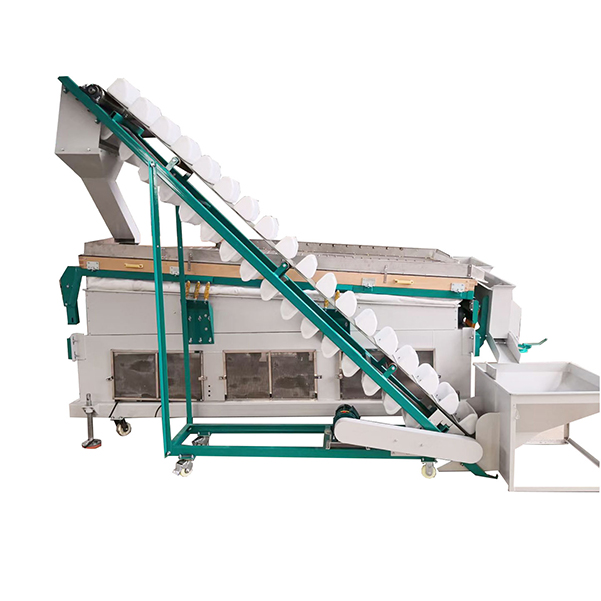
A gravity separator (also known as a gravity cleaner, gravity grader, or density separator) is a core fine cleaning/grading device in agricultural grain and oilseed processing. Its core principle is to utilize the density (specific gravity) difference between materials and impurities, combined with airflow suspension, vibration loosening, and table tilting, to achieve precise separation. It is often used as a fine processing step after air sieving, for seed selection, commercial grain grading, and deep removal of heavy impurities (sand and gravel) and shriveled/insect-damaged grains.
I. Core Working Principle
Basic Premise: A significant density difference exists between the material particles and impurities (sand, gravel, shriveled particles, insect-damaged particles). Under suitable moisture content and without clumping, stratification can be achieved through airflow and vibration.
Stratification Process: The material is evenly spread onto an inclined porous platform (gravity platform) by a leveling device. A bottom fan provides a stable upward airflow, suspending low-density particles (shriveled particles, light impurities) and keeping high-density particles (full particles, sand and gravel) adhered to the platform. Simultaneously, a vibration system drives the platform to vibrate reciprocally, causing the material to loosen and flow along the inclination angle, forming a stratified structure of “upper layer of low-density impurities + lower layer of high-density qualified material/heavy impurities”.

The core of a gravity separator (gravity cleaner/gravity classifier) is to separate materials from impurities based on their density difference. Its efficiency (purity, capacity, recovery rate, energy consumption) is influenced by three main categories of factors: material characteristics, equipment structure and parameters, and the operating environment.
I. Material Characteristics (Basic Prerequisite, Affecting Separation Limits)
Density Difference Between Material and Impurities: This is the core prerequisite for gravity separation. The greater the density difference, the easier the separation and the higher the efficiency; conversely, the difficulty increases dramatically.
Moisture Content of Material: Moisture content is a key influencing factor. Excessive moisture content leads to material agglomeration and increased surface stickiness, not only destroying the material’s looseness but also altering its effective density, causing difficulties in stratification and clogging of the screen/gravity table. Insufficient moisture content may increase material brittleness, leading to breakage, and increased dust affects airflow stability. Generally, the suitable moisture content for grains and beans is 12%–14% (slight variations exist for different materials). Material Uniformity and Impurity Content: Excessive particle size variation leads to uneven stress on the gravity table, interfering with density stratification; a pre-screening/grading screen is required for initial size screening.
High impurity content (especially large, small, and lightweight impurities) occupies the effective area of the gravity table, reducing processing capacity and potentially clogging airflow channels; pre-cleaning is necessary.
Material Surface Condition: Particles with dust, chaff, insect damage, or breakage will affect stratification speed and separation accuracy due to changes in surface friction or density unevenness.
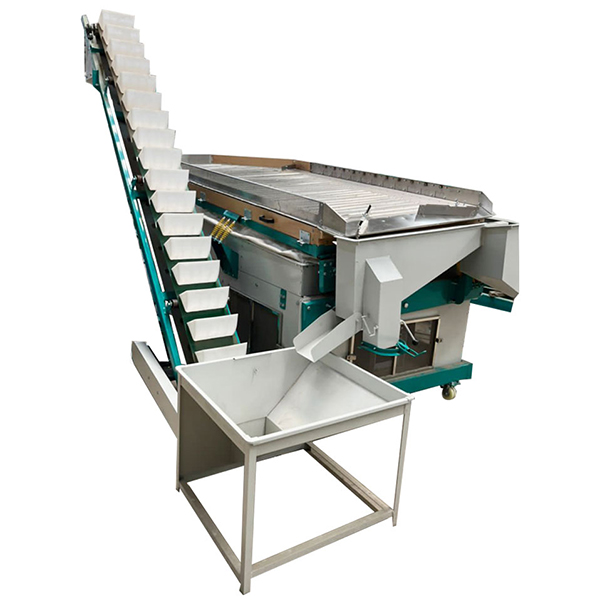
II. Equipment Structure and Operating Parameters (Core Controllable Variables)
Gravity Table/Screen Structure
Inclination Angle and Curvature: The longitudinal/transverse inclination angle of the gravity table determines the material flow velocity. An excessively large angle results in excessive material flow and insufficient stratification; an excessively small angle leads to stagnation and blockage. A curved table surface optimizes airflow distribution and improves stratification.
Screen/Table Material and Aperture: The aperture ratio and pore size of the perforated plate/canvas table affect airflow penetration; the material determines the friction between the material and the table surface. Excessive friction affects stratification, while insufficient friction causes material to slide easily.
Table Width and Length: Width determines the throughput, and length determines the stratification time. Insufficient length leads to incomplete separation, while excessive length increases energy consumption and equipment cost.
Airflow System Parameters
Air Volume and Velocity: Airflow is the driving force for achieving suspension stratification. Too low a velocity cannot support low-density particles, making stratification difficult; too high a velocity will blow away qualified materials, reducing the recovery rate. The velocity must match the material suspension velocity and be evenly distributed along the table surface. Airflow Stability: Airflow fluctuations disrupt the stratification process, leading to decreased separation accuracy. The stability of the fan, duct, and regulating valves is crucial; airflow pulsation must be avoided.
Vibration System Parameters:
Amplitude and Frequency: Vibration loosens the material, promoting stratification. Excessive amplitude can cause material splashing and breakage; insufficient amplitude prevents material loosening. The frequency must be coordinated with the airflow and tilt angle to form a virtuous cycle of “loosening—stratification—separation.”
Vibration Direction: Typically reciprocating linear vibration, with the direction matching the material flow direction to improve stratification efficiency.
Feeding and Discharge System:
Feed Uniformity: Uniform feeding is essential for consistent material thickness on the table. Localized overload leads to insufficient stratification; feeding speed and distribution must be controlled using a uniform feeding device (such as an impeller or gate).
Discharge Diverter Plate Position: The diverter plate determines the separation boundary between qualified material and impurities. Improper positioning can cause impurities to mix into the finished product or the finished product to be misclassified as impurities, directly affecting purity and recovery rate.
Post time: Jan-13-2026