

I. Air-Screen Cleaner (for Soybean Cleaning)
(I) Core Working Principles
Combined Principle of Air Separation + Vibratory Screening: Separation is achieved by leveraging the dual differences between soybeans and impurities—specifically, their aerodynamic characteristics (suspension velocity) and geometric dimensions (particle size, width, and thickness).
Air Separation Principle: Soybeans have a suspension velocity of approximately 8–10 m/s, whereas light impurities (dust, shriveled grains, broken pods, grass seeds) have a lower suspension velocity (3–6 m/s). A fan generates a directional airflow; light impurities are entrained and carried away by the airflow, while plump soybeans settle under gravity and proceed to the screening stage.
Screening Principle: A multi-layer vibratory screen system (comprising 2–4 layers) classifies the material based on particle size. The upper screen (large apertures) removes large impurities (straw, clods of soil, large stones); the middle screen (sized to match soybean dimensions) allows soybeans to pass through while retaining medium-sized impurities; and the lower screen (small apertures) sifts out small impurities such as broken beans and fine sand.
(II) Standard Cleaning Process
Feeding and Air Pre-cleaning
The mixed soybeans fall uniformly from the feed hopper into a vertical air column/duct, where a fan generates a steady airflow. Light impurities are drawn into a dust collector for collection and discharge, while the soybeans settle onto the upper layer of the vibratory screen.
Multi-layer Vibratory Screening
Upper Screen (Aperture: 12–15 mm): Large impurities (straw, large soil clods) are retained as oversize material and discharged, while the soybeans and smaller impurities pass through to the middle layer.
Middle Screen (Aperture: 7–9 mm—sized to match soybean dimensions): The soybeans are retained as oversize material and slide along the screen surface toward the clean product outlet; broken beans and small sand grains pass through to the lower layer.
Lower Screen (Aperture: 3–5 mm): This layer performs a final screening to remove fine impurities, ensuring a high level of purity in the final product.
Clean Product Discharge and Impurity Collection
The cleaned soybeans are discharged from the middle-layer outlet; meanwhile, the large, medium, and small impurities are discharged separately from their respective impurity outlets, thereby completing the cleaning process.
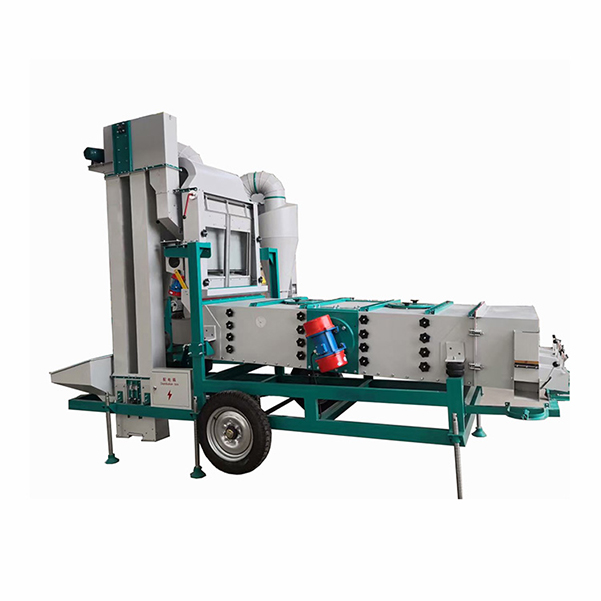
Factors Affecting the Cleaning Efficiency of Wind-Screen Separators for Soybeans
1. Fan Airflow and Air Pressure
Insufficient Airflow: Light impurities—such as shriveled grains, weed seeds, dust, and pods—are not effectively aspirated, resulting in poor purity.
Excessive Airflow: Plump, healthy soybeans are inadvertently aspirated along with the impurities, leading to material waste and a reduction in the final grain yield.
When soybeans have high moisture content or the individual grains are particularly heavy, it is necessary to appropriately increase the airflow volume.
2. Screen Surface Parameters
Screen Aperture Size
Apertures Too Large: Soybeans may fall through the screen along with the impurities, resulting in a loss of yield.
Apertures Too Small: Small clods of soil, broken beans, and fine impurities fail to pass through the screen, resulting in poor purity.
Screen Surface Inclination Angle
Steeper Angle: Material moves rapidly across the screen; this results in high throughput but potentially insufficient cleaning.
Shallower Angle: Material remains on the screen for a longer duration; this ensures thorough cleaning but results in lower throughput.
Damaged or Clogged Screens
Clogged apertures directly compromise the screening process, preventing impurities from passing through the screen.
3. Vibration Frequency and Amplitude
Insufficient Amplitude or Low Frequency: The material fails to loosen sufficiently, resulting in poor stratification and incomplete screening.
Excessive Amplitude: The material vibrates too violently and tends to slide directly across the screen surface without proper separation, resulting in poor grading performance.
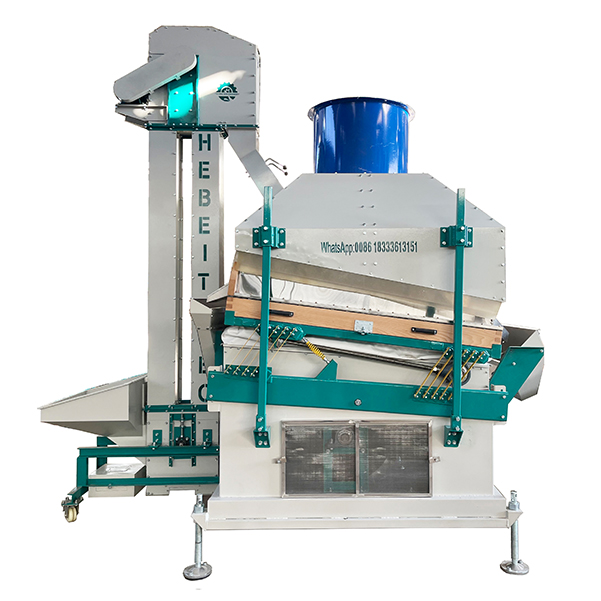
II. Destoner (Specific Gravity Destoner for Soybean Cleaning)
(I) Core Working Principle
Density (Specific Gravity) + Vibration + Airflow-Coupled Separation: Soybeans have a density of approximately 1.2–1.3 g/cm³, while stones and mud lumps have a density of 2.5–2.8 g/cm³—a significant difference.
An inclined “fish-scale” sieve surface (tilted at 8°–15°), combined with reciprocating vibration and an upward-flowing airstream, causes the materials to automatically stratify.
Heavier impurities (stones, mud lumps) settle to the bottom and adhere to the sieve surface; driven by the vibration and the friction of the sieve, they “crawl” upward toward the stone discharge outlet.
The soybeans, under the influence of the airflow, enter a semi-suspended, fluidized state and slide downward along the sieve surface toward the clean bean outlet.
(II) Standard Cleaning Process
Uniform Feeding and Stratification
Soybeans (including “companion stones”—stones of similar size) are spread uniformly across the destoning sieve surface by a material-leveling device. The sieve body undergoes reciprocating vibration (at a frequency of 400–500 cycles/minute), while a bottom-mounted blower supplies air (at an air pressure of 500–900 Pa). The materials rapidly stratify: stones and heavy impurities settle to the bottom layer, while the soybeans remain in the upper layer.
Directional Separation of Heavy Impurities and Soybeans
Stones/Heavy Impurities: Adhering to the sieve surface, they move upward along the incline, passing through the stone-gathering zone to be discharged via the stone outlet.
Soybeans: In a semi-suspended state, they slide downward along the incline, flowing toward the clean grain outlet.
Clean Material Output and Destoning Verification
Clean soybeans are discharged. If the stone discharge contains an excessively high proportion of soybeans, the airflow volume should be reduced, or the sieve angle increased; conversely, if stones fail to discharge, the airflow volume should be increased, or the sieve angle reduced.
Factors Affecting the Cleaning Efficiency of Destoners for Soybeans
A destoner primarily removes stones of similar size to the grain, clods of earth, and heavy impurities; the effectiveness of this process hinges critically on the stability of the specific gravity separation.
1. Airflow Volume (The Most Critical Factor)
Insufficient Airflow: The material fails to form a fluidized bed; stones and soybeans remain intermixed, resulting in incomplete destoning.
Excessive Airflow: The soybeans become suspended in the air current and are discharged alongside the stones through the stone outlet, leading to significant product loss.
The wetter and heavier the soybeans, the slightly higher the airflow volume required to achieve fluidization.
2. Screen Inclination Angle and Vibration Frequency
Steeper Angle: Soybeans slide down rapidly, resulting in high throughput; however, stones are more prone to carrying soybeans along with them.
Shallower Angle: Soybeans move slowly, ensuring thorough destoning but resulting in lower throughput.
Unstable Vibration Frequency or Inappropriate Amplitude: Material stratification is poor, and the upward migration of heavy impurities is hindered.
3. Condition of the Screen Plate
Worn or Deformed Fish-Scale Screen Plate: Airflow distribution becomes uneven, leading to poor localized fluidization and the creation of numerous “dead zones” where destoning does not occur.
Clogged Screen Perforations: Airflow is restricted, causing a drastic decline in destoning efficiency.
Post time: Apr-13-2026