
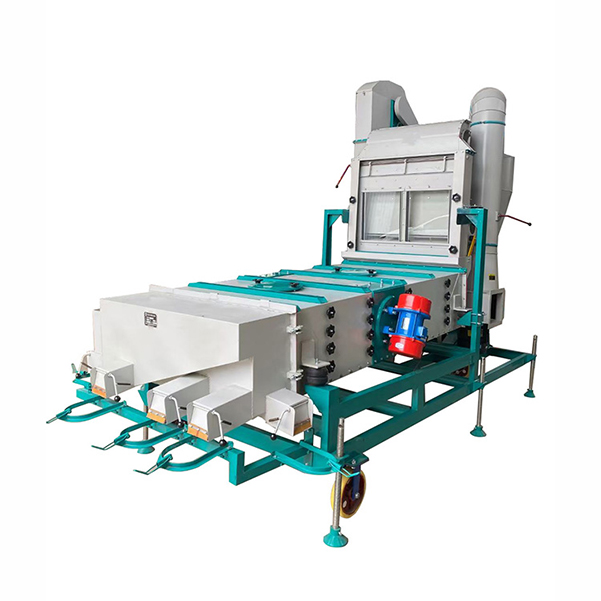
The efficiency of an air-screen cleaner when processing sesame seeds is primarily influenced by four major categories of factors: equipment parameters, material characteristics, operational conditions and environment, and the physical condition of the equipment. These factors directly determine the cleaning throughput, purity level, and loss rate.
I. Core Equipment Parameters (The Most Critical and Controllable Factors)
1. Air Separation System Parameters
Airflow Velocity / Air Volume: The critical suspension velocity for sesame seeds is approximately 6–10 m/s. If the wind speed is too low, light impurities (dust, shriveled seeds, leaf fragments) will not be effectively blown away; conversely, if the wind speed is too high, a large quantity of plump, viable sesame seeds will be suctioned away, causing the loss rate to skyrocket.
Uniformity of Airflow Distribution: Airflow turbulence within the air ducts or uneven wind speeds across the screen surface can create localized areas of “excessive airflow” or “insufficient airflow,” leading to cleaning blind spots and a decline in overall efficiency.
Fan Air Pressure and Stability: Insufficient air pressure or significant pressure fluctuations make it impossible to achieve a stable separation between the sesame seeds and light impurities; conversely, excessive air pressure increases energy consumption and raises the rate of seed breakage.
2. Screening System Parameters
Screen Aperture Size and Configuration: Sesame seeds typically have a diameter of approximately 1.5–3 mm, necessitating a multi-layer screen configuration (coarse screens to remove large impurities, grading screens to sort by size, and fine screens to remove small impurities). If the screen apertures are too large, impurities will fail to pass through; if they are too small, the apertures will become clogged, causing a drastic drop in throughput.
Screen Surface Inclination Angle: The inclination angle determines the flow velocity of the material. A steeper angle results in faster material flow and higher throughput, but may lead to insufficient screening; a shallower angle results in a longer dwell time—yielding a cleaner product—but at the cost of lower throughput.
Vibration Frequency and Amplitude: Insufficient frequency or amplitude results in poor material stratification and screen clogging; conversely, excessive frequency or amplitude causes material to splash, increases the breakage rate, and reduces screening efficiency.
Screen Surface Motion Pattern: The specific type of screen motion—such as linear, reciprocating, or circular vibration—influences how the material tumbles and the probability of particles passing through the screen apertures; the suitability of the chosen motion pattern directly impacts overall efficiency. 3. Feeding and Discharge Systems
Feeding Uniformity and Flow Rate: Uneven feeding or erratic flow (fluctuating between high and low volumes) leads to localized material accumulation on the sieve surface and disruption of the airflow field. If the flow rate exceeds the equipment’s rated capacity, cleaning becomes incomplete and material losses increase; conversely, if the flow rate is too low, production capacity is wasted.
Discharge Flow: Obstructed discharge of impurities or cleaned grain results in backflow and secondary contamination, thereby reducing overall operational efficiency.

II. Inherent Characteristics of the Sesame Material (Uncontrollable, Yet Significantly Influential)
Moisture Content: When the moisture content of sesame exceeds 10%, the seeds become sticky and their flowability deteriorates; they tend to adhere to screen perforations and clump together, resulting in reduced screen throughput and diminished cleaning efficiency. Conversely, if the moisture content is excessively low, the seeds become brittle and prone to breakage.
Type and Content of Impurities: The presence of large quantities of straw, soil clods, or grit tends to clog screen perforations and increases the operational load on the air-separation system. Furthermore, if the material contains a high proportion of shriveled seeds or broken kernels, their suspension velocities closely approximate those of plump, sound sesame seeds, making separation difficult and inefficient.
Seed Uniformity: Significant variations in seed size and plumpness increase the complexity of grading and cleaning operations; this necessitates a more precise alignment between screen aperture sizes and air velocities—otherwise, the process is prone to errors such as “clean grain containing impurities” or “impurities containing clean grain.”
Seed Surface Condition: Sesame seeds that retain their hulls, bear surface fuzz (trichomes), or are coated in oil residue exhibit altered aerodynamic characteristics; this results in blurred separation boundaries during air classification and a consequent decline in overall efficiency.
III. Operation and Operating Conditions
1. Equipment Suitability:A mismatch between the machine model and the sesame processing volume leads to an imbalance between processing efficiency and energy consumption.
Parameter Rationality:Failure to synergistically optimize parameters—such as wind speed, screen inclination angle, and vibration settings—results in inefficiencies. For instance, high wind speeds combined with rapid screen movement cause material to pass through too quickly, resulting in incomplete cleaning; conversely, low wind speeds combined with slow screen movement lead to low throughput and poor efficiency.
2. Environmental Temperature and Humidity: In hot and dry environments, sesame exhibits good flowability, leading to high cleaning efficiency. In high-humidity, low-temperature environments, however, condensation and material clumping are prone to occur, resulting in a decline in efficiency.
3. Continuous Operation Stability: Frequent starts and stops, along with repeated parameter adjustments, cause significant fluctuations in operating conditions; consequently, the average efficiency falls significantly below that achieved during stable, continuous operation.
IV. Equipment Condition and Maintenance
Screen Surface Condition: Worn, deformed, or clogged screen perforations reduce the material’s pass-through rate. Furthermore, damaged screen mesh allows impurities to mix with the cleaned grain, necessitating rework and reducing overall efficiency.
Airflow Patency: Dust accumulation within air ducts or clogged air filters result in insufficient airflow volume and pressure, as well as turbulent airflow, rendering the air-separation process ineffective.
Transmission and Vibration Components:Loose drive belts, worn bearings, or malfunctioning vibration motors cause vibration parameters to deviate from their design specifications, leading to a sudden drop in screening efficiency.
Sealing and Dust Collection: Poor sealing results in air leakage and the escape of light impurities. Ineffective dust collection leads to high dust levels within the workshop and dust accumulation on the equipment, thereby compromising long-term operational stability.
Core Strategies for Efficiency Optimization
Precise Parameter Matching: Based on the sesame’s moisture content and impurity levels, set the wind speed within the range of 6–10 m/s, select appropriate multi-layer screen perforations, and optimize vibration settings and screen inclination angles.
Ensure Uniform Feeding:Control the material flow rate to remain within the equipment’s rated capacity, ensuring that the material is distributed evenly across the screen surface.
Intensify Routine Maintenance: Regularly clean screen perforations, clear air ducts, and inspect transmission components to maintain the equipment in optimal operating condition.
Integrated Cleaning and Grading:Combine air separation with multi-layer screening, and—when necessary—incorporate destoning or gravity separation techniques to enhance overall processing efficiency and product purity.
Post time: Mar-28-2026