
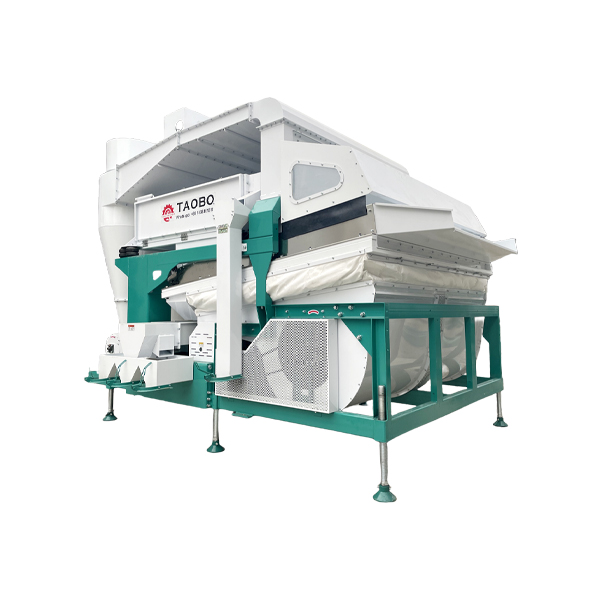
I. Working Principle of the Air-Screen Gravity Separator
The machine first employs a combination of airflow and sieving for coarse cleaning, followed by gravity separation for fine sorting, thereby removing light impurities, heavy impurities, and defective seeds in a single pass.
Essentially, it integrates an air-screen cleaner and a gravity separator into a single unit, comprising two core sections: the front section (air-screen cleaning) and the rear section (gravity separation table).
I. Front Section: Air-Screen Cleaning (Coarse Cleaning)
1. Air Separation (Fan-Assisted)
As material falls from the feed hopper, it is met by—or passes through from below—a stream of airflow:
Light Impurities: Dust, husks, grass clippings, shriveled grains, and insect-damaged hollow grains are blown away by the airflow and discharged via a dust collection bag.
Plump Grains & Heavy Impurities: Being heavier, these are unaffected by the airflow and continue to fall onto the sieving surface.
2. Multi-Layer Sieving
The material lands on a stack of two or three vibrating screens, where it is graded according to particle size:
Upper Layer (Large Mesh): Screens out impurities larger than the grain (e.g., straw, pods, clods of earth, and large debris).
Lower Layer (Small Mesh): Screens out impurities smaller than the grain (e.g., sand, broken grains, and fine debris).
Middle Layer (Qualified Grains): These remain on the screen surface and are conveyed to the gravity separation table.
Function:
To preliminarily remove impurities that differ significantly in size or weight, thereby laying a solid foundation for the subsequent fine gravity separation process.
II. Rear Section: Gravity Table Separation (Fine Cleaning)
This constitutes the most critical section of the machine, utilizing density differences to perform the separation. 1. Air Cushion Formation
The screen deck of the gravity separator is perforated with numerous small holes; a fan located beneath blows air upward, creating an air cushion within the layer of material:
High-density, plump, and mature—the “good” seeds: Being heavy, they settle to the lower layer, resting directly against the screen deck.
Low-density, shriveled, moldy, insect-damaged, or broken seeds: Being light, they are lifted by the airflow and float in the upper layer.
2. Vibratory Conveyance
The screen deck undergoes a reciprocating, inclined vibration:
Plump, high-quality grains resting against the deck: Propelled by the vibration, they move toward the higher end of the screen.
Floating light impurities and defective grains: Carried by the airflow and gravity, they slide toward the lower end.
3. Graded Discharge
A continuous gradient is established along the length of the screen, allowing for discharge through distinct outlets:
High-end Outlet: Plump, high-quality grains (Finished Product).
Mid-range Outlet: Intermediate-quality grains (Suitable for re-processing/re-sorting).
Low-end Outlet: Shriveled grains, broken grains, insect-damaged grains, and light impurities.
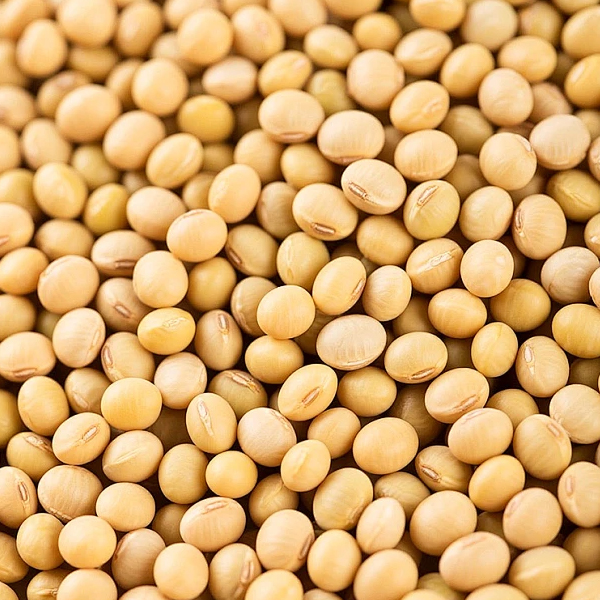
I. Soybean Cleaning: Key Considerations
Soybeans are large-grained, possess a relatively high specific gravity, and have skins that are prone to damage and breakage. The primary focus during cleaning is to prevent breakage, avoid screen clogging, utilize high airflow volumes, and employ coarse screen meshes.
1. Screen Selection (Mandatory Replacement)
Upper Screen (Removes large impurities): 8.0–9.0 mm round or square perforations
Lower Screen (Removes small impurities and broken beans): 3.5–4.5 mm
Principle: Perforations must not be too small; otherwise, beans will become lodged in the screen, leading to increased breakage. Conversely, they must not be too large, or small impurities will fail to pass through.
2. Airflow Volume and Pressure (Higher than for Wheat)
Fan Speed / Air Damper Setting: Set 10%–20% higher than for wheat.
Optimal State: The layer of beans on the specific gravity table should be uniformly suspended—neither being blown away nor accumulating in piles.
If too low: Shriveled beans, insect-damaged beans, and light impurities will not be effectively separated. If too high: Whole beans will be blown away, and breakage rates will increase.
3. Vibration and Inclination Angle
Amplitude: Set slightly higher (Soybeans possess greater inertia and require stronger vibration to be propelled forward).
Longitudinal Inclination Angle: Set slightly steeper to facilitate the forward movement of larger grains.
Frequency: 400–500 cycles/minute (slightly lower than for wheat).
4. Moisture Content and Feeding
Optimal Moisture Content: 12%–14%
If too high: Beans become sticky, stratification is poor, and screens are prone to clogging.
If too low: Bean skins become brittle, causing breakage rates to skyrocket.
Feeding: Ensure a uniform, thin layer; concentrated dumping is strictly prohibited to prevent crushing and ensure proper stratification.
5. Primary Impurity Removal Targets
Large Impurities: Pods, stalks, clods of soil.
Small Impurities: Broken beans, sand grains, fine dust/soil particles.
Specific Gravity Impurities: Insect-damaged beans, moldy beans, shriveled beans, broken beans, stones/pebbles.
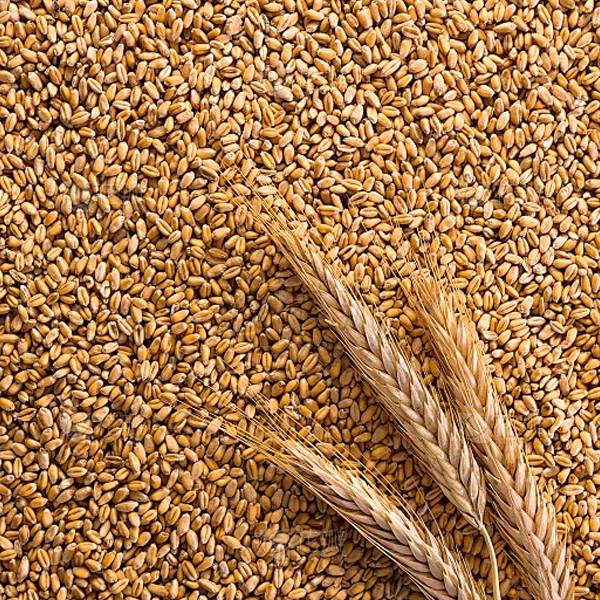
II. Wheat Cleaning: Key Considerations
Wheat kernels are small, have a relatively low specific gravity, feature a longitudinal furrow, and often retain fine hairs or husks; furthermore, there is frequently a high proportion of shriveled kernels. Therefore, the primary focus lies on utilizing fine-mesh screens, moderate airflow, intensive air separation, and the effective removal of shriveled kernels and husks.
1. Screen Selection (Significantly smaller than for soybeans)
Upper Screen (Removes coarse impurities): 3.5–4.5 mm
Lower Screen (Removes fine impurities): 1.8–2.5 mm
Principle: Small, dense perforations are essential to effectively screen out shriveled kernels, broken grains, and dust.
Using large-hole screens (typically used for soybeans) → The wheat kernels will fall through completely, rendering the cleaning process entirely ineffective.
2. Airflow and Air Pressure (Moderate and Precise)
Airflow Volume: Lower than that required for soybeans; the flow rate should be calibrated so that the wheat layer appears to “hover” slightly, while shriveled kernels visibly lift and float.
Front Section (Specific Gravity Table): Airflow should be slightly stronger to effectively lift and separate husks, fine hairs, shriveled kernels, and insect-damaged grains.
Rear Section: Airflow should be reduced to ensure that plump, healthy wheat kernels settle and discharge smoothly.
3. Vibration and Inclination Angle
Amplitude: Relatively low; Frequency: Relatively high (450–550 cycles/minute).
Longitudinal Inclination Angle: Slightly shallower than that used for soybeans. Since wheat is lighter, an excessively steep angle would cause the grains to slide too rapidly, resulting in insufficient separation.
4. Moisture Content and Feeding
Optimal Moisture Content: 12%–14%.
Too High: Kernels may clump together, fine hairs become difficult to dislodge, and screens may become clogged.
Too Low: Generates excessive dust, increases grain fragility, and leads to significant static electricity buildup.
Feeding: Must be uniform, thin, and steady. Avoid uneven layer thickness, as this prevents airflow from penetrating the grain bed effectively and hinders proper stratification.
5. Primary Impurity Removal Targets
Light Impurities: Husks, straw fragments, dust, shriveled kernels, and empty shells.
Fine Impurities: Broken kernels and sand grains.
Specific Gravity Impurities: Insect-damaged grains, moldy grains, sprouted grains, grains with black embryos, diseased grains, and small stones.
Post time: Apr-01-2026