
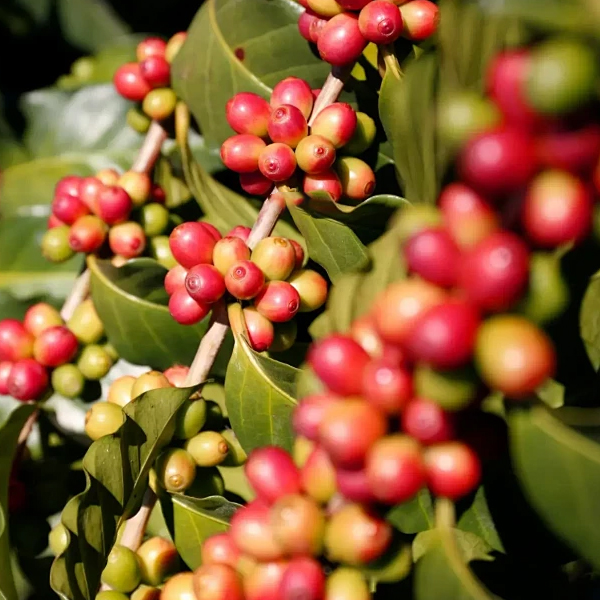
Ethiopia is recognized worldwide as the birthplace of coffee and is Africa’s largest producer of Arabica coffee. Here is a detailed overview of its coffee bean cultivation:
Planting Area: The exact area of coffee-growing land in Ethiopia is difficult to determine due to the scattered plots and intercropping with other crops. It is estimated that coffee trees cover more than 320,000 hectares.
Planting Regions: Coffee cultivation is mainly concentrated in the western and southern regions.
Planting Patterns:
Forest Coffee: Accounts for 10% of production, distributed in the Kafa forests of the west and southwest. This is wild coffee, with dense trees providing natural shade, requiring no human intervention and protected by the government.
Semi-Forest Coffee: Accounts for 35% of production, also distributed in the Kafa forests of the west and southwest. Farmers manually prune overly dense branches in the wild forests and weed annually to increase yield.
Rural Coffee: This is the most popular cultivation method, accounting for 50% of total production. Farmers plant coffee trees in their backyards or fields, intercropped with other crops. This is mainly distributed in Sidamo in the south and the southeast.
Farm-grown coffee: Employing modern agronomical management methods, including standardized procedures for seedling cultivation, pruning, fertilization, and pesticide application, this is the only non-organic cultivation method and accounts for only 5% of the country’s annual production.
Varieties: Ethiopia is a gene pool for Arabica coffee, with an estimated 2,000 varieties, but less than 5% have been thoroughly studied and their morphology and characteristics confirmed. Common varieties include the native species (Heirloom). Additionally, varieties developed by JARC, such as 74158, 74110, and 74112, are also grown in regions like Sidamo.
Production: Ethiopia’s annual coffee bean production ranges from 200,000 to 250,000 tons, with the exact amount depending on factors such as weather and price. Approximately 35% of the production is consumed locally.
The air sieve cleaner, gravity separator, and grading sieve are the core equipment for cleaning green coffee beans. Each has a distinct function: the grading sieve primarily sorts beans by size; the air sieve combines airflow with sieving to separate light and heavy impurities by size; and the gravity separator separates defective beans from heavy impurities by density/specific gravity. All three are well-suited to the small-volume, high-impurity characteristics of Ethiopian coffee bean cleaning.
Air Screen Cleaner: Combining Air Power and Screening for One-Stop Light Impurity Removal and Size Determination
Core Principle: This machine integrates the “light and heavy separation” of air power cleaning with the “size separation” of screening cleaning into a single unit. Both screening processes are completed in a single feeding operation. It is the most commonly used general-purpose cleaning equipment in Ethiopian cooperatives and border crossings, significantly replacing the manual winnowing and bamboo sieve methods used by small farmers.
Core Structure: Feed inlet, air classifier chamber (including blower and damper), multi-layer screen, discharge outlet, and impurity collection outlet. The core is the series design of the air classifier chamber and screen.
Working Process:
Step 1: Air Classification: Raw materials enter the air classifier chamber. The blower generates an adjustable-speed directional airflow (the airflow speed for coffee cleaning is controlled at 3-5 m/s to avoid blowing away qualified beans). The material is suspended in the airflow.
✅ Light impurities (fruit peel fragments, dried fruit pulp, shriveled beans, dust, light twigs and leaves) are blown towards the light impurity collection outlet due to their light weight.
✅ Qualified coffee beans + heavy impurities (stones, metal) are overcome by airflow resistance due to their greater weight and fall into the screening area below.
Step 2: Screening and Cleaning: The material after air classification (qualified beans + heavy impurities) enters the multi-layer screen, where it is sorted by size according to the working principle of the grading screen. Large/small size impurities are removed, and qualified beans are collected according to size.
Coffee cleaning and sorting equipment: The air speed of the coffee air sieve cleaner can be precisely adjusted (to suit the light weight characteristics of Arabica beans). The sieve surface is mostly designed to be non-slip to prevent coffee beans from accumulating on the sieve surface. Small machines are suitable for cooperatives (output of 50-200kg per hour), and medium-sized machines are suitable for ports (output of 500-1000kg per hour).
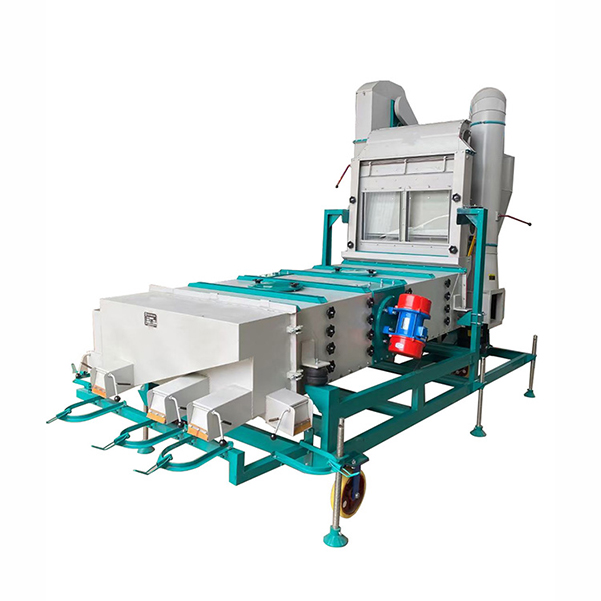
Gravity separator: A high-end device for separating coffee beans by density/specific gravity, eliminating defects of “different qualities within the same size”. Core principle: Utilizing the difference in specific gravity (density) between coffee beans and impurities, combined with vibration and airflow/inclined surfaces, materials of different specific gravities are separated and displaced on the screen surface, achieving precise separation. This is the core equipment for solving the problem of “grading sieves and air sieves being unable to remove defective beans/heavy impurities of the same size”. It is mainly used in the cleaning of high-end coffee batches from Ethiopian specialty estates and border crossings.
Working Process: Coffee beans pre-treated by a grading sieve/air sieve are evenly fed into the gravity sieve. A vibrating motor drives the sieve to vibrate at high frequency with small amplitude. A bottom fan blows a low-speed, uniform airflow upwards. The airflow passes through the sieve mesh, lifting the material to form a suspended fluidized bed.
Material Segregation: Under the combined action of vibration and airflow, materials of different specific gravities automatically separate into layers—the heaviest impurities (pebbles, metal) settle at the bottom of the sieve, in direct contact with the sieve surface, and move towards the lower end of the sieve with vibration, being discharged through the heavy impurity outlet; qualified coffee beans of medium specific gravity are in the middle layer, moving towards the middle of the sieve with vibration and entering the qualified bean collection area; the lightest defective beans (hollow beans, insect-damaged beans, shriveled beans) float on the top layer, are lifted by the airflow to the upper end of the sieve surface, and are discharged through the light defect outlet. The separation accuracy can be precisely controlled throughout the process by adjusting the airflow speed (controlling the suspension height), vibration frequency (controlling the material movement speed), and the position of the discharge baffle.
Grading Screen: The fundamental equipment for precise sorting of coffee beans by size.
Core Principle: Utilizing screens with different aperture sizes, vibration causes relative movement between coffee beans and impurities, achieving grading and impurity removal based on particle diameter and thickness.
Working Process: Coffee beans are evenly fed into the upper screen. A vibrating motor drives the screen to reciprocate linear/micro-circular vibrations, causing the material to spread evenly and move forward on the screen.
Imperfections larger than the screen aperture (such as pebbles, large leaves, and clumps of beans) cannot pass through and remain on the upper screen, being discharged from the outlet.
Qualified coffee beans that match the screen aperture size pass through the corresponding screen layer and fall into the middle/lower collection area, achieving grading by size (e.g., G1-G5 grades at the coffee outlet, the core of which relies on the grading screen to determine the basic size).
Imperfections smaller than the screen aperture (such as broken beans, coffee powder, and fine sand) pass through the bottom screen and are collected by the bottom collection port.
Post time: Jan-30-2026