
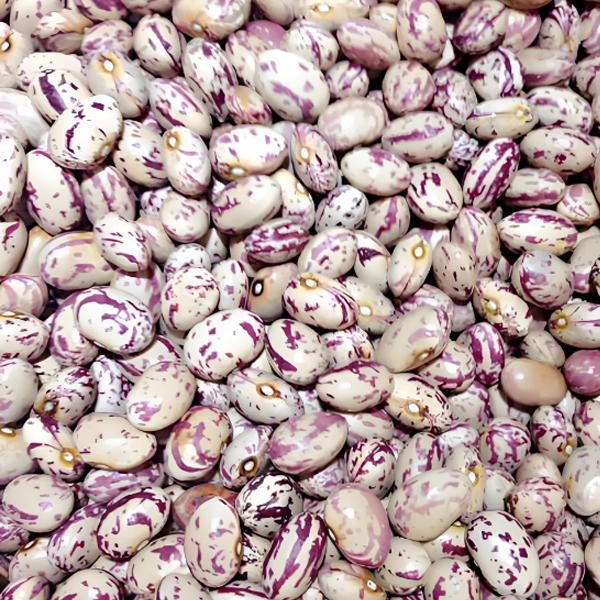
Kenya is the world’s seventh-largest and East Africa’s second-largest producer of common beans, which are the second-largest food crop after maize and the most important source of legume protein.
I. Core Production Data
Planted Area: Approximately 1.1 million hectares (approximately 1.1 million hectares)
Total Production: Approximately 760,000 tons (dried beans)
Average Yield: Approximately 0.6–0.7 tons/hectare (significantly lower than the potential of 1.5–2.5 tons/hectare)
Production Value: Approximately 60 billion Kenyan shillings/year
Planting Entities: Approximately 1.5 million smallholder farmers, primarily for self-sufficiency, with increasing commercialization.
II. Distribution of Major Production Areas
Rift Valley Province: Approximately 33% (Nakuru, Eldoret, Baringo, etc.)
Eastern Province: Approximately 24% (Meru, Embu, Kiambu, etc.)
Lake Victoria Region: Approximately 18% (Busia, Vishiga, Homa Bay, etc.)
Western Province: Approximately 13% (Bongoma, Kakamega, etc.)
Central Province: Approximately 13% (Kianbu, Mulanka, Neri, etc.)
III. Planting Patterns and Agronomic Characteristics
Core Pattern: Maize-Bean Intercropping (most common), nitrogen fixation, soil fertility improvement, and increased land utilization
Row Spacing: Maize row spacing 75–90cm, with 1–2 rows of beans planted in between (plant spacing 10–15cm)
Sowing:
Season: Primarily during the long rainy season (March–May), supplemented by the short rainy season (October–December)
Sowing Rate: 40–50kg seeds per hectare, depth 4–5cm
Soil and Climate:
Preferred: Well-drained, organic-rich loam; pH 6.0–7.0
Rainfall: 800–2000mm/year, most suitable altitude 1000–2200m
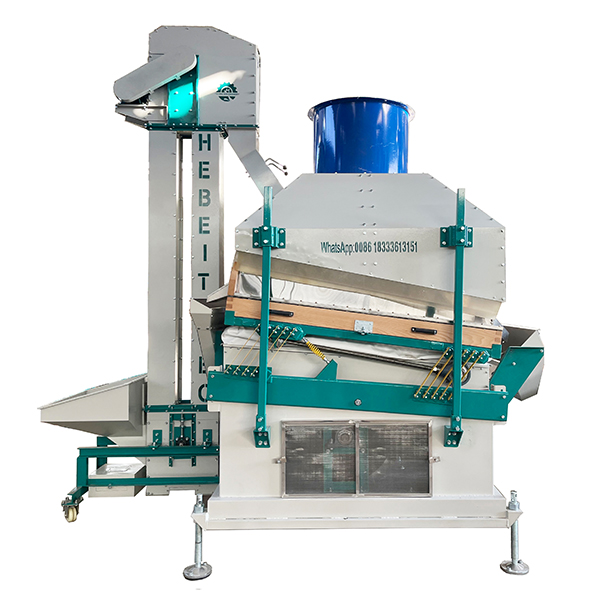
Destoners (usually gravity destoners) remove stones and impurities from beans. The core principle is to utilize the difference in specific gravity and suspension velocity between beans and stones, achieving precise separation through the combined action of vibration and airflow. They are particularly effective at removing “side-by-side stones” that are similar in size to the beans.
I. Core Principle: The Triple Action of Specific Gravity + Airflow + Vibration
Beans (specific gravity approximately 1.2–1.4 g/cm³) and stones (specific gravity approximately 2.5–2.8 g/cm³) have a significant difference in density. Inside the equipment, stones are heavier, sink more easily, and are harder to lift by the airflow; beans, on the other hand, are relatively lighter, easily suspended, and flow downwards with vibration and airflow.
II. Complete Workflow (Taking a Suction-Type Gravity Destoner as an Example)
Uniform Feeding: Beans (including stones) are fed through a hopper and a uniform feeding device, spreading evenly and in a thin layer on an inclined fish-scale perforated/woven screen surface. The thickness is typically 10–20 mm, ensuring that airflow and vibration reach every particle of material.
Airflow Stratification (Crucial Step) A fan below the screen blows vertical airflow upwards (approximately 1.2–1.5 m/s). The airflow passes through the screen openings and the material layer:
Stones: High density and high suspension velocity, unable to be lifted by the airflow, adhere tightly to the bottom of the screen.
Plump beans: Semi-suspended by the airflow, located in the upper middle part of the material layer.
Shriveled grains, broken beans, and light impurities: Completely lifted by the airflow, floating on the top layer, some are removed by the suction system.
Vibration-Driven Reverse Movement (Separation Core) The screen body reciprocates (amplitude 3–5 mm, frequency approximately 500–600 times/minute), combined with a screen surface inclination angle of 5°–9°, creating a “heavy on top, light on bottom” movement trend:
Stones: Adhere tightly to the screen surface, crawling upwards along the screen surface (towards the stone outlet) under the thrust of vibration.
Beans: Semi-suspended, sliding downwards along the screen surface (towards the discharge outlet) under the action of gravity and vibration.
Fish-scale perforated sieve surface: The holes face the stone outlet to prevent the stones from sliding down and guide the pinto beans downwards, thus enhancing separation.
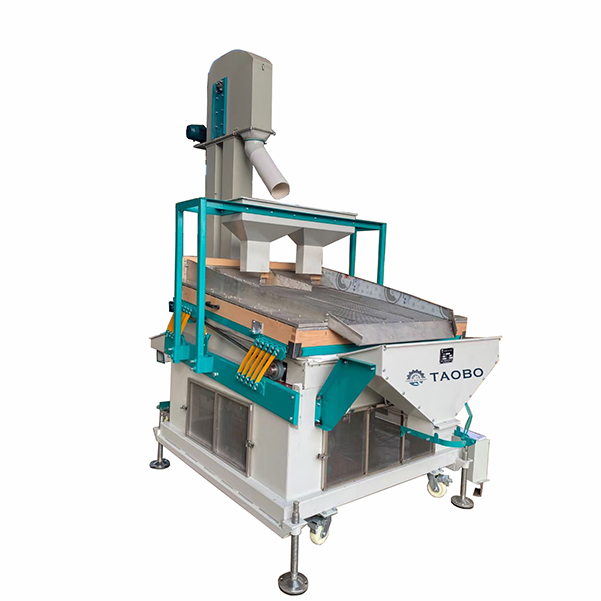
Grading and Discharge
Pure Pinto Beans: Discharged from the bottom of the screen (outlet) to the next process.
Stones + Small Amount of Heavy Impurities: Discharged from the top of the screen (stone outlet) for centralized collection and processing.
Light Impurities: Drawn to the settling chamber by the top suction system, separated, and then discharged.
III. Equipment Characteristics and Parameters for Pinto Beans
Screen Surface: Mostly woven mesh or fish-scale perforated plates, with aperture matching the pinto bean particle size to ensure air permeability and material flowability.
Airflow: Fine-tuned according to the fullness of the pinto beans to ensure only the beans are supported, not the stones, preventing beans from being washed away by stones or stones from being carried away by beans.
Amplitude/Inclination Angle: Excessive amplitude leads to material mixing, while insufficient amplitude results in slow separation; the inclination angle affects the material flow rate and needs to be matched to output and purity requirements.
Stone Removal Rate: Under normal operating conditions, the stone removal rate can reach over 98%, suitable for the fine cleaning of pinto beans and other grains.
The pinto beans are plump and have a stable specific gravity, with a sufficiently large specific gravity difference compared to stones. They are also mostly round or oval, which allows them to flow well on the vibrating screen and prevents them from getting stuck. This makes them very suitable for the separation mechanism of a gravity destoner.
Post time: Mar-25-2026