
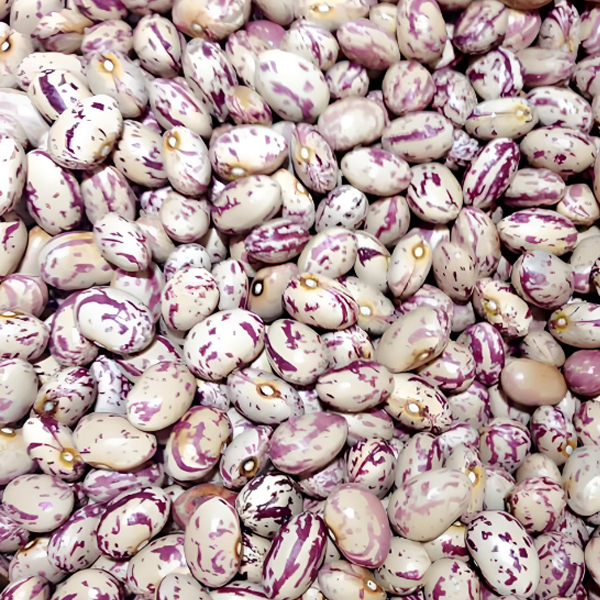
Mexico is one of the world’s leading producers and exporters of pinto beans. Cultivation is highly concentrated in the arid and semi-arid plateaus of the northern and northwestern regions, characterized by a strong export orientation and a high degree of mechanization.
I. Production Area Distribution and Cultivation Scale
Core Production Areas: Chihuahua and Sonora are the absolute dominant production states, accounting for approximately 70% of the national pinto bean output. These are followed by central plateau states such as Durango and Zacatecas.
Cultivation Share: Within Mexico’s total pulse production, pinto beans account for approximately 35%—ranking second only to black beans (53%)—making them the country’s second-largest pulse crop.
Area and Yield: In 2024, the total national area dedicated to pulse cultivation was approximately 900,000 hectares, with pinto beans occupying about 315,000 hectares. In recent years, the total national dry bean yield has ranged between 800,000 and 900,000 tons, with pinto beans contributing approximately 280,000 to 315,000 tons.
Producers: Production is dominated by family farms and medium-sized growers; approximately 87% of growers cultivate an area of 5 hectares or less. In the core northern production regions, the entire cultivation process—including sowing, irrigation, harvesting, and cleaning—has been fully mechanized.
II. Cultivation Conditions and Seasons
Climate: Pinto beans thrive in warm, dry environments with abundant sunlight. The optimal temperature range is 15–27°C; the crop is intolerant of frost (seedlings are susceptible to freezing damage at temperatures of -2°C or lower). An annual precipitation level of 300–600 mm is sufficient, as the crop possesses strong drought resistance.
Soil: The crop prefers loose, well-drained sandy loam to loam soils with a pH between 6.0 and 7.5. It is tolerant of nutrient-poor soils and is well-suited for rotation with corn or wheat, a practice that helps fix nitrogen and improve soil fertility.
Cultivation Seasons:
Spring Sowing (Main Season): Sowing takes place in May–June, with harvesting in September–October; the growth cycle spans 90–110 days.
Winter Sowing (Irrigated Areas): In irrigated regions—such as Sonora and Sinaloa—sowing can occur in November–December, with harvesting in March–April of the following year, thereby enabling a double-cropping system.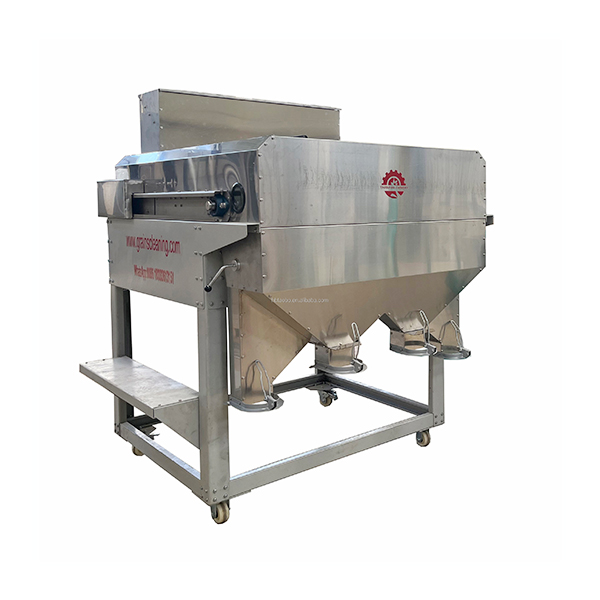
How does a magnetic separator remove soil from pinto beans?
A magnetic soil separator—or simply “magnetic separator” for short—is, as the name implies, a device that utilizes magnetic force to remove soil; it is primarily used for removing soil impurities from grain.
The iron content found in soil does not exist as free, elemental iron, but rather as iron-bearing compounds. However, many of these iron compounds exhibit ferromagnetism; consequently, soil itself possesses a certain degree of magnetic susceptibility. Thus, the magnetic soil separator operates by leveraging this inherent magnetic property of soil to extract soil clumps and other impurities. Since the ferromagnetism of soil is extremely weak, ordinary magnets typically struggle to exert a noticeable attractive force upon it. To overcome this, the device must first employ a specialized structural configuration to significantly intensify the magnetic force at its specific point of application. Secondly, it must effectively harness this elusive, faint attraction—achieved with such difficulty—and amplify its impact through a technique akin to “using a feather to move a mountain,” thereby ensuring flawless separation with absolutely no soil clumps slipping through the process.
During operation, the material travels along a conveyor belt. As the belt wraps around the magnetic roller, the material enters a state of free fall, tracing a parabolic trajectory. During this descent, soil clumps are attracted by the high-intensity magnets; their trajectories are thereby altered, causing them to be diverted and separated from the grain stream by a partition.
To achieve effective soil separation, the magnetic separator relies on the precise control of numerous operational details. These include regulating the thickness of the material layer as it follows its parabolic trajectory, ensuring sufficient penetration of the magnetic field lines through the grain layer, and optimizing parameters such as the drop height and belt speed—factors that pertain directly to the practical application and operational execution of the device.
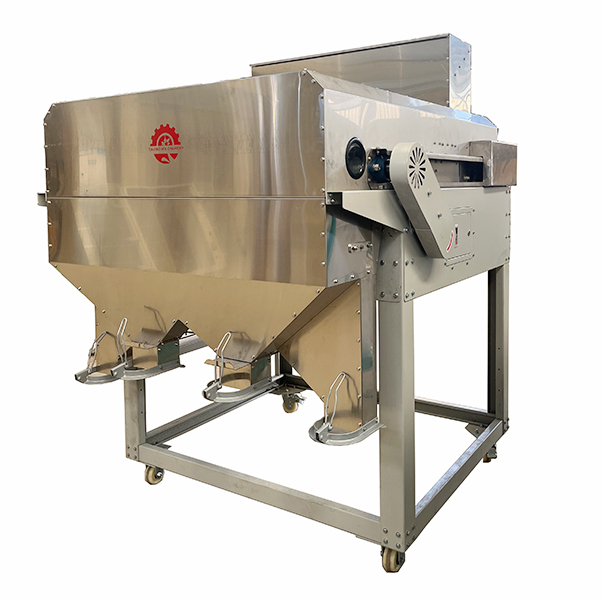
Magnetic Separator Workflow: Material is fed into the hopper, conveyed via an elevator and a three-way splitter into the feed box, and then distributed by a spreading mechanism to ensure uniform coverage on the conveyor belt. As the belt transports the material, it passes over two rows of filtering magnets and a magnetic roller before being projected forward in a parabolic trajectory. (This process removes strongly magnetic ferrous impurities from the material—thereby preventing contact between these impurities and the magnetic roller, which could otherwise damage the conveyor belt.) Since soil particles often contain ferromagnetic substances and possess magnetic properties, their trajectory is altered after passing over the magnetic roller. Consequently, a diversion plate is utilized to separate the material from the soil particles, directing them separately into the designated outlets for grain and soil, respectively.
I. Applicable Crops
Primarily suitable for granular, round/oval, and free-flowing seeds of legumes, miscellaneous grains, oilseeds, and cereals. It is particularly well-suited for raw materials containing high levels of soil clods, dirt lumps, and magnetic impurities:
1. Leguminous Crops (Core Application / Best Fit)
Pinto Beans (Speckled Beans)
Kidney Beans (Red, White, and Speckled Kidney Beans)
Mung Beans, Green Peas, Black Beans, Soybeans
Broad Beans, Garden Peas, Chickpeas, Lentils
Black-eyed Peas, Common Beans, Adzuki Beans, and various other miscellaneous beans
2. Cereals and Miscellaneous Grains
Wheat, Barley, Oats, Paddy Rice
Corn (Small-kernel varieties / Seed Corn)
Sorghum, Millet, Proso Millet, etc.
3. Oilseeds and Other Cash Crops
Rapeseed, Sesame Seeds, Peanut Kernels (Small-kernel varieties)
Melon Seeds, Sunflower Seeds, and other granular seeds
II. Applicable Processing Scenarios
Grain Purchasing Stations / Collection Points
Initial cleaning of raw materials upon arrival: Removal of soil, dirt clods, and ferrous impurities to protect downstream equipment.
Legume Cleaning, Sorting, and Processing Plants
Cleaning of Pinto beans, Kidney beans, Mung beans, etc., to meet export-grade and commercial-grade standards.
Removal of soil lumps and dirt clods to enhance appearance, purity, and grade classification.
Seed Processing Industry
Pre-treatment prior to seed sorting and selection.
Removal of ferrous impurities and soil to protect sorting machines, seed coating machines, and packaging machines.
Feed Processing and Grain/Oil Processing
Raw material pre-treatment to remove metal contaminants and soil impurities, thereby enhancing product purity.
Protection of critical equipment such as crushers, pelletizers, and grinding mills.
Post time: Mar-18-2026