
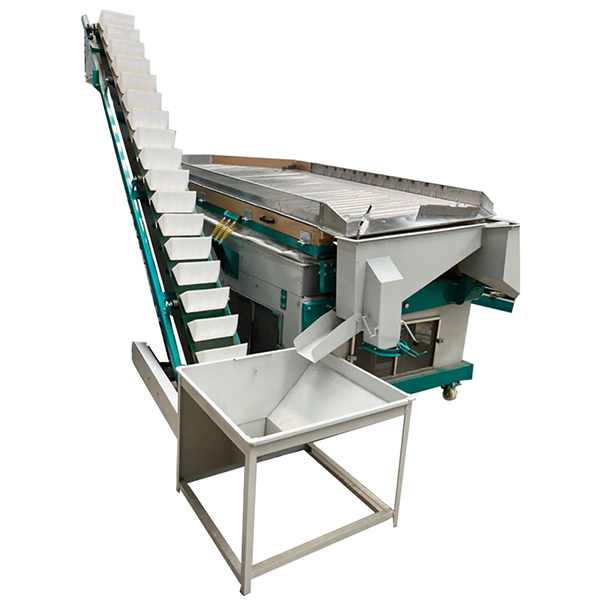
The gravity separator sorts materials based on density differences, utilizing a combination of upward airflow and reciprocating deck vibration to stratify particles. Unlike standard gravity destoners—which focus primarily on stone removal—the gravity separator is designed for precision sorting; it removes shriveled, insect-damaged, moldy, and sprouted grains while offering grading capabilities and the ability to remove stones of similar size to the product. It serves as a core piece of equipment for high-precision sorting in processing lines for beans, coarse grains, and seeds.
Working Principle
Material enters the porous gravity sorting deck evenly from the inlet. A fan beneath the deck blows air upwards, creating a fluidized, boiling material bed, while the deck undergoes directional reciprocating vibration.
Denser, plump beans and stones settle to the bottom of the material bed, resting against the screen mesh; driven by vibration, they climb toward the high end of the deck. Plump, finished product exits through the main discharge, while stones and heavy impurities exit through the heavy impurity outlet.
Less dense particles—such as insect-damaged beans, shriveled beans, moldy grains, and sprouted beans—are suspended in the upper layer of the bed by the airflow. Without contacting the screen mesh, they slide down the inclined deck toward the low end and exit through the light impurity outlet.
Core Advantage: Performance is unaffected by particle size. The gravity separator successfully separates particles of identical size but different densities—a task that air-screen cleaners cannot accomplish.
Main Structure
Includes a material feeding and distribution mechanism, a 304 stainless steel gravity sorting deck, a vibration drive system, multi-zone independently adjustable air chambers, a variable-frequency fan, and shock-absorption components. Multiple outlets are provided: finished product, light impurities, heavy impurities, and recirculated mixed material. Adjustment mechanisms include controls for airflow volume, deck longitudinal and transverse tilt angles, and vibration frequency. High-end models feature a PLC system capable of storing parameter recipes for various crops, enabling rapid production changeovers.
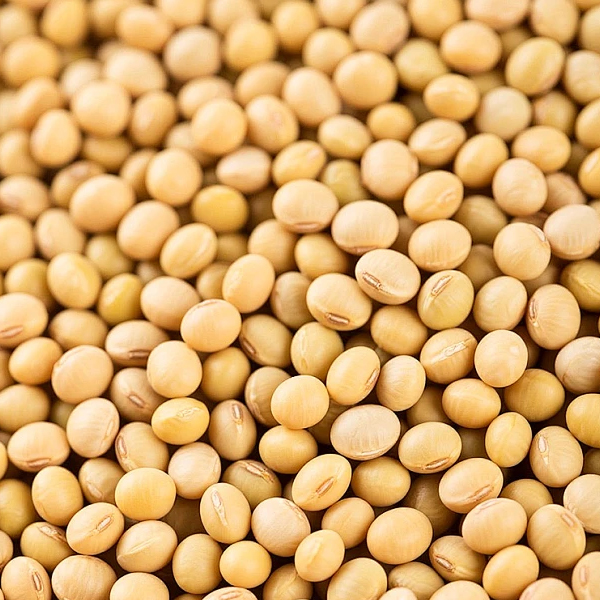
In a complete bean cleaning production line, the general process flow is: elevating and feeding → air-screen cleaner (removing large debris, small impurities, and empty shells) → gravity separator → subsequent color sorting, polishing, and packaging. Air-screen cleaners separate impurities based on particle size; however, many contaminants—such as stones of similar size to the beans, insect-damaged beans, and moldy or shriveled beans—share dimensions nearly identical to good beans and cannot be removed by air-screening alone. The gravity separator handles this task, serving as a core process for achieving high purity in deep bean processing and seed processing.
First, it removes stones, clods of earth, and mud pellets of similar size. Raw beans are often mixed with stones and soil clods that are similar in size to the beans themselves, making them impossible to remove with standard screens. By utilizing density differences, the gravity separator lifts and discharges denser stones and soil clods. This prevents stones from entering polishing or packaging machines—thereby avoiding equipment damage—and ensures the final product is free of grit and stones, meeting food-grade export standards.
Second, it classifies and removes low-density, inferior beans. It separates out insect-damaged beans, moldy beans, shriveled grains, immature beans, sprouted beans, and empty husks. Although these beans are similar in size and shape to sound beans, they are internally hollow or moldy and have a lower overall density. Under the combined action of airflow and vibration, they float to the top and are discharged as light impurities. This effectively reduces the proportion of defective beans in the final product and improves the beans’ visual quality. In seed processing, removing shriveled or damaged beans significantly increases the seed germination rate.
Third, it performs secondary purification of the bean material to consolidate product purity, enabling the final product to reach a purity level of 99.5%. Material that has passed through the air-screen cleaner may still contain density-based impurities; the gravity separator provides deep purification, thereby easing the workload on downstream color sorters, reducing processing pressure, and minimizing the consumption of color-sorting consumables. It also reduces the loss of defective beans during the subsequent polishing stage.
Fourth, it enables density-based grading of the beans. Beans of the same variety are graded based on density: those with high plumpness are classified as premium-grade product, while those with moderate plumpness are categorized as secondary-grade. This material grading facilitates separate sales and enhances the product’s economic value.
II. Key Adjustable Operating Parameters for the Gravity Separator
Airflow: The most critical factor. Moderate airflow causes the material to hover in a state of gentle fluidization (suspension) without violent turbulence. Excessive airflow causes the loss of good material; insufficient airflow prevents suspension, leading to a failure in stratification. Airflow requirements vary by crop: lower airflow for small seeds (sesame, rapeseed) and higher airflow for large-grained legumes.
Amplitude / Vibration Frequency: Typical amplitude is 3–5 mm; larger amplitudes suit large grains, while smaller amplitudes suit small seeds. Vibration generates the thrust that drives heavy particles to move upward along the deck.
Deck Inclination: Longitudinal inclination ranges from 5° to 14°. A steeper angle increases material flow speed and throughput but reduces separation precision; a shallower angle extends residence time, resulting in cleaner separation but lower throughput.
Feed Rate: A thin material layer facilitates better stratification but yields lower throughput; an excessively thick layer prevents airflow from penetrating the material, causing stratification failure and incomplete impurity removal. Uniform, continuous feeding is essential.
Startup Sequence: Start the fan first → start vibration → begin feeding slowly. Shutdown Sequence: Stop feeding first → stop vibration → turn off the fan last. Operating the machine with vibration while the deck is empty is prohibited.
III. Applicable Materials
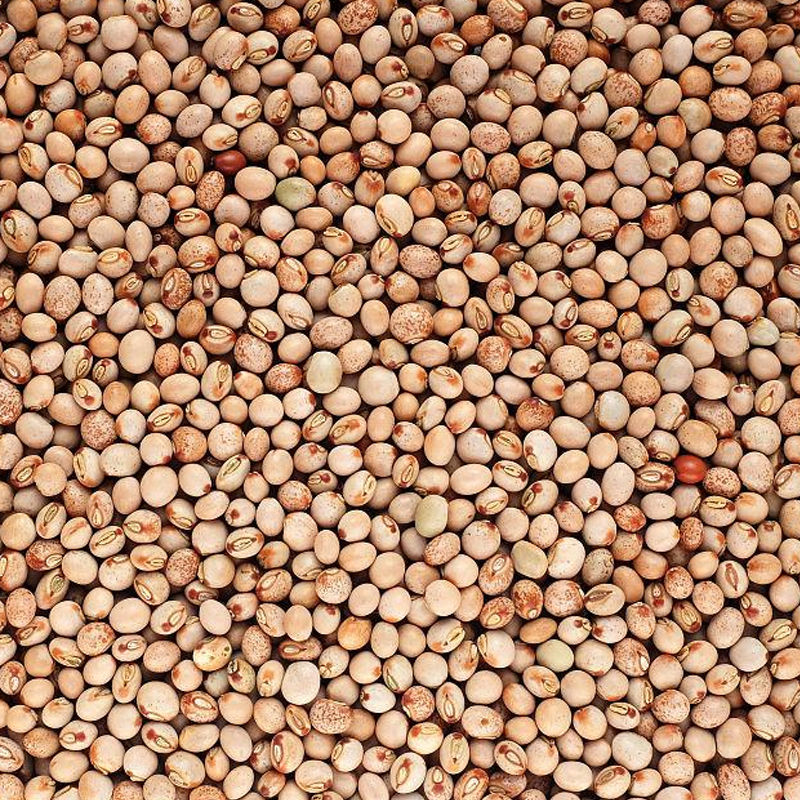
Wheat, corn, sorghum, rice; soybeans, mung beans, kidney beans, pinto beans, pigeon peas; sesame, rapeseed, chili seeds; peanuts, sunflower seeds; various vegetable and forage grass seeds; also suitable for processing certain dried fruits and granular traditional Chinese medicinal herbs.
Impurities Removed: Stones, soil clods, shriveled grains, immature grains, insect-damaged grains, moldy grains, sprouted grains, smut-infected grains, and empty husks. It significantly improves seed germination rates and commercial grain purity, achieving a final product purity level of 99.5%.
Post time: Aug-25-2026