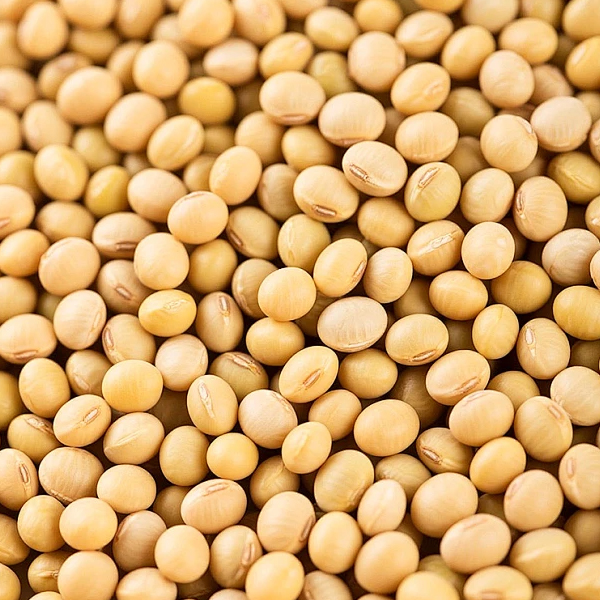
Soybeans are a core export crop for commercial agriculture in Bolivia’s eastern lowlands, with a production of 3.29 million tons in 2025 (a 63% increase year-on-year). 99% of this production is concentrated in Santa Cruz Province, primarily through large-scale mechanized farming. The main products are soybean meal and soybean oil for export, and the crop is significantly affected by climate and market fluctuations.
Key Characteristics of Cultivation:
Highly Concentrated Production Areas: Santa Cruz Province is the dominant production area. It has a tropical savanna climate, with planting in November–December and harvesting in April–May, primarily a single-crop year. A few irrigated farms experiment with crop rotation.
Main Cultivation Entities and Models: Large-scale commercial farms (dominated by Brazilian capital) + mechanization/irrigation; smallholder farmers have a low proportion. The mainstream crop rotation is “soybean-corn/sorghum” to prevent continuous cropping degradation and pests and diseases.
Varieties and Technologies: Primarily high-oil, stress-resistant varieties introduced from Brazil/Argentina. Herbicides and fertilizers are widely used, and some farms implement no-till farming and precision irrigation.
Key constraints: Floods during the harvest season (March-April) can reduce yields; yields are lower than in Brazil (approximately 3 tons/hectare); logistics costs are high, and the country relies on road transport to Brazilian ports.
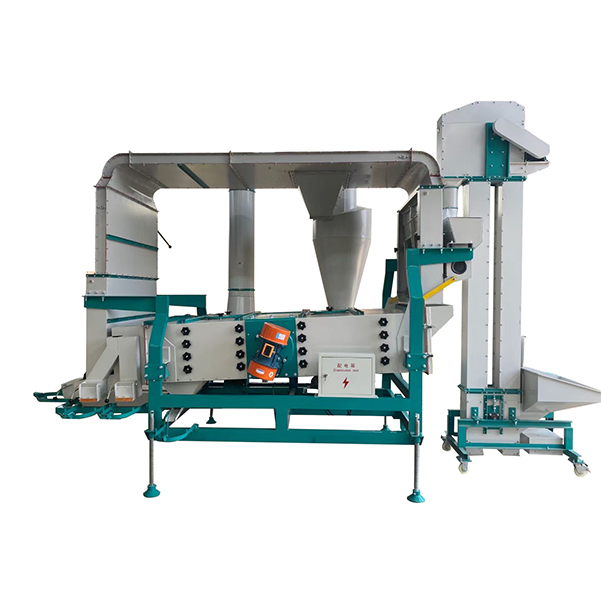
The Core Function of the Air Screen Cleaner
The air screen cleaner combines airflow separation and sieving functions, serving as the first crucial step in soybean cleaning. It primarily removes the following impurities:
Airflow Separation for Light Impurities
Utilizing airflow generated by an adjustable-speed fan, it separates impurities lighter than soybeans, such as:
Shriveled pods, straw fragments, dust, and shriveled soybeans
Light weed seeds and leaf fragments
The principle is that light impurities are carried away by the airflow, while plump soybeans, due to their greater weight, fall onto the screen surface for further separation.
Screening to Remove Large/Small Impurities: Impurities with large size differences are separated using a combination of screens with different apertures. The screening process is divided into two stages: Upper Screen (Large Aperture Screen): Retains impurities larger than soybean particles, such as large stones, clods of earth, whole bean pods, and large weed stems. Lower Screen (Small Aperture Screen): Allows out impurities smaller than soybean particles, such as small stones, mud, fine weed seeds, and broken bean grains. Pre-treatment to Protect Subsequent Equipment: Removing most large and light impurities first prevents clogging of the gravity separator’s screen holes and air ducts, reduces the gravity separator’s operating load, and improves overall cleaning efficiency.
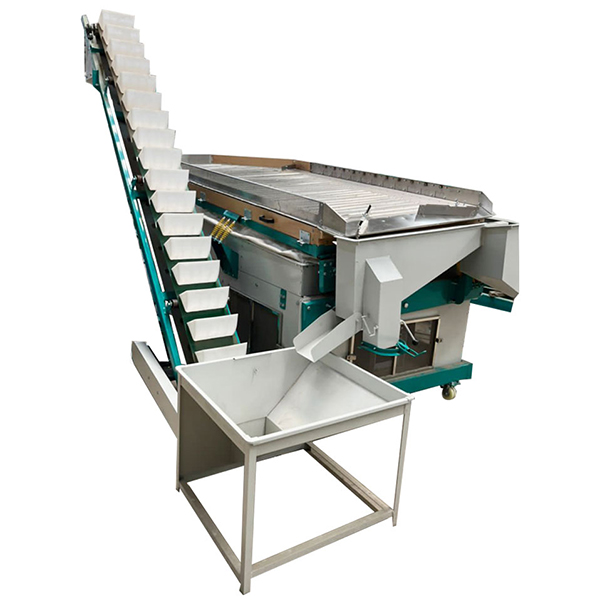
The gravity separator (also known as a gravity grading and destoning machine) utilizes the difference in material specific gravity and the synergistic effect of vibration and airflow to process “similar-sized impurities” that cannot be separated by air screen cleaners. It is a core piece of equipment for deep purification of soybeans and mainly solves the following problems: Precise removal of adjacent stones/clods of soil This is the most core function of the gravity separator. “Side-by-side stones” refer to pebbles and clods of mud that are similar in size to soybeans but much heavier. These cannot be separated by an air sieve, but a gravity separator can separate them using the following principle: The inclined screen surface vibrates at high frequency, while airflow is blown upwards from below the screen, causing soybeans and side-by-side stones to move along different trajectories.
Soybeans, being lighter, are lifted by the airflow and move towards the lower end of the screen surface with the vibration (collected as clean soybeans).
Side-by-side stones, being heavier, cannot be lifted by the airflow and embed themselves in the fish-scale holes of the screen surface, moving towards the upper end of the screen surface with the vibration (discharged as impurities).
Separation of moldy and insect-damaged soybeans: Moldy and insect-damaged soybeans have a lower specific gravity than normal plump soybeans. Under the vibration and airflow of the gravity separator, they are separated into the inferior product channel, improving the quality grade of the finished soybeans.
Grading and screening soybeans of different plumpness: By adjusting the airflow intensity and vibration frequency, soybeans can be graded according to their plumpness. For example:
High-plumpness soybeans: used for food processing and seed saving.
The Combination Logic of These Two Elements in the Soybean Cleaning Process:
Soybean Raw Material → Air Screen Cleaner (Removes light impurities + large/small impurities) → Gravity Analyzer (Removes side stones + moldy soybeans) → Clean Soybean Finished Product
Air Screen Cleaner: Coarse cleaning stage, removes over 80% of easily separable impurities.
Gravity Analyzer: Fine cleaning stage, removes the remaining 20% of difficult-to-separate impurities, determining the final cleanliness and quality.
Post time: Dec-24-2025