
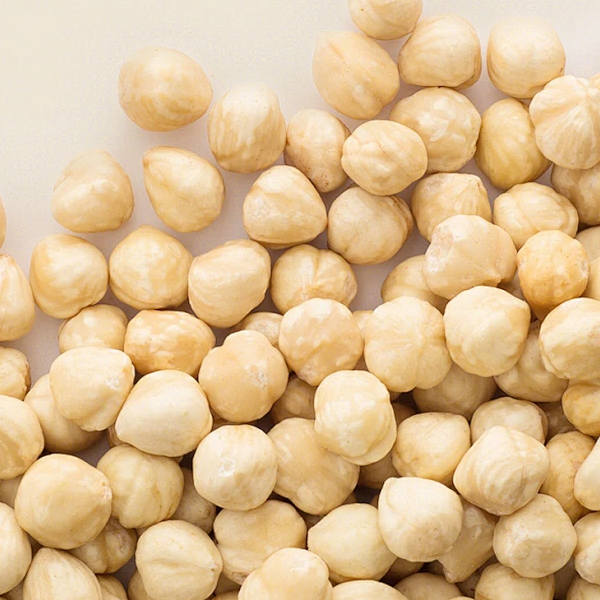
Chickpeas, coffee beans, and sesame are core agricultural categories in Ethiopia, each with distinct characteristics in terms of planting area, climate suitability, yield, and export status.
I. Chickpeas
Chickpeas are Ethiopia’s most important legume crop, a major producer in Africa, serving both as a staple food and for export, and well-suited to high-altitude rainfed agriculture.
Cultivation: Major production areas are concentrated in the central and northern highlands (Amhara and Tigray regions), at altitudes of 1400–2300 meters. They prefer annual rainfall of 700–2000 mm, often rotated or intercropped with wheat and barley, primarily using small-scale rainfed farming with limited irrigation. In 2024/25, the planted area was approximately 228,000 hectares, with an average yield of about 2.09 tons/hectare, higher than the global average.
Production and Status: In 2024/25, Ethiopia’s chickpea production was approximately 493,000 tons, accounting for about 3% of the global total, making it the third largest chickpea producer in Africa, after India and Australia. Both white and brown chickpeas are grown, with white chickpeas being more favored in export markets, mainly sold to the Middle East and India, and serving as an important cash cow for local smallholder farmers.
II. Coffee Beans: As the origin of coffee, Ethiopia’s coffee industry is its largest source of export revenue, known for its smallholder cultivation and specialty beans, adapted to its high-altitude, cloudy climate.
Cultivation: The main producing areas are in the south (Sidamo, Yirgacheffe), southwest (Gambera), and east (Harar), at high altitudes of 1500–2200 meters, with an average annual temperature of 15–24℃ and annual rainfall of 1200–2000 mm. Arabica small-bean varieties are predominant, with 95% of cultivation done by smallholder farmers and a small number of large-scale estates. The planting cycle is rainy season planting and the following year harvesting, relying on traditional shade cultivation to emphasize unique flavor.
Production and Status: In 2024/25, production reached 10.63 million bags (60 kg/bag), equivalent to approximately 638,000 tons, a year-on-year increase of 16%, accounting for about 6% of the global market. Coffee exports account for over 30% of Ethiopia’s total agricultural exports, making it a core supplier of specialty coffee globally, mainly exported to the EU, the US, and Japan.
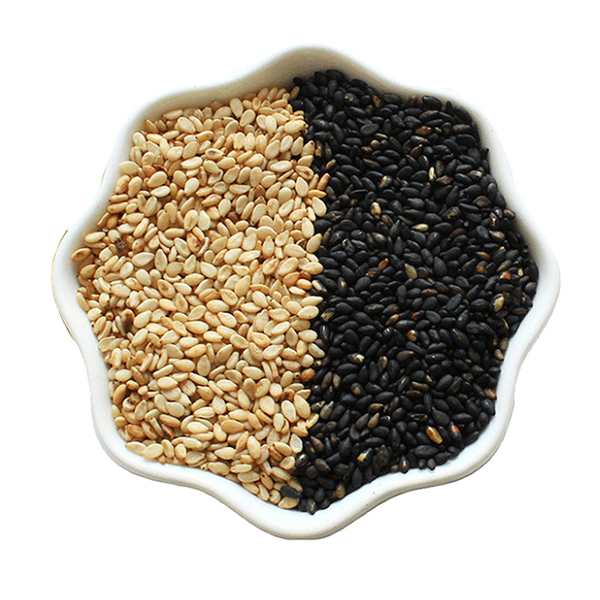
III. Sesame: Sesame is Ethiopia’s second largest export crop, and the region is an important oilseed producing area in Africa. It is well-suited to the lowland, arid climate, producing high-quality sesame with a high oil content.
Cultivation: The main production areas are concentrated in the northwest (Benshangul-Gumaz Region, Humera and Wellega regions of Amhara Region) and the western lowlands, at altitudes below 1250 meters. Preferred annual rainfall is 500–800 mm, with rainfed cultivation as the primary method. The planting season is June–September (rainy season). The main varieties are white sesame (with an oil content of over 50%) and black sesame. The planting area has been continuously expanding in recent years, with cultivated land increasing by 88,000 hectares in 2025, an increase of 8.5%, bringing the total area to over 1 million hectares.
Production and Status: Sesame production in 2024 was approximately 190,000 tons, and exports in 2025 reached 210,000 tons (a decrease of over 40% compared to 359,000 tons five years prior, affected by climate and logistics). Ethiopia is the second largest sesame exporter in Africa, after Sudan. Its products are mainly exported to China, India, and the European Union, with high quality and low impurities as its core competitiveness.
Sesame, chickpeas, and coffee beans often contain impurities after harvesting, such as:
Soil impurities: clods of soil, fine sand, and stone chips. Because Ethiopia has mostly sandy soil in its highlands and lowlands, the plants are often laid directly on the ground with soil attached during harvesting, making it easy for seeds to stick and get mixed in. Fine sand can also get embedded in the gaps between sesame seeds and in the remnants of chickpea pods.
Straw impurities: withered stalks, thin stems, and roots of the crops themselves. The thin stems of sesame easily entangle the seeds, while the coarse stalks of chickpeas are mostly whole sections of stems. Both are lightweight impurities and can be separated by winnowing.
How can we remove these impurities?
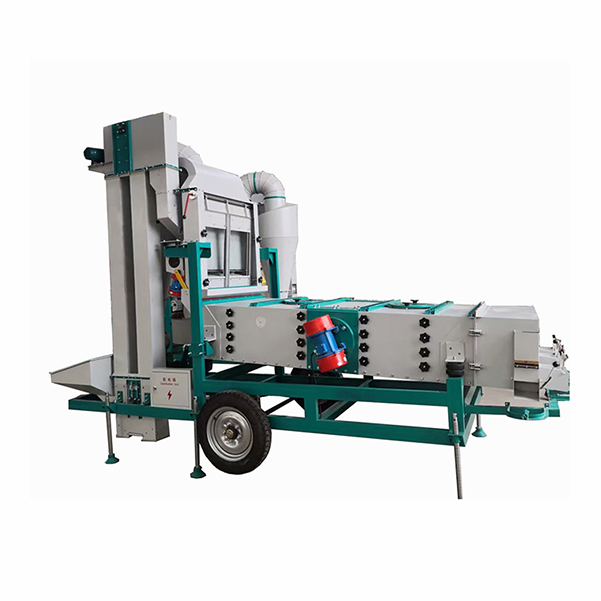
Air Screen Cleaner: The air screen cleaner is a combined air separation and screening machine. It utilizes the aerodynamic characteristics (suspension velocity) and geometric differences (particle size, shape) of materials to separate light impurities, large/small particles, and qualified seeds. It is the first basic piece of equipment in agricultural product cleaning, used before gravity separators and grading screens.
Gravity Separator: The gravity separator (also called a gravity cleaner/gravity separator) is a specialized density separation device. It utilizes the difference in specific gravity (density) of materials, combined with the dual action of vibration and airflow, to separate qualified seeds from impurities of different densities (such as shriveled seeds, empty seeds, broken seeds, and sand). It is the core fine screening equipment for cleaning sesame seeds and chickpeas, solving the problem of “same particle size, different density” impurities that air screen cleaners cannot separate (such as shriveled sesame seeds and empty chickpea seeds, with the same particle size as qualified seeds but significant density differences). Grading Screen
Core Working Principle
A grading screen (also called a specification screen/grader) is a pure particle size specification sorting device. It only utilizes the differences in the geometric dimensions (particle size, shape) of materials to achieve particle size classification through screens with different aperture sizes. There is no airflow assistance. It is divided into single-layer grading screens and multi-layer grading screens. It is a key piece of equipment for the standardization of finished agricultural products. It can be used alone or in conjunction with a gravity meter to complete the grading after fine screening.
The combination of sesame (air sieve cleaning machine + gravity analyzer) and chickpeas (gravity analyzer + grading screen) essentially follows the sequence of “first removing impurities, then fine screening, and then grading,” utilizing the different physical properties of the materials for step-by-step processing: first, the air sieve cleaning machine removes easily separable light, heavy, large, and small basic impurities, reducing the processing load on subsequent equipment; then, the gravity analyzer separates core quality impurities (shriveled kernels, empty kernels, and broken kernels) of “different densities of the same particle size” that the air sieve cannot handle, improving the purity of the finished product; finally, the grading screen achieves standardization of the finished product specifications, meeting the market demands for processing and export.
Post time: Jan-22-2026