
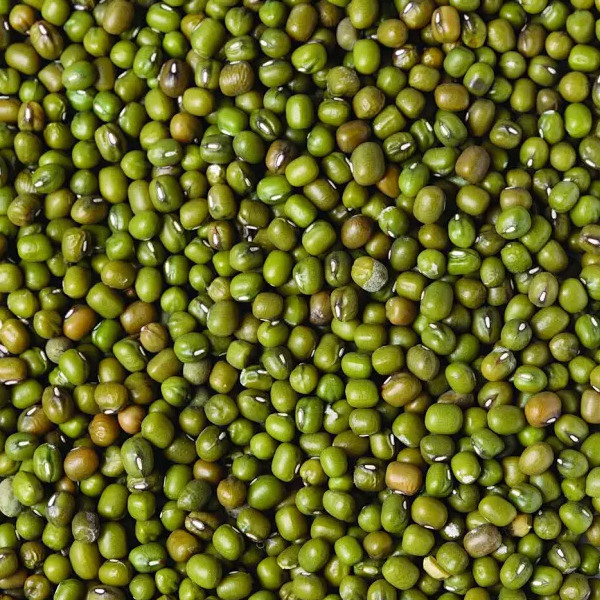
I. Mung Bean Cultivation in Pakistan
1. Industry Status and Scale
Mung beans are Pakistan’s most important summer legume crop (Kharif Pulse), and a significant source of protein intake and export revenue.
Planting Area: Stable annually at 1.1-1.2 million hectares (approximately 16.5-18 million mu), with a slight increase in recent years due to policy support and export demand.
Total Production: Approximately 750,000-850,000 tons, with a national average yield of approximately 0.65-0.75 tons/hectare (43-50 kg/mu), indicating a relatively low overall yield.
Consumption and Export: Domestically, mung beans are mainly processed into mung bean dal (mung bean paste) for daily consumption. Pakistan is also a major global exporter of mung beans, with exports accounting for approximately 30-40% of production, primarily destined for the Middle East, South Asia, and Southeast Asia.
2. Distribution of Major Production Areas: Highly concentrated in Punjab Province, accounting for 88% of the national planting area and 85% of the output, making it the absolute core production area.
Core planting counties: Layyah, Bhakkar, Mianwali, Rawalpindi, etc., mainly arid and semi-arid, sandy loam soils.
Secondary production areas: Sindh Province and Khyber Pakhtunkhwa Province (KP), mainly spring-sown, accounting for less than 10% of both area and output.
Uzbekistan Mung Bean Cultivation Situation
1. Industry Status and Scale: Mung beans are a newly emerging specialty legume crop in Uzbekistan. In recent years, due to the rapid growth in demand for sprouted mung beans for export, Uzbekistan has become an important producer and exporter in Central Asia.
Planting Area: Rapidly expanding in recent years, approximately 400,000–500,000 hectares (6,000,000–7,500,000 mu), still in a growth phase.
Total output: Approximately 150,000–160,000 tons, with a national average yield of approximately 0.3–0.35 tons/hectare (20–23 kg/mu), significantly lower than that of Pakistan.
Export-oriented: Over 90% is exported, making it China’s largest source of sprouted mung beans, accounting for approximately 55% of China’s sprouted bean imports; a small amount is used for domestic consumption and processing.
2. Distribution of Major Production Areas: A clear east-west divide exists, with the west being the core high-quality production area: Western production area (core high-quality area): Karakalpakstan, Bukhara, Khiva, etc., with abundant sunshine and heat, large diurnal temperature variations, and sandy soil, producing small, plump mung beans with a high germination rate (>95%). This is the main production area for sprouted beans, accounting for over 55% of exports.
Eastern producing areas: Tashkent, Samarkand, Fergana, etc., have good irrigation conditions and a high degree of mechanization, but the grains are relatively large and the breakage rate is high, so they are mainly used for export as commercial soybeans.
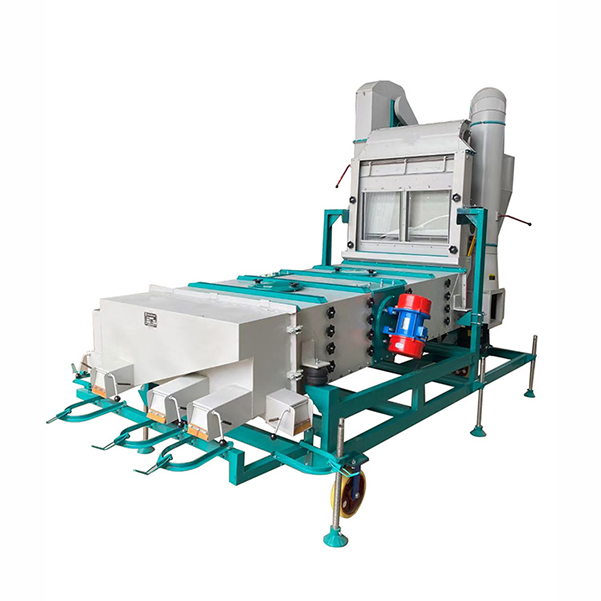
The air-screen cleaner is a composite cleaning device combining screening and air separation. The core principle of cleaning mung beans is to simultaneously utilize differences in particle size and suspension velocity to achieve dual separation, resulting in a more thorough impurity removal effect.
Its working process is completed collaboratively by the screening system and the air separation system:
1. Screening System Working Principle
Basically the same as the grading screen, it relies on multiple layers of screens with different apertures to separate mung beans by particle size under vibration:
The upper screen removes large impurities;
The middle screen retains qualified mung beans;
The lower screen removes fine impurities, sand, broken beans, and other small impurities.
The screening system mainly addresses impurities of different sizes, creating a uniform and stable material layer for subsequent air separation.
2. Air Separation System Working Principle
Air separation utilizes airflow to separate particles of different weights and densities based on their suspension velocity differences.
A stable and controllable vertical or horizontal airflow field is formed inside the equipment. When the sieved mung beans fall evenly into the air duct or air separation chamber: Plump, mature, and dense qualified mung beans have a high suspension velocity, which the airflow cannot carry away. They fall normally under gravity and enter the finished product channel.
Substances with low density and light weight, such as shriveled beans, insect-damaged beans, immature beans, bean skins, broken shells, straw clippings, dust, and light grass seeds, have a low suspension velocity and are directly sucked away by the airflow. They are collected through the air duct to the settling chamber or dust collector, separating from the clean mung beans.
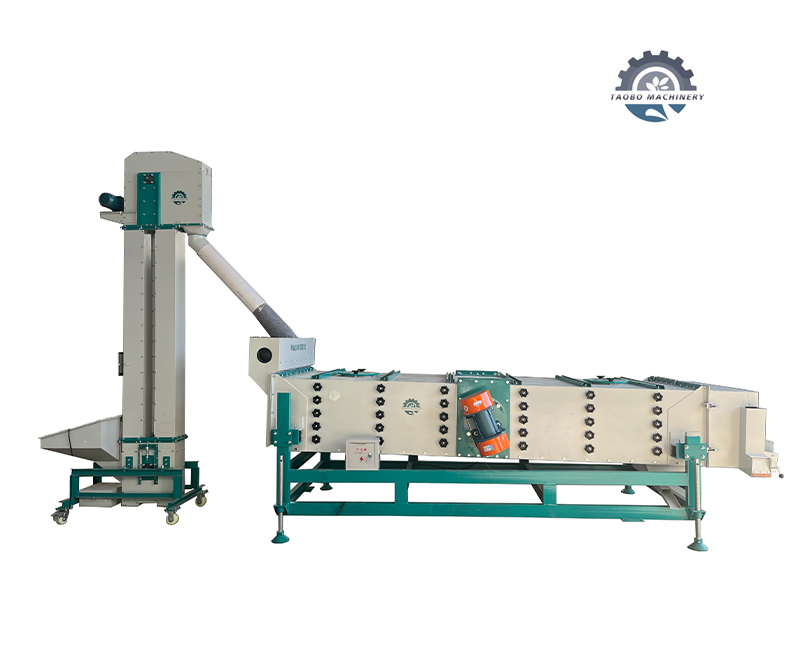
The working principle of the grading screen for cleaning mung beans: The grading screen is a purely physical particle size screening device. Its core principle for cleaning mung beans is to utilize the differences in the geometric dimensions (diameter, thickness, length) of the material particles to separate them through a screen surface with regular apertures.
After entering the equipment, the mung beans continuously tumble and move forward along the screen surface under the action of directional reciprocating vibration or planar rotary motion generated by the vibration mechanism. The sieve surface is generally divided into multiple layers, each with a different mesh size, each performing a different separation task:
Upper Layer (Large-hole sieve): The mesh size is larger than the mung bean particle size. Its main function is to trap large impurities that exceed the allowed length, width, or thickness, such as straw, weeds, clods of soil, plastic filaments, rope ends, and large stones. Mung beans and smaller impurities can pass through the mesh smoothly and enter the next sieve layer.
Middle Layer (Grading sieve/Qualified Product sieve): The mesh size matches the mung bean particle size. Qualified mung beans cannot pass through the mesh and will move directionally along the sieve surface under vibration, exiting from the qualified product outlet. Irregularly shaped particles and excessively long grass seeds, which are close to the mung bean particle size, are still restricted by the sieve surface, achieving preliminary grading.
Lower Layer (Small-hole sieve):The mesh size is smaller than the mung bean particle size. It is mainly used to separate small impurities such as sand, broken beans, broken bean fragments, small mud particles, and small grass seeds. These impurities pass through the mesh and exit from the lower impurity outlet, achieving the separation of mung beans from small impurities.
III. Advantages of the Air Screen Cleaner
1. Integrated Screening and Air Separation for More Comprehensive Cleaning: The air screen cleaner combines particle size screening and air separation functions. It removes large and small impurities through the screen and separates light impurities using airflow. A single operation completes both coarse cleaning and partial fine cleaning, achieving a significantly higher cleaning purity than grading screens.
2. Effective Removal of Light Impurities, Improving Finished Product Appearance: Utilizing airflow based on material suspension velocity differences, it effectively removes shriveled grains, insect-damaged grains, bean skins, broken shells, grass seeds, dust, and other light impurities from mung beans. The cleaned mung beans are fuller and have a cleaner appearance, better meeting market demand.
3. Higher Degree of Automation and Integration: The air screen cleaner integrates feeding, screening, air separation, and discharging into a single unit. The process is simple, requires little space, and a single machine can complete the preliminary fine cleaning work that traditionally requires multiple machines, improving processing efficiency. IV. Advantages of Grading Screens
1. Simple Structure and Stable, Reliable Operation: Grading screens consist only of the screen body, screen mesh, and vibrating motor or transmission mechanism. They lack complex components such as fans, air ducts, and regulating dampers, resulting in a low failure rate, strong stability during continuous operation, and low technical requirements for operators and maintenance personnel, making them suitable for long-term continuous production.
2. Low Equipment Cost and Small Investment: Under the same processing capacity, the manufacturing and procurement costs of grading screens are far lower than those of air-cooled cleaning machines. For processing scenarios requiring only preliminary impurity removal and with limited budgets, they offer a significant economic advantage.
3. Precise and Stable Grading Results: Grading screens achieve material separation through multiple layers of screen mesh with different apertures. The grading of mung beans by size and the removal of large and small impurities are intuitive and stable. Once the screen mesh aperture is determined, the grading accuracy is consistent, making it suitable as a dedicated equipment for mung bean grading.
Post time: Feb-24-2026