
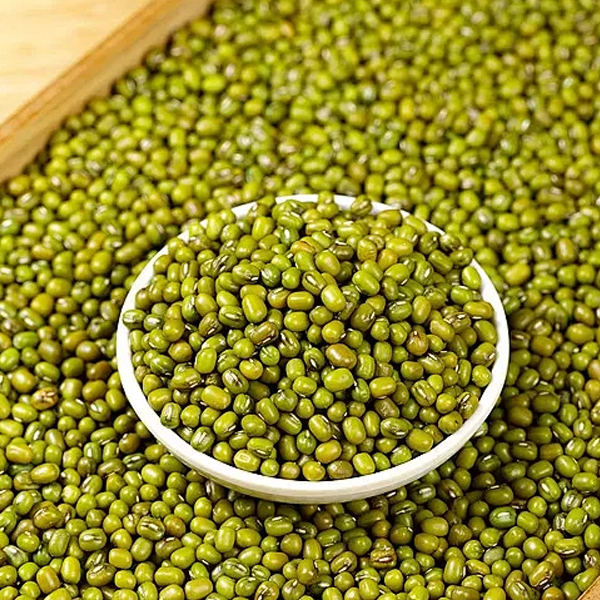
Located in the heart of Central Asia, Uzbekistan features a typical arid continental climate characterized by significant diurnal temperature variations and abundant sunlight. Its well-developed irrigation-based agriculture—particularly the oasis farming found in the Amu Darya and Syr Darya river basins—provides ideal growing conditions for legumes, such as mung beans. Mung beans are among the country’s most important leguminous cash crops. They are widely cultivated across regions including Namangan, Surkhandarya, Tashkent, Andijan, Syrdarya, Jizzakh, and Samarkand, with the Fergana Valley and the Syr Darya basin serving as the primary production hubs. In terms of production scale, mung beans are grown not only as a staple crop but also extensively within wheat-legume crop rotation systems, where they serve to fix nitrogen and improve soil health. (According to some academic statistics in Uzbekistan, the total area dedicated to cereal and leguminous crops nationwide is approximately 346,000 hectares, a significant portion of which is used for mung bean rotation.) This practice forms a vital component of the country’s land-restoration strategy, which emphasizes shifting from continuous grain cultivation to crop rotation and the integration of forage crops. Data from the Statistics Agency of Uzbekistan indicate that the total annual production of various cereals and legumes in 2025 reached approximately 10.112 million tonnes—an increase of about 13% year-on-year. Legumes account for a stable share of this total, and with mung bean production climbing year after year, Uzbekistan has emerged as one of the largest producers and exporters of mung beans in Central Asia.
The market influence of Uzbekistan’s mung beans is most notably reflected in its export performance. According to the national statistics agency, the country consistently exports mung beans to over 20 countries and regions. In the first eight months of 2022 alone, Uzbekistan exported mung beans to 23 countries, with China being the largest destination (receiving approximately 47,900 tonnes), followed by Kazakhstan. By the first 11 months of 2022, the export reach had expanded to 26 countries. Key regions contributing to these exports included Tashkent (approx. 38,700 tonnes), Namangan (approx. 18,500 tonnes), Jizzakh (approx. 16,000 tonnes), and Samarkand (approx. 11,200 tonnes). According to data cited by the Economic and Commercial Office of the Chinese Embassy in Uzbekistan, the country exported approximately 62,000 tons of mung beans—valued at about $48.4 million—between January and October 2024. China ranks as the top destination, importing roughly 53,700 tons, followed by Kazakhstan; this underscores China’s position as the primary market for Uzbekistan’s mung bean exports. Within the industry, Uzbekistan has developed a comprehensive supply chain, ranging from large-scale farms to specialized exporters. Leading enterprises can reach an annual production capacity of 200,000 tons, with approximately 70,000 tons destined for overseas markets. Export-grade mung beans typically require high standards of purity—often reaching 98% purity with an impurity content of 0.5% or less. Regarding the national context, the official language is Uzbek, while Russian is widely spoken. The power supply standard is 220V/50Hz, and the capital, Tashkent, operates on UTC+5 (three hours behind Beijing time). These factors should be taken into account when planning the export of equipment and the provision of installation services.
II. Sources of Impurities in Raw Mung Beans
During harvesting, sun-drying, storage, transport, and primary processing, various types of impurities can contaminate raw mung beans. Based on their physical properties, these impurities are categorized into four groups: (1) Light impurities—such as pod husks, leaf fragments, straw, glumes, shriveled beans, and dust—which have low density and can be easily separated using airflow. (2) Large impurities—such as whole stalks, twine, clods of soil, stones, and metallic foreign objects—which are significantly larger than the mung beans themselves. (3) Medium and small impurities—such as broken beans, split beans, weed seeds of similar size, and small stones—which have dimensions comparable to the mung beans, making them difficult to remove completely through screening alone. (4) Heavy impurities and defective beans—such as dense soil, stones, sand, and metal, as well as insect-damaged, moldy, or discolored beans. For mung beans intended for export, the requirement for an impurity content of no more than 0.5% and a high degree of visual uniformity necessitates a multi-stage cleaning process—combining air aspiration, screening, gravity separation, and magnetic separation—as no single piece of equipment is sufficient to meet these standards.
III. Configuration of Cleaning Equipment (Principle-Driven)
To address the characteristics of the aforementioned impurities, mung bean processing plants in Uzbekistan typically organize their cleaning lines into three stages: “Primary Cleaning — Precision Cleaning — Quality Enhancement.”
Stage 1: Primary Cleaning (Removal of large and light impurities). A primary cleaning screen is the preferred choice; its large-aperture mesh quickly intercepts large debris such as stalks, twine, and soil clods. Simultaneously, a negative-pressure dust extraction system removes surface dust and husks, thereby protecting downstream equipment and reducing wear.
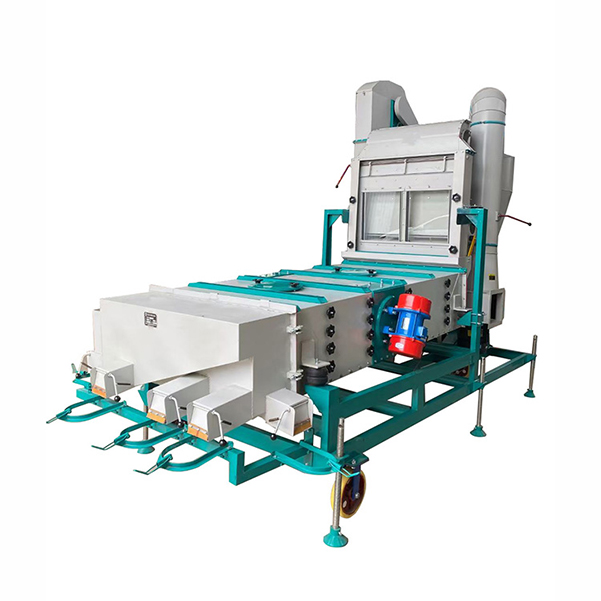
Stage 2: Precision Cleaning (Core impurity removal). This is the critical phase of the mung bean cleaning process, typically involving an air-screen cleaner paired with a gravity destoner. The air-screen cleaner integrates pneumatic separation with multi-stage screening. An adjustable airflow removes light impurities, shriveled grains, and dust, while a series of screens—customized for the specific particle size of mung beans (with aperture gradients typically set at 1/3 to 1/2 of the smallest grain dimension)—separate out large, medium, and small impurities, achieving a final product purity of over 99.5%. The beans then pass through a destoner, which leverages the density differences between mung beans and contaminants like stones or soil clods; through the combined action of vibration and airflow, heavy impurities of similar size are separated and discharged. This is a critical piece of equipment for the destoning of mung beans intended for export. For seed-grade or high-specification commercial beans, a magnetic separator can be added to remove soil-based impurities, followed by an optical sorter to eliminate discolored, moldy, or insect-damaged grains, ensuring the product meets both visual and food-safety standards for export.
Stage 3: Elevation and Buffering (Auxiliary Systems). Bucket elevators are installed between processing stages to facilitate continuous transport with minimal grain breakage. A raw material silo is positioned at the front end to act as a buffer, ensuring a uniform feed rate and a stable load for the cleaning equipment. The entire process is integrated with a dust-removal system, maintaining a dust-free environment within the facility and ensuring compliance with environmental and sanitary regulations.
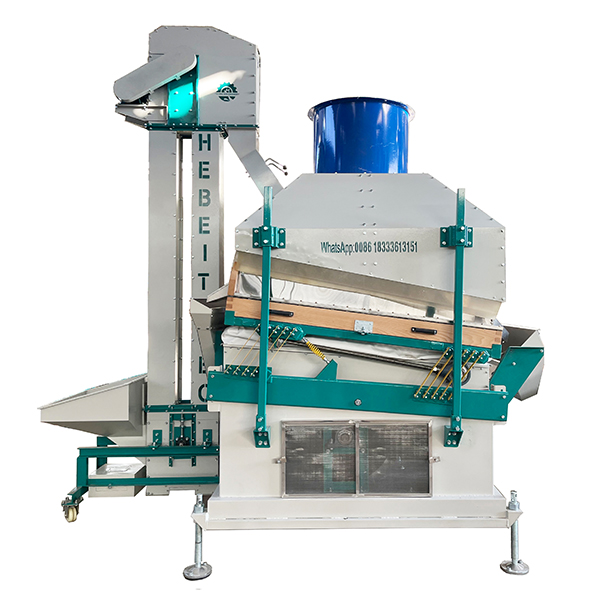
Equipment selection should be guided by the required processing capacity and target purity levels. For small-to-medium-scale facilities processing several tons per day, a foundational three-unit configuration—comprising a primary cleaner, an air-screen cleaner, and a destoner—is recommended. For large-scale plants, a comprehensive processing line is advised, consisting of a primary cleaner, an air-screen cleaner, a destoner, a gravity separator, a magnetic separator, an optional optical sorter, bucket elevators, and storage silos. Such a system can handle capacities ranging from several tons to tens of tons per hour, consistently achieving a finished-product purity of over 99.5% with impurity levels kept below 0.5%. The entire line operates on a 220V/50Hz power supply and features a modular layout, allowing for rapid assembly, disassembly, and screen replacement to accommodate batches of mung beans with varying grain sizes and impurity profiles.
Post time: Oct-23-2026