Poland is, in every sense, Europe’s “land of pumpkins.” According to Eurostat, Poland accounts for approximately 88% of the European pumpkin market, with an annual production nearing 360,000 tonnes—a position that has made it the largest pumpkin producer in the European Union since 2020. In 2024, Poland’s total pumpkin harvest reached approximately 383,000 tonnes, cultivated across an area of about 9,300 hectares. The cultivation landscape is distinctly bifurcated: on one hand, there is widespread production of traditional culinary pumpkins and giant ornamental varieties (notably featured in the country’s famous giant pumpkin competitions, where the 2025 winning specimen weighed in at 546 kilograms). On the other hand, the cultivation of oil-seed pumpkins—specifically the Styrian oil pumpkin—has seen explosive growth in recent years, evolving from a niche, marginal crop into a fully-fledged value chain supported by contract farming, large-scale agricultural production, and industrial processing. The Lublin Voivodeship accounts for nearly 62% of the nation’s total pumpkin cultivation area; within this region, the municipality of Wisznice alone covers approximately 929 hectares—roughly 7% of Poland’s total pumpkin acreage—and serves as the hub for a private processing cluster that includes the facility in Horodyszcze. Oil-seed pumpkins typically yield between 500 and 600 kilograms of seeds per hectare, a figure that can climb as high as 1,000 kilograms under favorable climatic conditions. These seeds, characterized by their thin husks and high oil content, serve as the primary raw material for the production of pumpkin seed oil—a high-value, stable-market specialty product within the EU’s premium edible oil sector. Pumpkin seeds have a wide range of applications, primarily categorized into three areas. First, they serve as a snack food; the kernels can be roasted and consumed as a nutritious snack, rich in protein, unsaturated fatty acids, zinc, magnesium, and phytosterols. Second, they are used for oil production; by roasting the seeds—either with or without their shells—at temperatures between 100°C and 120°C and then pressing them, one can obtain pumpkin seed oil. Characterized by a deep green color and a unique flavor, this oil is rich in unsaturated fatty acids and phytosterols and is considered a premium edible oil in Europe. Third, they allow for comprehensive utilization: the residual meal left after pressing can be used as animal feed, while the seed hulls can serve as biomass or as a secondary raw material for further processing. Whether intended for direct consumption, oil extraction, or export, pumpkin seeds must undergo rigorous cleaning before processing to remove impurities such as stones, soil, straw, shriveled seeds, discolored seeds, and dust. This is precisely where air screen cleaners and gravity separator play a critical role.
I. Working Principle and Advantages of the Air Screen Cleaner
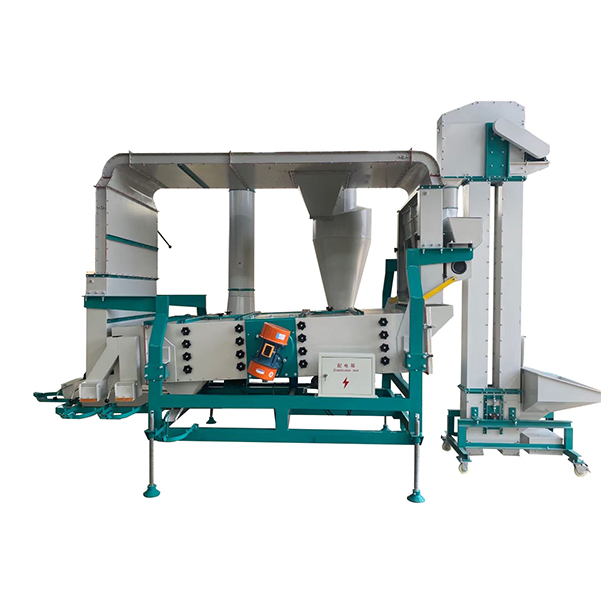
The air screen cleaner integrates pneumatic cleaning with multi-layer vibrating screen separation, operating through the synergy of “air” and “screening.” Raw material is fed into a sealed air-separation chamber via an elevator, where a high-pressure fan generates a negative-pressure airflow. Within this stream, the material becomes suspended: plump pumpkin seeds, having a higher specific gravity, fall naturally due to gravity, while lighter impurities—such as shriveled seeds, empty shells, dust, and straw fragments—are carried away by the upward airflow and captured by a dust-removal system. This completes the initial pneumatic separation stage. Subsequently, the pumpkin seeds descend onto a multi-layer screen assembly. The screens vibrate with a specific inclination and amplitude, causing the material to move in stratified layers: large impurities (e.g., stones, plant stalks, or string) are trapped by the upper screens and discharged, while fine impurities (e.g., dust or broken particles) pass through the screen mesh. Pumpkin seeds of the correct size then exit from the end of the screen assembly. By utilizing dual or even triple air channels combined with 2–4 layers of screens, the machine can simultaneously remove light, large, and fine impurities in a single pass.
Its advantages include: First, comprehensive impurity removal—handling light, large, and fine debris in one process, which reduces the number of required machines and saves floor space. Second, high adaptability—parameters such as airflow volume, air velocity, screen inclination, and vibration amplitude are infinitely adjustable, allowing for precise configuration based on the specific impurity profile of each batch of pumpkin seeds. Third, a clean working environment—the use of negative-pressure air separation and a sealed dust-collection structure prevents dust leakage, meeting the hygiene standards required for food-processing facilities intended for export. Fourth, robust performance—constructed from carbon steel and featuring a proven vibrating-screen design, the equipment offers stable operation, a low failure rate, and easy maintenance. With a high processing capacity, it integrates seamlessly with downstream processes such as destoning, color sorting, and polishing, serving as the primary safeguard for ensuring product purity within the entire processing line.
II. Working Principle and Advantages of the gravity separator
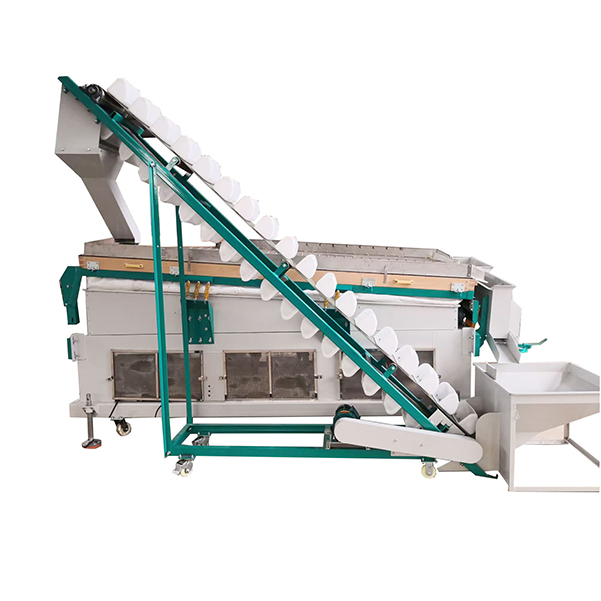
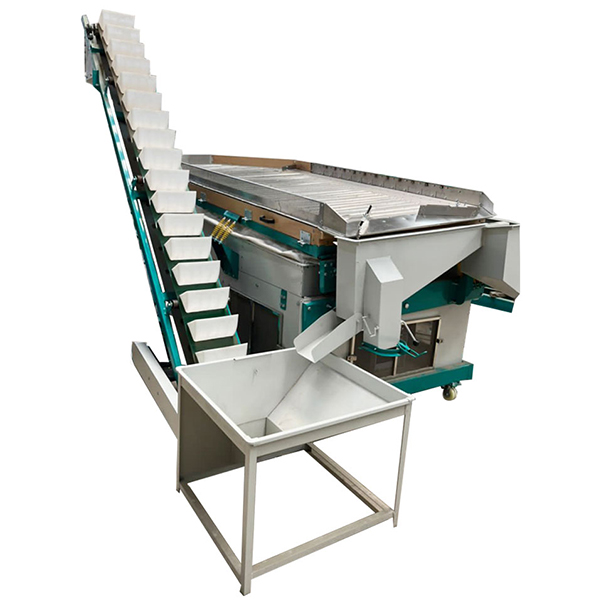
The gravity separator functions by exploiting differences in specific gravity between materials and impurities, categorizing it as a gravity-based sorting device. Its core component is a working surface featuring a porous screen, which is driven by an eccentric mechanism to perform an inclined, reciprocating vibration. Simultaneously, a fan located beneath the screen directs a uniform upward airflow through it. When pumpkin seeds are fed into the machine, the combination of the upward airflow and the vibration of the screen “fluidizes” the material layer; the particles become loosely suspended and automatically stratify—lighter pumpkin seeds rise to the top, while heavier contaminants such as stones, soil clods, and metal fragments sink to the bottom. Driven by the inertial force of the screen’s vibration and the component of gravity, the pumpkin seeds on the upper layer move upward along the screen surface toward the discharge outlet, while the heavier stones and debris slide downward along the screen toward the stone-discharge outlet. By precisely adjusting the airflow volume and vibration parameters, the machine achieves continuous, highly efficient separation of pumpkin seeds from stones and debris.
Its advantages include: First, it is highly targeted, specifically addressing “co-sized” impurities—stones or soil particles that are similar in size to pumpkin seeds but significantly denser—thereby covering gaps left by conventional air-screen cleaners. Second, it offers high separation precision, effectively removing stones while minimizing the loss of pumpkin seeds, thus ensuring a high yield. Third, it utilizes a purely physical, dry-processing method; it requires no water or heat, ensuring that the moisture content, oil content, and flavor of the pumpkin seeds remain unaltered—fully meeting the quality standards required for food processing and export. Fourth, it features a high degree of automation, with the ability to integrate with a PLC system for automatic airflow adjustment; it operates smoothly with low noise levels and minimal maintenance costs. Fifth, when used in tandem with an air-screen cleaner, it significantly reduces the false-rejection rate of downstream optical sorters, extends the service life of precision equipment, and enhances the overall stability and economic efficiency of the processing line.
In pumpkin seed cleaning production lines in Poland, the combination of an air-screen cleaner and a gravity separator establishes a comprehensive cleaning logic: “air-based removal of light impurities, gravity-based removal of heavy impurities, and screen-based sizing.” The air-screen cleaner first handles the bulk of light and particulate impurities, while the gravity separator subsequently targets and removes heavier impurities based on specific gravity—each machine performing its distinct, complementary role. This configuration ensures a consistent purity level of over 99.5% for pumpkin seeds, meeting the rigorous standards of the European market for both edible pumpkin seed kernels and seeds intended for oil extraction. The entire line offers high throughput and robust operational continuity, perfectly aligning with the requirements for large-scale processing in Poland. Hebei Taobo Machinery Equipment Co., Ltd. provides flexible equipment selection and configuration tailored to specific production volumes and impurity profiles, delivering efficient, high-purity processing solutions for pumpkin seed processors in Poland and the surrounding regions.
Post time: Oct-16-2026