

Pakistan is a significant global producer and exporter of sesame seeds, and sesame stands as one of the few oilseed crops for which the country maintains a net export position. According to data from Pakistan’s Ministry of National Food Security and Research, the area under sesame cultivation expanded substantially from approximately 259,900 hectares in the 2022/23 crop year to about 399,800 hectares in 2023/24—an increase of 53%. Production reached approximately 301,200 tonnes, marking a 97.7% year-on-year surge. For the 2024/25 crop year, production is projected to rise further to approximately 440,000 tonnes (a 44.7% year-on-year increase), with the harvested area—as recorded by FAOSTAT—exceeding 700,000 hectares. The primary production regions are concentrated in Punjab province (cultivated during the Kharif monsoon season, covering approximately 1.76 million acres in 2024) and parts of Sindh province. In recent years, the promotion of agricultural technology and the adoption of contract farming—supported by China-Pakistan cooperation initiatives—have led to significant improvements in both crop yields and the level of commercialization.
II. Working Principle and Advantages of Air Screen Cleaners for Sesame
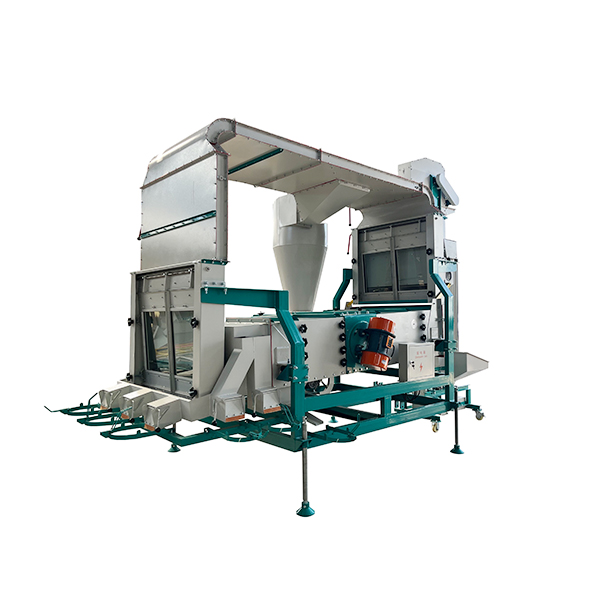
Working Principle. An air screen cleaner functions by integrating two physical separation methods—screening and air-based separation (aspiration)—into a single unit. Sesame seeds enter through an inlet into a hopper, where a flow-control mechanism ensures they are spread evenly across the screen surface. Driven by an eccentric mechanism, the screen assembly undergoes reciprocating vibration, causing the sesame seeds to tumble and move forward along the screen. The screens are arranged in layers with varying aperture sizes: the upper layer traps and discharges large impurities such as stalks, long grass, twine, and stones, while the lower layer retains the sesame seeds, allowing fine particles—such as sand, soil, and debris—to pass through. Simultaneously, a fan generates a controlled, directional airflow that passes through an aspiration duct, removing lightweight or high-surface-area impurities like dust, husks, shriveled/empty seeds, and light weed seeds. Consequently, the sesame seeds are separated from large, small, and lightweight impurities in a single pass.
Advantages. First, it offers significantly improved purity and high processing capacity. By combining screening and air-based separation, the machine can rapidly remove the vast majority of easily separable impurities—such as stalks, dust, husks, and empty seeds—at the intake stage. This substantially reduces the workload for downstream processes, ensuring high throughput and productivity. Second, it minimizes damage to the sesame seeds and offers high versatility. Utilizing gentle reciprocating vibration and pneumatic separation rather than mechanical impact, the process ensures a low breakage rate, preserving the integrity of the seeds and their oil content. Furthermore, the screen apertures can be changed quickly, and parameters such as airflow, vibration amplitude, and feed rate are adjustable, allowing the equipment to be flexibly adapted for other crops, such as mung beans or soybeans. Third, it features a reliable design and environmentally friendly operation. The fully enclosed structure, combined with an integrated dust collection system, minimizes dust leakage and ensures a clean, hygienic environment. Additionally, the machine’s simple design makes it easy to maintain and results in a low failure rate. This precisely encapsulates the core features of the Hebei Taobo Machinery air-screen cleaner: “high airflow, low breakage, and high adjustability.”
III. Working Principle and Advantages of Gravity Separators for Sesame Processing
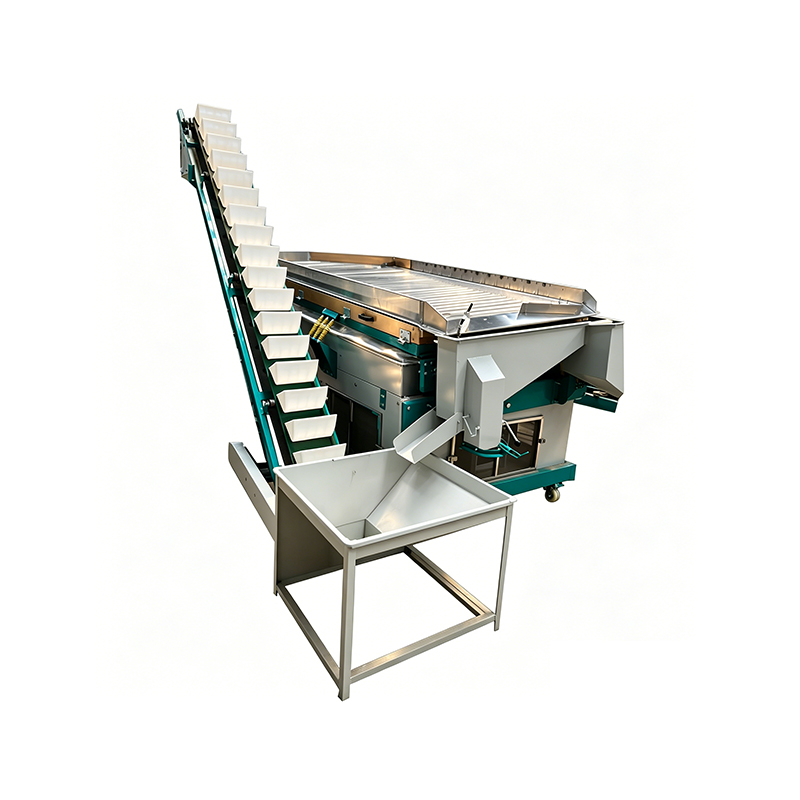
Working Principle. Gravity separators address the challenge of removing “heavy” impurities—particles similar in size to sesame seeds but with a different specific gravity—which air-screen cleaners cannot effectively handle. The process relies on the synergy of three physical mechanisms: fluidization via airflow, vibration of the screen deck, and inclined conveyance. As sesame seeds enter the gravity separator, a fan forces air upward through a perforated screen deck, creating a uniform, rising airflow that fluidizes the bed of material, causing the particles to become suspended. In this fluidized state, heavier contaminants—such as stones, sand, soil clods, and metal fragments—sink to the bottom and come into direct contact with the screen surface, while the lighter, plump sesame seeds are buoyed by the airflow and remain in the upper layer. Simultaneously, the screen deck, driven by an eccentric mechanism, undergoes reciprocating vibration while positioned at an incline. The heavy debris at the bottom is conveyed upward along the screen surface toward a dedicated discharge outlet, while the plump sesame seeds in the upper layer move downward along the incline toward the product outlet. Key operational parameters—airflow volume, vibration amplitude, frequency, and the tilt angle of the screen deck—must be precisely calibrated based on the specific impurity profile of the sesame batch.
Advantages. First, it offers targeted and thorough removal of heavy impurities. While air-screen cleaners are ineffective against stones of similar size to sesame seeds, gravity separators remove them efficiently, fundamentally eliminating the risk of sand or stones in exported sesame products and ensuring food safety. Second, it enables quality grading, enhancing the uniformity of the final product. Beyond stone removal, the equipment separates plump seeds from shriveled or broken ones based on specific gravity, resulting in greater consistency in terms of plumpness, bulk density, and color—thereby significantly improving both the commercial grade and the market appeal of the product for export. Third, it reduces the workload for downstream processing stages, leading to an overall increase in operational efficiency. By the time the sesame seeds—already refined through gravity-based sorting—enter the optical sorter, they are exceptionally clean. This allows for more precise identification and higher efficiency, simultaneously boosting both the purity of the final product and the overall production capacity; the system can reliably achieve a sesame purity level of over 99.5%.
For export-oriented sesame processing in Pakistan, it is recommended to implement a complete production line consisting of an air-screen cleaner, gravity separator, grading screen, color sorter, and automatic packaging machine, supplemented by bucket elevators, storage silos, and a dust collection system. The air screen cleaner removes bulk light and large impurities; the gravity separator precisely eliminates stones and heavy contaminants; the grading screen ensures uniform particle size; the color sorter removes discolored or defective grains; and the automatic packaging machine handles accurate weighing and sealing. This integrated five-stage process consistently elevates sesame purity to over 99.5%, ensuring uniform color and consistent grain size—meeting the rigorous standards required for exports to China and the global market. The sesame processing equipment from Hebei Taobo Machinery features a high-airflow, low-breakage, and highly adjustable design. With easily swappable screens and precise parameter tuning tailored to the small, high-oil-content nature of sesame seeds, the system offers a fully enclosed, dust-free operation with high throughput and stable performance. It serves as a reliable solution for Pakistani sesame processors aiming to achieve high-purity, low-breakage, and premium-grade exports.
Post time: Oct-30-2026