
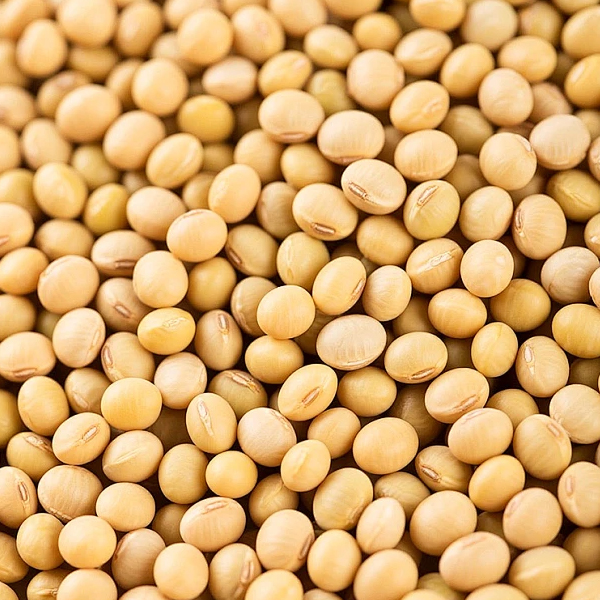
I. Complete Workflow of the Air-Screen Gravity Separator for Soybean Cleaning
The process follows a logical sequence—feeding → pre-air separation → vibratory grading/screening → secondary air separation → gravity separation → finished product discharge—sequentially removing various types of impurities. It is suitable for processing both commercial soybeans and soybean seeds:
1. Uniform Feeding
An elevator conveys raw soybeans into the feed buffer hopper, where the material is evenly distributed into a thin layer to prevent piling and ensure stable downstream sorting.
2. Primary Vertical Air Separation (Dust and Light Impurity Removal)
As the soybeans fall, an adjustable airflow removes dust, pod fragments, straw bits, dried skins, and lightweight shriveled beans. Light impurities are collected in a cyclone dust collector, while clean soybeans fall onto the lower screen deck.
3. Multi-layer Vibratory Grading/Screening
The upper screen retains large impurities: soil clods, long straw, and whole pods;
The lower screen allows small impurities to pass through: fine sand/soil, broken bean fragments, and tiny weed seeds;
Large and small impurities are discharged through separate outlets, while soybeans of the correct size continue moving downward.
4. Secondary Air Separation
The material undergoes a second air blast to remove airborne dust and residual light impurities stirred up during screening, thereby reducing the load on the gravity separator.
5. Gravity Separation
Soybeans land on an inclined, reciprocating vibrating deck, with continuous airflow from below creating a fluidized layer:
Plump, high-density, high-quality soybeans move upward along the direction of vibration;
Lower-density materials—such as shriveled beans, insect-damaged beans, moldy beans, frost-damaged/weak grains, and sprouted beans—are carried by the airflow toward the lower discharge end;
Small stones and high-density soil clods are also separated out during this stage.
6. Finished Product Discharge
Clean, sorted soybeans are discharged from the finished product outlet, ready for direct bagging or transfer to the next processing stage (polishing, color sorting, or packaging).
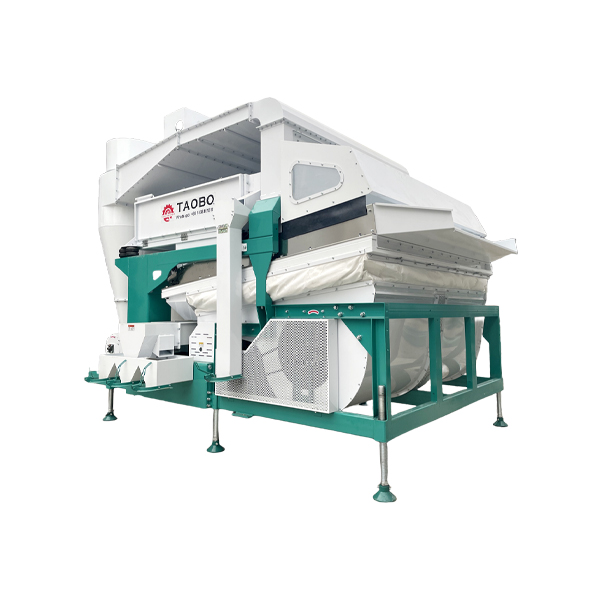
II. Core Advantages in Soybean Cleaning Applications
Comprehensive impurity removal addressing the limitations of single-function equipment
Standard vibrating screens rely solely on particle size for sorting, failing to separate moldy or insect-damaged beans that match the size of healthy ones. This machine integrates three principles—air separation (weight), screening (size), and gravity separation (density)—to remove dust, stalks, soil clods, broken beans, shriveled beans, and defective beans in a single pass. It achieves a purity level of 99.5%, meeting standards for soybean exports, food-grade raw materials, and seed propagation.
Low breakage rate, preserving soybean skin integrity
The machine features a gentle material-feeding design and soft fluidizing airflow to minimize impact from falling. The sorting process involves no forceful mechanical impact, effectively reducing skin damage; this makes it ideal for processing raw materials for soy products and commercial edible soybeans, thereby minimizing value loss caused by broken beans.
Integrated processing steps, simplifying production line layout
A single unit performs both coarse and fine cleaning, eliminating the need for a series of separate machines (air separators, vibrating screens, and gravity separators). This reduces the need for multiple transfers and lifting, lowers material loss, shortens the overall production line, saves factory floor space, and reduces auxiliary investment costs.
Strong adaptability to various soybean sources
It processes raw grain straight from the field, soybeans from storage/transit, and imported bulk soybeans. Parameters such as fan airflow, screen inclination, gravity table vibration frequency, and table tilt are fully adjustable. Stable production is maintained through simple adjustments even when moisture levels vary or impurity content fluctuates. Screen changes allow for the processing of other legumes, such as black soybeans, kidney beans, and mung beans.
Eco-friendly enclosed dust removal for a clean working environment
Equipped with a cyclone dust removal system, it collects dust in an enclosed manner, preventing airborne dust clouds. It is suitable for grain depots, oilseed pretreatment plants, and export-oriented legume processing workshops.
Distinguishes between processing needs for commercial soybeans and soybean seeds
When processing soybean seeds, gravity separation removes low-density, weak beans, thereby increasing the overall germination rate. When processing commercial edible soybeans, it removes moldy beans, reducing the risk of aflatoxin contamination in the final product and increasing its market value.
Application Scenarios for Air-Screen Gravity Separators
I. Processing of Grain and Oilseed Commodities
Legumes (soybeans, black soybeans, kidney beans, adzuki beans, mung beans, chickpeas, pinto beans, pigeon peas, etc.): Removes stalks, dust, shriveled grains, insect-damaged beans, moldy beans, and stones from harvested raw crops. Enhances product appearance and quality to meet standards for wholesale markets, soy product manufacturers, and export requirements.
Cereal and Coarse Grain Processing
Wheat, corn, sorghum, millet, oats, buckwheat, and barley: Removes light impurities, broken grains, and moldy kernels. Serves as a pre-treatment step for flour production and the packaging of coarse grain products.
Oilseed Pre-treatment
Sesame seeds, sunflower seeds, and peanut kernels: Removes empty shells/husks, moldy kernels, and stones/grit. Reduces impurities in raw materials for oil extraction, minimizes wear on processing equipment, and improves the quality of the finished oil.
II. Seed Propagation Industry
Grain seeds, vegetable seeds, forage seeds, and legume seeds (soybean seeds, mung bean seeds, etc.).
Uses gravity-based stratification to eliminate weak, insect-damaged, sprouted, and unfilled seeds, effectively increasing germination rates. Seed grading facilitates packaging and field sowing; widely used by seed companies and improved seed propagation bases.
Post time: Jul-31-2026