
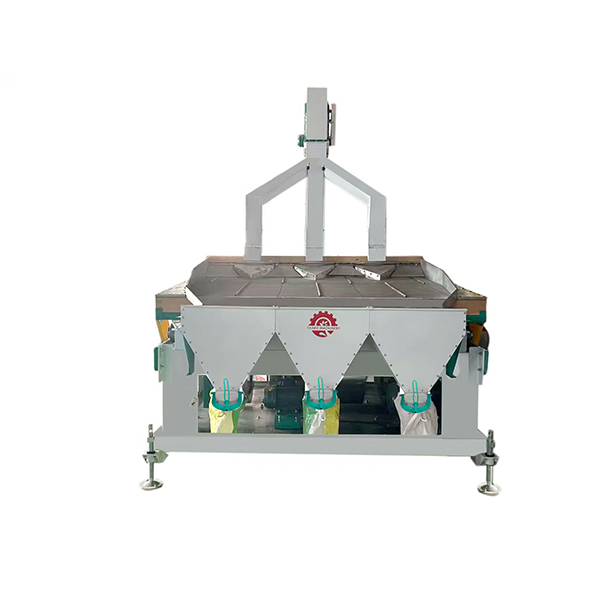
I. Working Principle (Applicable to Soybeans and Wheat)
Material Classification
The mixed grain enters through the feed inlet and falls onto the central section of the inclined, scale-patterned sieve plate. Under the combined action of an upward airflow and reciprocating vibration, the materials automatically stratify:
Stones / Mud Clods: Possessing a high specific gravity (sand/gravel: approx. 2.5–2.7; soybeans: approx. 1.18–1.20; wheat: approx. 1.22–1.25) and a low suspension velocity, they settle to the bottom layer, resting firmly against the sieve surface.
Soybeans / Wheat: Possessing a lower specific gravity, they are lifted by the airflow into a semi-suspended state, floating in the upper layer.
Counter-directional Separation
Clean Grain (Soybeans / Wheat): Driven by their own weight, vibration, and the thrust from incoming feed, the clean grains slide downward along the inclined sieve surface and are discharged through the outlet at the lower end.
Stones / Heavy Impurities: The scale-patterned perforations generate a unidirectional thrust; driven by vibrational inertia, these heavy impurities “climb” upward along the sieve surface, moving toward the stone discharge outlet located at the higher end.
Precision Separation (Grain-Free Stones)
A counter-current airflow at the top blows any soybean or wheat kernels entrained within the stone layer back into the grain layer, thereby ensuring that the discharged stones are virtually free of grain, and the processed grain is virtually free of stones.
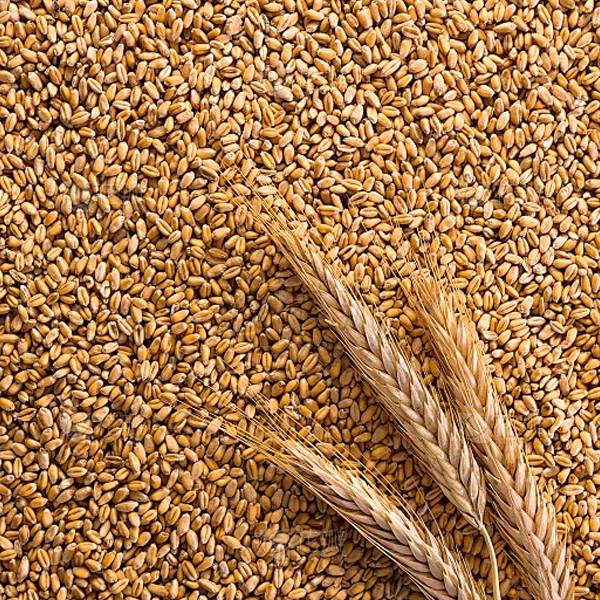
II. Key Factors Affecting Destoning Efficiency (Slight Variations for Soybeans vs. Wheat)
1. Equipment and Operational Parameters
Airflow Velocity (Most Critical Factor)
Wheat: 1.2–1.3 m/s; Soybeans: 1.0–1.2 m/s (Soybeans have larger kernels and a slightly lower suspension velocity).
Excessive Airflow: Grain is blown away, and stones carry grain with them. Insufficient Airflow: Grain fails to suspend and travels upward along with the stones, resulting in incomplete destoning.
Sieve Surface Inclination Angle
Common Range: 10°–14° (Can be slightly lower for soybeans, slightly higher for wheat).
Steeper Angle: Faster grain flow and higher throughput; however, stones face greater resistance moving upward, leading to a reduced destoning rate.
Shallower Angle: Cleaner destoning; however, grain flow is slower, throughput is lower, and there is an increased risk of grain being carried into the stone discharge.
Vibration Parameters
Amplitude: 3–5 mm; Frequency: Approx. 400–500 r/min; Throw Angle: 30°–35°.
Excessive Amplitude/Frequency: Material bounces excessively, stratification becomes chaotic, and destoning performance suffers.
Insufficient Amplitude/Frequency: Material moves too slowly, the material layer becomes too thick, and classification is poor.
Sieve Plate Condition
Clogged “fish-scale” perforations, or a loose/damaged sieve surface → Uneven material layer and unstable airflow → Separation failure.
2. Raw Material Properties
Moisture Content
When wheat moisture exceeds 14% or soybean moisture exceeds **13%**, the kernels become sticky, flowability is poor, and stratification is difficult, leading to a significant decline in the destoning rate.
Stone Content and Impurities
Excessively high stone content, or failure to pre-remove large/light impurities → Clogged sieve perforations and a chaotic material layer → Poor performance and reduced throughput.
Material Uniformity
High proportion of shriveled or broken kernels → Inconsistent specific gravity → These particles are easily carried by the airflow into the stone discharge zone → Increased grain content in the discharged stones.
Variety and Grain Size
Large-kernel soybeans/wheat: Require lower airflow velocity and a slightly steeper inclination angle. Small-kernel varieties: The reverse applies.
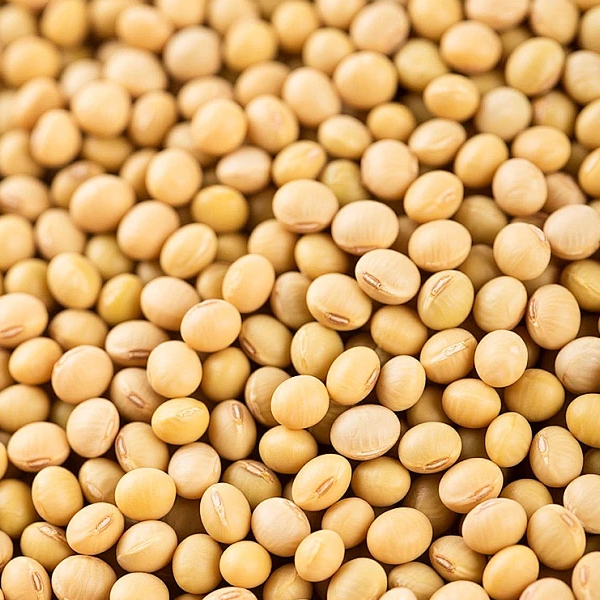
3. Feeding and Operating Conditions
Feeding Uniformity
Fluctuating feed rates (surges and drops) → Inconsistent material bed thickness → Airflow and vibration fail to compensate → Unstable separation.
Negative Pressure / Sealing
Suction-type destoners rely on negative pressure to stabilize airflow; air leaks → Insufficient airflow, dust escape, and poor separation performance.
III. Soybeans vs. Wheat: Key Operational Differences
Soybeans:Larger grain size, slightly lower specific gravity, slightly poorer flowability.
→ Lower air velocity (1.0–1.1 m/s), shallower deck inclination (10°–12°), slightly larger vibration amplitude to prevent grain breakage.
Wheat:Smaller grain size, slightly higher specific gravity, good flowability.
Higher air velocity (1.2–1.3 m/s), deck inclination adjustable up to 12°–14° to ensure effective stone removal purity.
IV. Key Controls for Stable Performance
First, remove coarse impurities, light impurities, and ferrous contaminants before feeding the material into the destoner.
Control raw material moisture content: Wheat ≤ 14%, Soybeans ≤ 13%.
Ensure uniform feeding to maintain a consistent material bed thickness.
Regularly clean the sieve deck; inspect vibration mechanisms and air dampers; fine-tune airflow, deck inclination, and vibration settings according to the specific grain variety being processed.
Post time: Apr-14-2026